Lighting Research Center, Rensselaer Polytechnic Institute, 21 Union Street, Troy, NY 12180, USA.
BMC Geriatr. 2011 Aug 24;11:49. doi: 10.1186/1471-2318-11-49.
The visual system plays an important role in maintaining balance. As a person ages, gait becomes slower and stride becomes shorter, especially in dimly lighted environments. Falls risk has been associated with reduced speed and increased gait variability.
Twenty-four older adults (half identified at risk for falls) experienced three lighting conditions: pathway illuminated by 1) general ceiling-mounted fixtures, 2) conventional plug-in night lights and 3) plug-in night lights supplemented by laser lines outlining the pathway. Gait measures were collected using the GAITRite© walkway system.
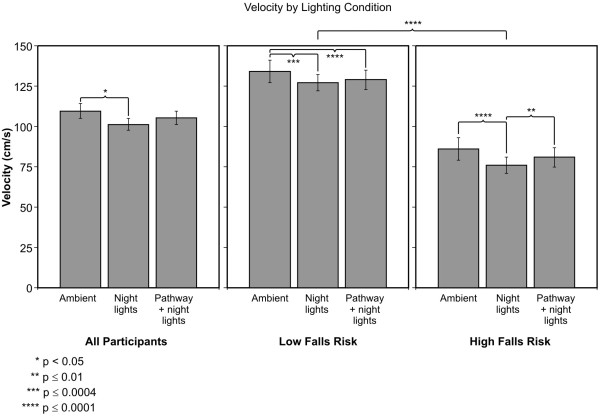
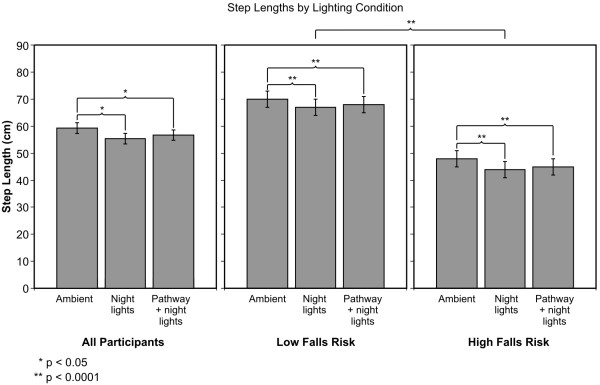
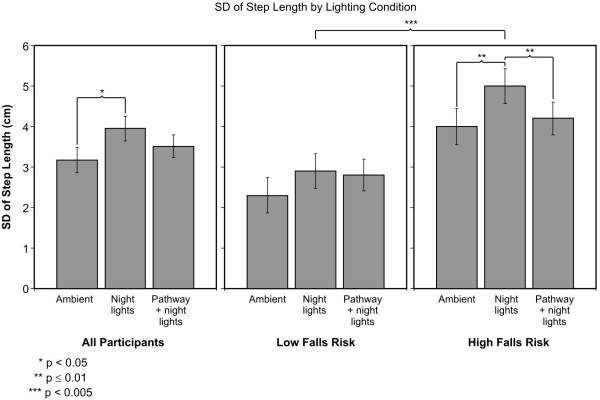
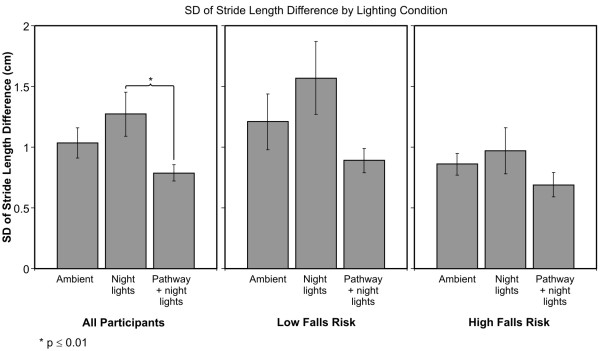
Participants performed best under the general ceiling-mounted light system and worst under the night light alone. The pathway plus night lights increased gait velocity and reduced step length variability compared to the night lights alone in those at greater risk of falling.
Practically, when navigating in more challenging environments, such as in low-level ambient illumination, the addition of perceptual cues that define the horizontal walking plane can potentially reduce falls risks in older adults.
视觉系统在维持平衡方面起着重要作用。随着年龄的增长,人的步态会变得越来越慢,步幅也会越来越短,尤其是在光线昏暗的环境中。跌倒的风险与速度降低和步态变化增加有关。
24 名老年人(其中一半被认为有跌倒风险)在三种照明条件下进行了体验:1)由通用天花板安装灯具照明的路径;2)常规的插件夜灯;3)由插件夜灯和激光线补充照明的路径。使用 GAITRite©步道系统收集步态测量数据。
参与者在通用天花板照明系统下表现最好,在单独使用夜灯时表现最差。与单独使用夜灯相比,在夜间灯光的基础上增加激光线可以提高有跌倒风险的参与者的步态速度,并减少步长的变异性。
实际上,在更具挑战性的环境中导航时,例如在低水平环境光照下,增加可以定义水平行走平面的感知线索,可能会降低老年人跌倒的风险。