School of Design, The Hong Kong Polytechnic University, Hong Kong, China.
School of System Design and Intelligent Manufacturing, Southern University of Science and Technology, Shenzhen, China.
J Neuroeng Rehabil. 2024 May 28;21(1):85. doi: 10.1186/s12984-024-01375-0.
Sensor-based interventions (SI) have been suggested as an alternative rehabilitation treatment to improve older adults' functional performance. However, the effectiveness of different sensor technologies in improving gait and balance remains unclear and requires further investigation.
Ten databases (Academic Search Premier; Cumulative Index to Nursing and Allied Health Literature, Complete; Cochrane Central Register of Controlled Trials; MEDLINE; PubMed; Web of Science; OpenDissertations; Open grey; ProQuest; and Grey literature report) were searched for relevant articles published up to December 20, 2022. Conventional functional assessments, including the Timed Up and Go (TUG) test, normal gait speed, Berg Balance Scale (BBS), 6-Minute Walk Test (6MWT), and Falling Efficacy Scale-International (FES-I), were used as the evaluation outcomes reflecting gait and balance performance. We first meta-analyzed the effectiveness of SI, which included optical sensors (OPTS), perception sensors (PCPS), and wearable sensors (WS), compared with control groups, which included non-treatment intervention (NTI) and traditional physical exercise intervention (TPEI). We further conducted sub-group analysis to compare the effectiveness of SI (OPTS, PCPS, and WS) with TPEI groups and compared each SI subtype with control (NTI and TPEI) and TPEI groups.
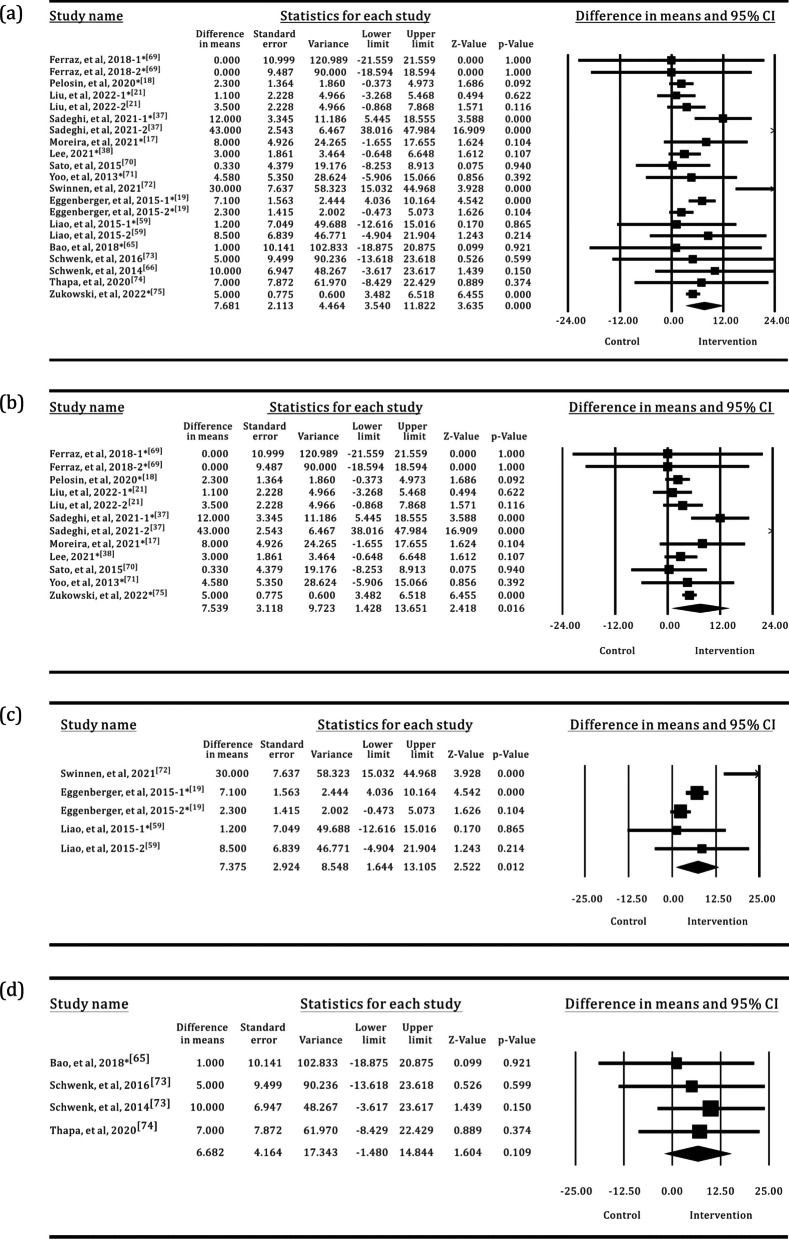
We scanned 6255 articles and performed meta-analyses of 58 selected trials (sample size = 2713). The results showed that SI groups were significantly more effective than control or TPEI groups (p < 0.000) in improving gait and balance performance. The subgroup meta-analyses between OPTS groups and TPEI groups revealed clear statistically significant differences in effectiveness for TUG test (mean difference (MD) = - 0.681 s; p < 0.000), normal gait speed (MD = 4.244 cm/s; p < 0.000), BBS (MD = 2.325; p = 0.001), 6MWT (MD = 25.166 m; p < 0.000), and FES-I scores (MD = - 2.036; p = 0.036). PCPS groups also presented statistically significant differences with TPEI groups in gait and balance assessments for normal gait speed (MD = 4.382 cm/s; p = 0.034), BBS (MD = 1.874; p < 0.000), 6MWT (MD = 21.904 m; p < 0.000), and FES-I scores (MD = - 1.161; p < 0.000), except for the TUG test (MD = - 0.226 s; p = 0.106). There were no statistically significant differences in TUG test (MD = - 1.255 s; p = 0.101) or normal gait speed (MD = 6.682 cm/s; p = 0.109) between WS groups and control groups.
SI with biofeedback has a positive effect on gait and balance improvement among a mixed population of older adults. Specifically, OPTS and PCPS groups were statistically better than TPEI groups at improving gait and balance performance, whereas only the group comparison in BBS and 6MWT can reach the minimal clinically important difference. Moreover, WS groups showed no statistically or clinically significant positive effect on gait and balance improvement compared with control groups. More studies are recommended to verify the effectiveness of specific SI. Research registration PROSPERO platform: CRD42022362817. Registered on 7/10/2022.
基于传感器的干预(SI)被提议作为一种替代康复治疗方法,以提高老年人的功能表现。然而,不同传感器技术在改善步态和平衡方面的有效性仍不清楚,需要进一步研究。
我们检索了 10 个数据库(学术搜索高级版;综合护理与联合健康文献累积索引,完整;Cochrane 对照试验中心注册;医学文献在线;PubMed;Web of Science;OpenDissertations;Open grey;ProQuest;和灰色文献报告),以获取截至 2022 年 12 月 20 日发表的相关文章。传统的功能评估包括计时起立行走(TUG)测试、正常步态速度、伯格平衡量表(BBS)、6 分钟步行测试(6MWT)和跌倒效能国际量表(FES-I),这些评估结果反映了步态和平衡表现。我们首先对 SI(包括光学传感器[OPTS]、感知传感器[PCPS]和可穿戴传感器[WS])与对照组(非治疗干预[NTI]和传统物理治疗干预[TPEI])进行了元分析。我们进一步进行了亚组分析,比较了 SI(OPTS、PCPS 和 WS)与 TPEI 组的有效性,并将每种 SI 亚型与对照组(NTI 和 TPEI)和 TPEI 组进行了比较。
我们共扫描了 6255 篇文章,并对 58 项选定试验进行了元分析(样本量=2713 人)。结果表明,SI 组在改善步态和平衡表现方面明显优于对照组或 TPEI 组(p<0.000)。OPTS 组与 TPEI 组之间的亚组元分析显示,TUG 测试(MD=-0.681s;p<0.000)、正常步态速度(MD=4.244cm/s;p<0.000)、BBS(MD=2.325;p=0.001)、6MWT(MD=25.166m;p<0.000)和 FES-I 评分(MD=-2.036;p=0.036)的有效性存在明显的统计学差异。PCPS 组与 TPEI 组在正常步态速度(MD=4.382cm/s;p=0.034)、BBS(MD=1.874;p<0.000)、6MWT(MD=21.904m;p<0.000)和 FES-I 评分(MD=-1.161;p<0.000)方面也存在统计学差异,除了 TUG 测试(MD=-0.226s;p=0.106)。WS 组与对照组在 TUG 测试(MD=-1.255s;p=0.101)或正常步态速度(MD=6.682cm/s;p=0.109)方面无统计学差异。
具有生物反馈功能的 SI 对改善混合老年人群的步态和平衡有积极作用。具体来说,OPTS 和 PCPS 组在改善步态和平衡表现方面明显优于 TPEI 组,而 BBS 和 6MWT 的组间比较仅能达到最小临床重要差异。此外,WS 组与对照组相比,在改善步态和平衡方面无统计学或临床意义上的显著积极作用。建议进行更多的研究来验证特定 SI 的有效性。研究注册 PROSPERO 平台:CRD42022362817。注册于 2022 年 7 月 10 日。