Department of Immunology and the Howard Hughes Medical Institute, University of Washington, Seattle, WA 98195, USA.
Immunity. 2011 Aug 26;35(2):161-8. doi: 10.1016/j.immuni.2011.07.010.
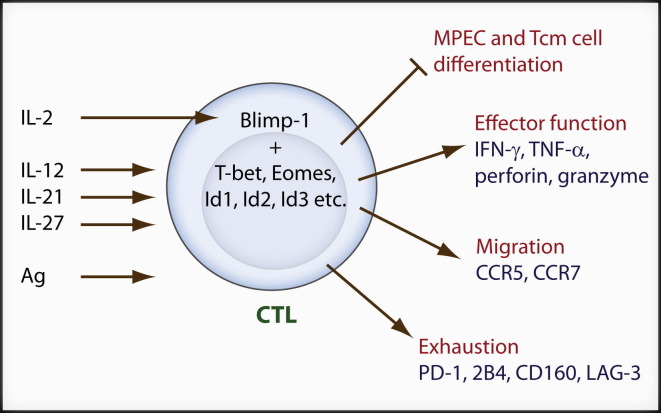
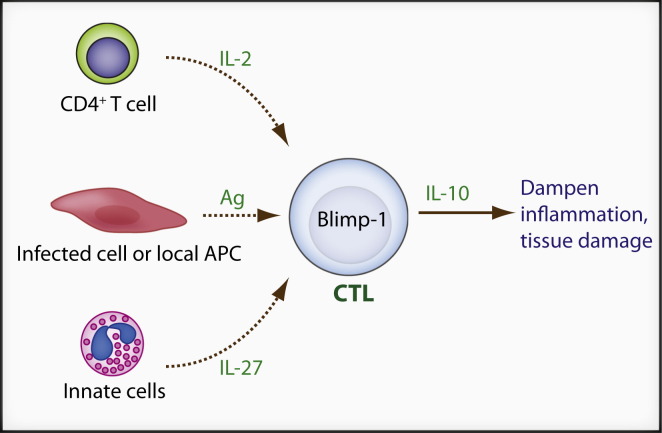
Resting naive CD8(+) T cells have an astounding capacity to react to pathogens by massive expansion and differentiation into cytotoxic effector cells that migrate to all corners of the body to clear the infection. The initial interaction with antigen-presenting cells in the central lymphoid organs drives an orchestrated program of differentiation aimed at producing sufficient numbers of effectors to get the job done without resulting in clonal exhaustion. Interactions with antigen-presenting cells and other immune cells continue at the site of infection to regulate further on-site expansion and differentiation, all with the goal of protecting the host with minimal bystander tissue damage. Here we review recent advances in CD8(+) T cell recognition of antigen in lymphoid as well as in nonlymphoid tissues in the periphery, and how CD8(+) T cell expansion and differentiation are controlled in these contexts.
静息初始 CD8(+) T 细胞具有惊人的能力,可通过大量扩增和分化为细胞毒性效应细胞来对病原体作出反应,这些细胞迁移到身体的各个角落以清除感染。与中央淋巴器官中的抗原呈递细胞的初始相互作用驱动了一个协调的分化程序,旨在产生足够数量的效应细胞来完成工作,而不会导致克隆耗竭。与抗原呈递细胞和其他免疫细胞的相互作用在感染部位继续进行,以调节进一步的原位扩增和分化,所有这些都是为了在最小的旁观者组织损伤的情况下保护宿主。在这里,我们回顾了 CD8(+) T 细胞在淋巴组织以及外周非淋巴组织中识别抗原的最新进展,以及在这些情况下 CD8(+) T 细胞的扩增和分化是如何受到控制的。