Soleimani Reza, Heytens Elke, Darzynkiewicz Zbigniew, Oktay Kutluk
Laboratory of Molecular Reproduction, Institute for Fertility Preservation, Department of Obstetrics & Gynecology, New York Medical College, Valhalla, New York, USA.
Aging (Albany NY). 2011 Aug;3(8):782-93. doi: 10.18632/aging.100363.
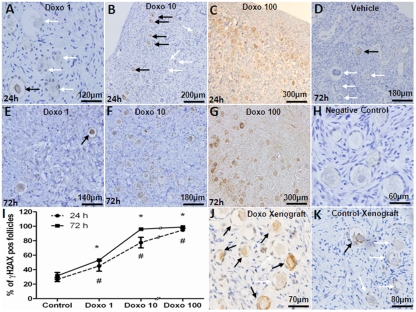
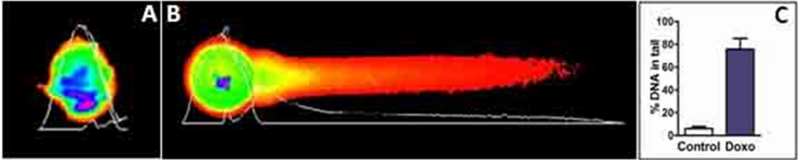
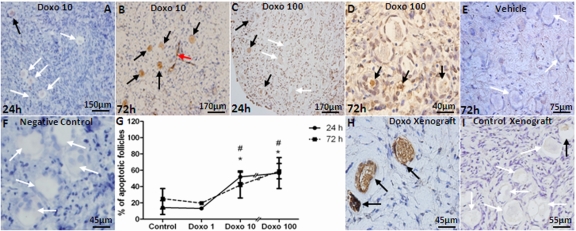
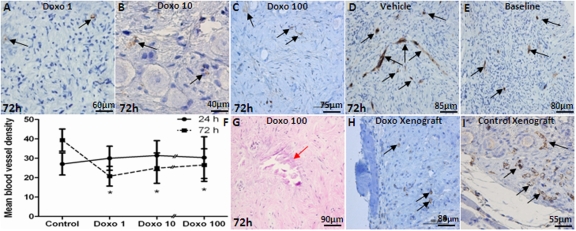
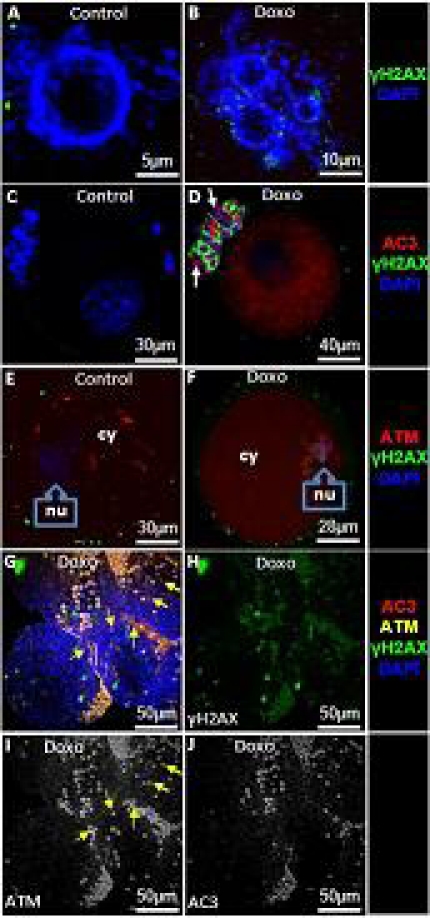
The mechanism of chemotherapy-induced acceleration of ovarian aging is not fully understood. We used doxorubicin, a widely used cancer chemotherapeutic, in a variety of in vivo xenograft, and in vitro models to investigate the impact of chemotherapy-induced aging on the human ovary. Doxorubicin caused massive double-strand-DNA-breaks in primordial follicles, oocytes, and granulosa cells in a dose dependent fashion as revealed by accumulating γH2AX foci. This damage was associated with apoptotic oocyte death and resulted in the activation of ATM. It appeared that the repair response enabled a minor proportion of oocytes (34.7%) and granulosa cells (12.1%) to survive while the majority succumbed to apoptotic death. Paradoxically, inhibition of ATM by KU-55933 resulted in improved survival, probably via prevention of downstream activation of TAp63α. Furthermore, doxorubicin caused vascular and stromal damage in the human ovary, which might impair ovarian function both pre- and post-menopausally. Chemotherapy-induced premature ovarian aging appears to result from a complex process involving both the germ- and non-germ cell components of the ovary. These effects may have clinical implications in aging both for premenopausal and postmenopausal cancer survivors.
化疗诱导卵巢衰老的机制尚未完全明确。我们使用阿霉素(一种广泛应用的癌症化疗药物),通过多种体内异种移植和体外模型,研究化疗诱导的衰老对人卵巢的影响。如累积的γH2AX病灶所示,阿霉素以剂量依赖方式在原始卵泡、卵母细胞和颗粒细胞中导致大量双链DNA断裂。这种损伤与卵母细胞凋亡死亡相关,并导致ATM激活。似乎修复反应使一小部分卵母细胞(34.7%)和颗粒细胞(12.1%)得以存活,而大多数细胞则死于凋亡。矛盾的是,KU-55933抑制ATM可提高存活率,可能是通过预防TAp63α的下游激活实现的。此外,阿霉素会导致人卵巢血管和基质损伤,这可能在绝经前和绝经后损害卵巢功能。化疗诱导的卵巢早衰似乎是一个复杂的过程,涉及卵巢的生殖细胞和非生殖细胞成分。这些影响可能对绝经前和绝经后癌症幸存者的衰老具有临床意义。