Department of Biological Sciences, Macquarie University, Sydney, NSW 2109 Australia.
Front Zool. 2011 Aug 27;8:21. doi: 10.1186/1742-9994-8-21.
Insects are known to rely on terrestrial landmarks for navigation. Landmarks are used to chart a route or pinpoint a goal. The distant panorama, however, is often thought not to guide navigation directly during a familiar journey, but to act as a contextual cue that primes the correct memory of the landmarks.
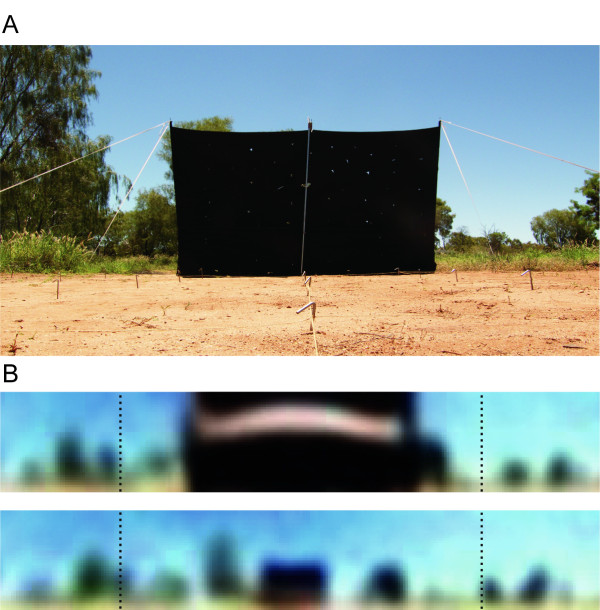
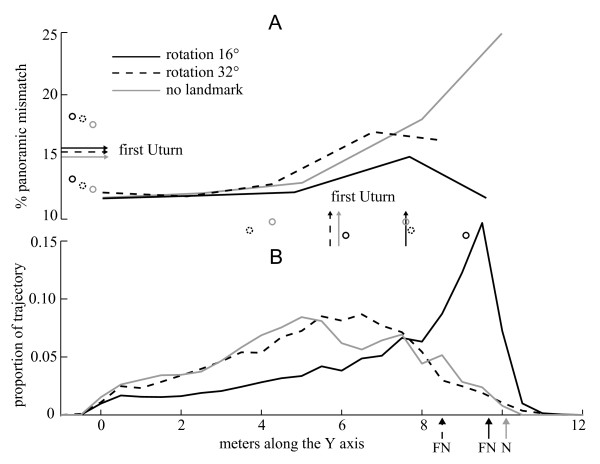
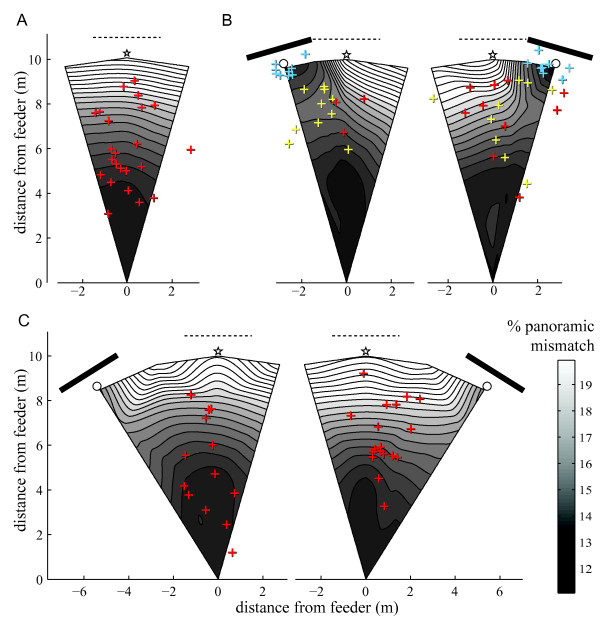
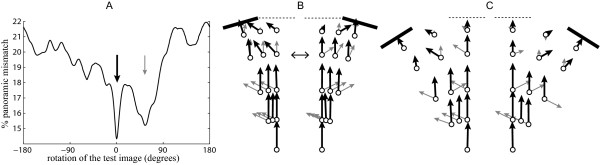
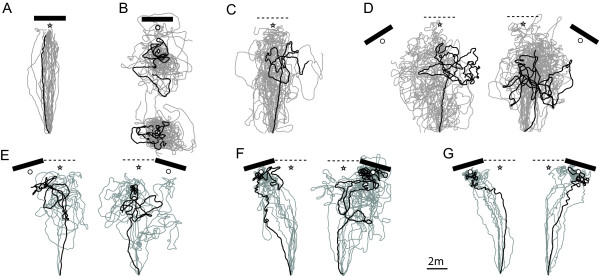
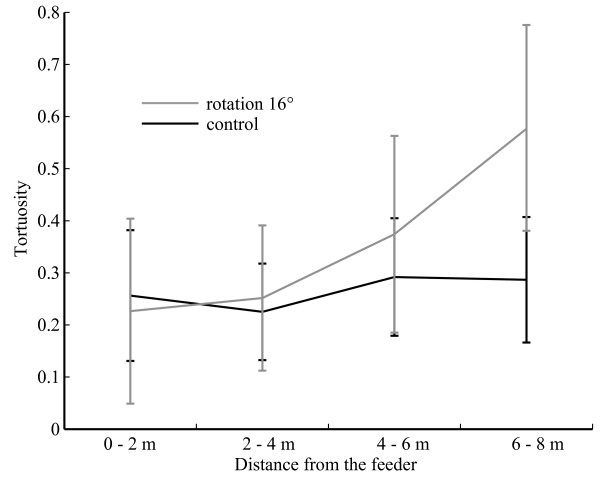
We provided Melophorus bagoti ants with a huge artificial landmark located right near the nest entrance to find out whether navigating ants focus on such a prominent visual landmark for homing guidance. When the landmark was displaced by small or large distances, ant routes were affected differently. Certain behaviours appeared inconsistent with the hypothesis that guidance was based on the landmark only. Instead, comparisons of panoramic images recorded on the field, encompassing both landmark and distal panorama, could explain most aspects of the ant behaviours.
Ants navigating along a familiar route do not focus on obvious landmarks or filter out distal panoramic cues, but appear to be guided by cues covering a large area of their panoramic visual field, including both landmarks and distal panorama. Using panoramic views seems an appropriate strategy to cope with the complexity of natural scenes and the poor resolution of insects' eyes. The ability to isolate landmarks from the rest of a scene may be beyond the capacity of animals that do not possess a dedicated object-perception visual stream like primates.
众所周知,昆虫依靠陆地地标进行导航。地标用于绘制路线或精确定位目标。然而,远距离全景通常被认为不会在熟悉的旅程中直接引导导航,而是作为一个情境线索,激活正确的地标记忆。
我们为 Melophorus bagoti 蚂蚁提供了一个位于巢穴入口附近的巨大人工地标,以了解导航蚂蚁是否将这种突出的视觉地标作为归巢引导的焦点。当地标被小或大的距离位移时,蚂蚁的路线受到不同的影响。某些行为似乎与仅基于地标进行引导的假设不一致。相反,对现场记录的全景图像进行比较,包括地标和远距离全景,可以解释蚂蚁行为的大部分方面。
沿着熟悉路线导航的蚂蚁不会专注于明显的地标或过滤掉远距离全景线索,而是似乎受到覆盖其全景视野大部分区域的线索的引导,包括地标和远距离全景。使用全景视图似乎是一种应对自然场景复杂性和昆虫眼睛分辨率低的合适策略。从场景的其余部分中分离出地标可能超出了那些没有像灵长类动物那样专门的物体感知视觉流的动物的能力。