Immunology and Hematopoiesis Division, Department of Oncology and Medicine, Sidney Kimmel Comprehensive Cancer Center, Johns Hopkins University School of Medicine, Maryland 21231, USA.
Cell. 2011 Sep 2;146(5):772-84. doi: 10.1016/j.cell.2011.07.033. Epub 2011 Aug 25.
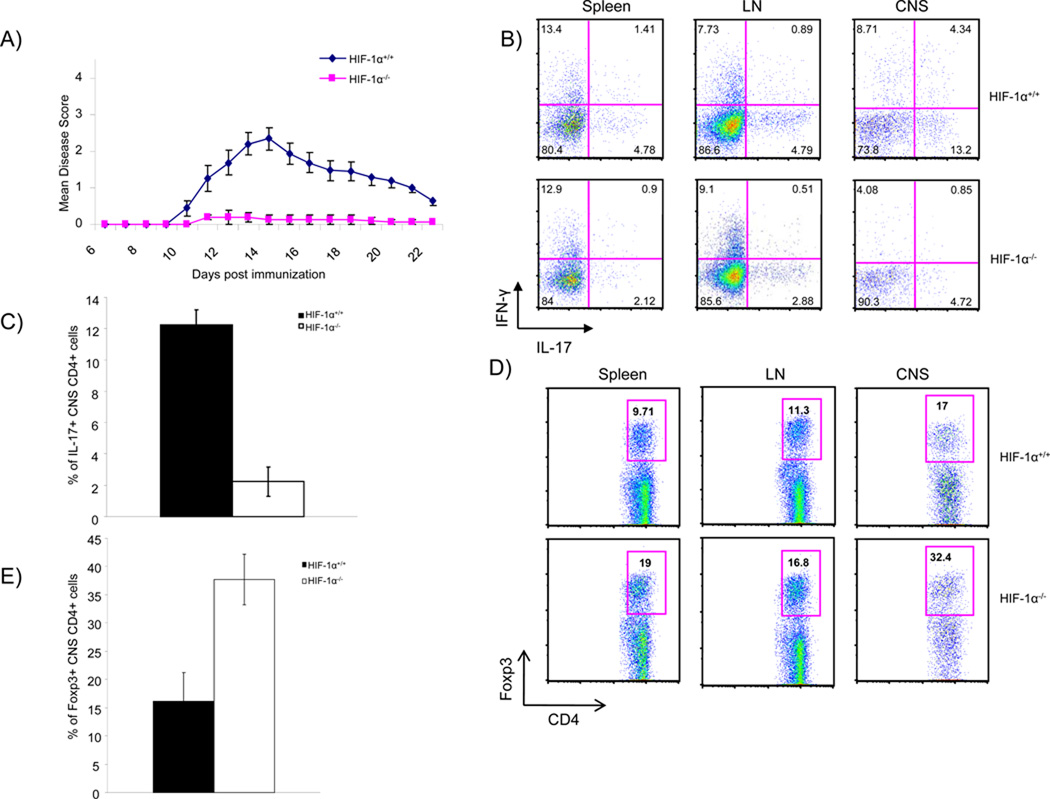
T cell differentiation into distinct functional effector and inhibitory subsets is regulated, in part, by the cytokine environment present at the time of antigen recognition. Here, we show that hypoxia-inducible factor 1 (HIF-1), a key metabolic sensor, regulates the balance between regulatory T cell (T(reg)) and T(H)17 differentiation. HIF-1 enhances T(H)17 development through direct transcriptional activation of RORγt and via tertiary complex formation with RORγt and p300 recruitment to the IL-17 promoter, thereby regulating T(H)17 signature genes. Concurrently, HIF-1 attenuates T(reg) development by binding Foxp3 and targeting it for proteasomal degradation. Importantly, this regulation occurs under both normoxic and hypoxic conditions. Mice with HIF-1α-deficient T cells are resistant to induction of T(H)17-dependent experimental autoimmune encephalitis associated with diminished T(H)17 and increased T(reg) cells. These findings highlight the importance of metabolic cues in T cell fate determination and suggest that metabolic modulation could ameliorate certain T cell-based immune pathologies.
T 细胞分化为不同功能的效应和抑制亚群部分受到抗原识别时存在的细胞因子环境的调节。在这里,我们表明缺氧诱导因子 1(HIF-1)是一种关键的代谢传感器,可调节调节性 T 细胞(Treg)和 T(H)17 分化之间的平衡。HIF-1 通过直接转录激活 RORγt 以及通过与 RORγt 形成三级复合物和募集 p300 到 IL-17 启动子来增强 T(H)17 的发育,从而调节 T(H)17 特征基因。同时,HIF-1 通过结合 Foxp3 并将其靶向蛋白酶体降解来抑制 Treg 的发育。重要的是,这种调节发生在常氧和缺氧条件下。缺乏 HIF-1α 的 T 细胞的小鼠对诱导 T(H)17 依赖性实验性自身免疫性脑脊髓炎具有抗性,这与 T(H)17 减少和 Treg 增加有关。这些发现强调了代谢线索在 T 细胞命运决定中的重要性,并表明代谢调节可能改善某些基于 T 细胞的免疫病理学。