Department of Vertebrate Genomics, Max Planck Institute for Molecular Genetics, D-14195 Berlin, Germany.
Toxicol Sci. 2011 Dec;124(2):278-90. doi: 10.1093/toxsci/kfr225. Epub 2011 Aug 27.
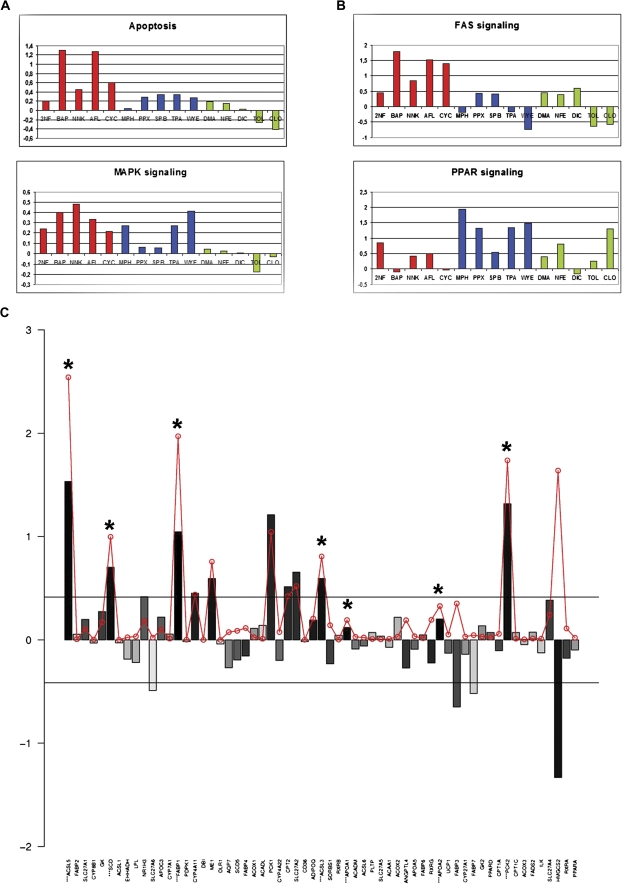
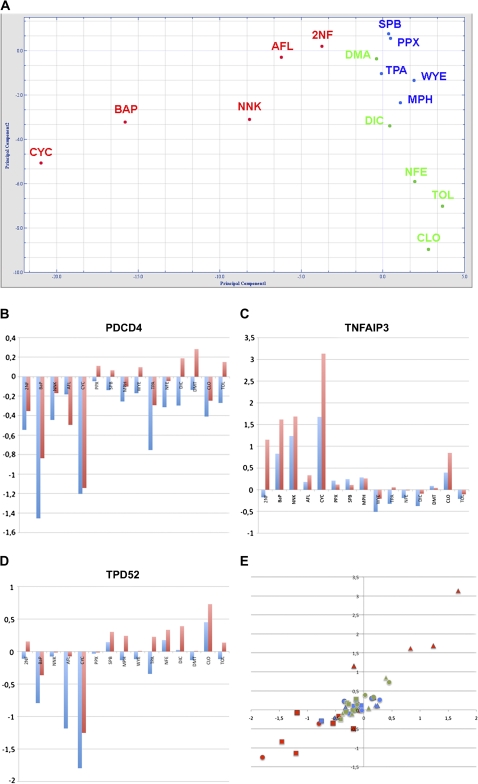
Hepatocyte-like cells derived from the differentiation of human embryonic stem cells (hES-Hep) have potential to provide a human relevant in vitro test system in which to evaluate the carcinogenic hazard of chemicals. In this study, we have investigated this potential using a panel of 15 chemicals classified as noncarcinogens, genotoxic carcinogens, and nongenotoxic carcinogens and measured whole-genome transcriptome responses with gene expression microarrays. We applied an ANOVA model that identified 592 genes highly discriminative for the panel of chemicals. Supervised classification with these genes achieved a cross-validation accuracy of > 95%. Moreover, the expression of the response genes in hES-Hep was strongly correlated with that in human primary hepatocytes cultured in vitro. In order to infer mechanistic information on the consequences of chemical exposure in hES-Hep, we developed a computational method that measures the responses of biochemical pathways to the panel of treatments and showed that these responses were discriminative for the three toxicity classes and linked to carcinogenesis through p53, mitogen-activated protein kinases, and apoptosis pathway modules. It could further be shown that the discrimination of toxicity classes was improved when analyzing the microarray data at the pathway level. In summary, our results demonstrate, for the first time, the potential of human embryonic stem cell--derived hepatic cells as an in vitro model for hazard assessment of chemical carcinogenesis, although it should be noted that more compounds are needed to test the robustness of the assay.
由人胚胎干细胞(hES-Hep)分化而来的肝样细胞有可能提供一种人类相关的体外测试系统,用于评估化学物质的致癌危害。在这项研究中,我们使用了一组 15 种化学物质进行了研究,这些化学物质被分类为非致癌物质、遗传毒性致癌物质和非遗传毒性致癌物质,并使用基因表达微阵列测量了全基因组转录组反应。我们应用了一种方差分析模型,该模型确定了 592 个对该组化学物质高度具有区分性的基因。使用这些基因进行的监督分类实现了 > 95%的交叉验证准确性。此外,hES-Hep 中这些反应基因的表达与体外培养的人原代肝细胞的表达强烈相关。为了推断化学物质暴露在 hES-Hep 中产生的后果的机制信息,我们开发了一种计算方法,该方法测量了生物化学途径对该组处理的反应,并表明这些反应对三种毒性类别具有区分性,并通过 p53、丝裂原激活的蛋白激酶和细胞凋亡途径模块与致癌作用相关联。进一步表明,在分析途径水平的微阵列数据时,毒性类别的区分得到了改善。总之,我们的结果首次证明了人胚胎干细胞衍生的肝细胞作为化学致癌作用危险评估的体外模型的潜力,尽管应该注意的是,需要更多的化合物来测试该测定的稳健性。