Department of Psychology, Pennsylvania State University, University Park, PA 16802, USA.
J Fam Psychol. 2011 Oct;25(5):709-18. doi: 10.1037/a0025279.
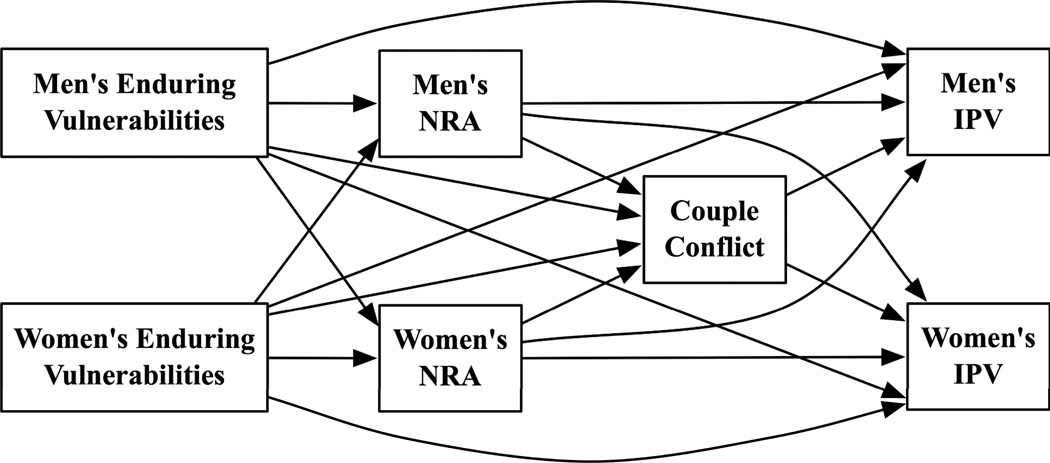
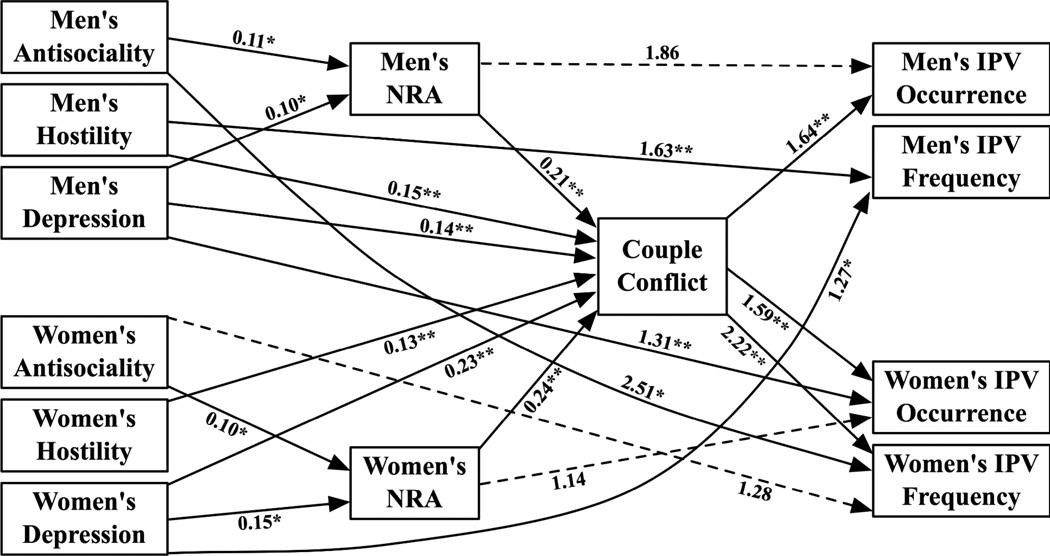
We tested an integrative model of individual and dyadic variables contributing to intimate partner violence (IPV) perpetration. Based on the vulnerability-stress-adaptation (VSA) model, we hypothesized that three "enduring vulnerabilities" (i.e., antisocial behavior, hostility, and depressive symptoms) would be associated with a "maladaptive process" (i.e., negative relationship attributions) that would lead to difficulties in couple conflict resolution, thus leading to IPV. Among a community sample of 167 heterosexual couples who were expecting their first child, we used an actor-partner interdependence model to account for the dyadic nature of conflict and IPV, as well as a hurdle count model to improve upon prior methods for modeling IPV data. Study results provided general support for the integrative model, demonstrating the importance of considering couple conflict in the prediction of IPV and showing the relative importance of multiple predictor variables. Gender symmetry was observed for the prediction of IPV occurrence, with gender differences emerging in the prediction of IPV frequency. Relatively speaking, the prediction of IPV frequency appeared to be a function of enduring vulnerabilities among men, but a function of couple conflict among women. Results also revealed important cross-gender effects in the prediction of IPV, reflecting the inherently dyadic nature of IPV, particularly in the case of "common couple violence." Future research using longitudinal designs is necessary to verify the conclusions suggested by the current results.
我们测试了一个综合模型,该模型涉及个体和对偶变量对亲密伴侣暴力(IPV)的贡献。基于脆弱性-应激-适应(VSA)模型,我们假设三个“持久的脆弱性”(即反社会行为、敌意和抑郁症状)将与“适应不良过程”(即负面的关系归因)相关联,这将导致夫妻冲突解决困难,从而导致 IPV。在一个由 167 对期待他们第一个孩子的异性恋夫妇组成的社区样本中,我们使用演员-伙伴相互依存模型来解释冲突和 IPV 的对偶性质,以及使用障碍计数模型来改进先前用于建模 IPV 数据的方法。研究结果为综合模型提供了普遍支持,证明了考虑夫妻冲突对 IPV 预测的重要性,并显示了多个预测变量的相对重要性。在 IPV 的发生预测中观察到了性别对称性,而在 IPV 的频率预测中则出现了性别差异。相对而言,IPV 频率的预测似乎是男性持久脆弱性的函数,而女性 IPV 频率的预测则是夫妻冲突的函数。结果还揭示了 IPV 预测中的重要跨性别效应,反映了 IPV 的固有对偶性质,特别是在“共同夫妻暴力”的情况下。未来使用纵向设计的研究对于验证当前结果所提出的结论是必要的。