INRA, UMR0598, Génétique Animale, 35042 Rennes cedex, France.
BMC Genet. 2011 Aug 29;12:76. doi: 10.1186/1471-2156-12-76.
Detection of quantitative trait loci (QTLs) affecting meat quality traits in pigs is crucial for the design of efficient marker-assisted selection programs and to initiate efforts toward the identification of underlying polymorphisms. The RYR1 and PRKAG3 causative mutations, originally identified from major effects on meat characteristics, can be used both as controls for an overall QTL detection strategy for diversely affected traits and as a scale for detected QTL effects. We report on a microsatellite-based QTL detection scan including all autosomes for pig meat quality and carcass composition traits in an F2 population of 1,000 females and barrows resulting from an intercross between a Pietrain and a Large White-Hampshire-Duroc synthetic sire line. Our QTL detection design allowed side-by-side comparison of the RYR1 and PRKAG3 mutation effects seen as QTLs when segregating at low frequencies (0.03-0.08), with independent QTL effects detected from most of the same population, excluding any carrier of these mutations.
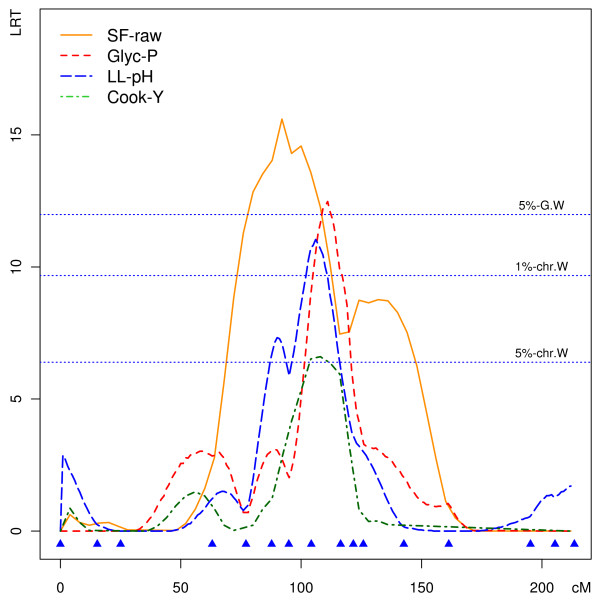
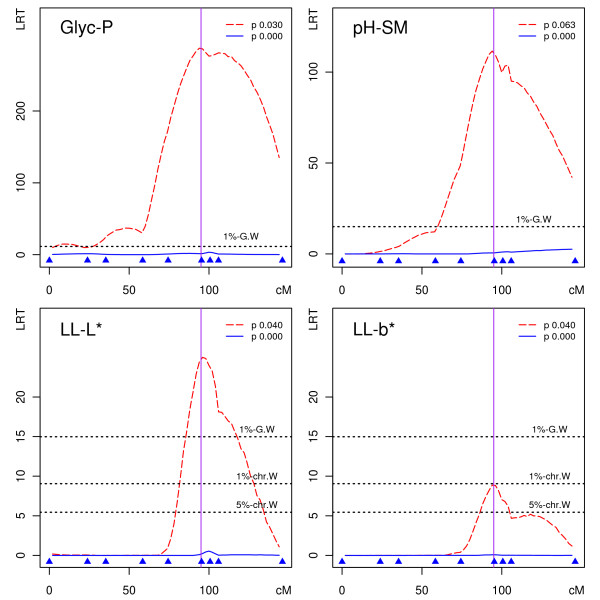
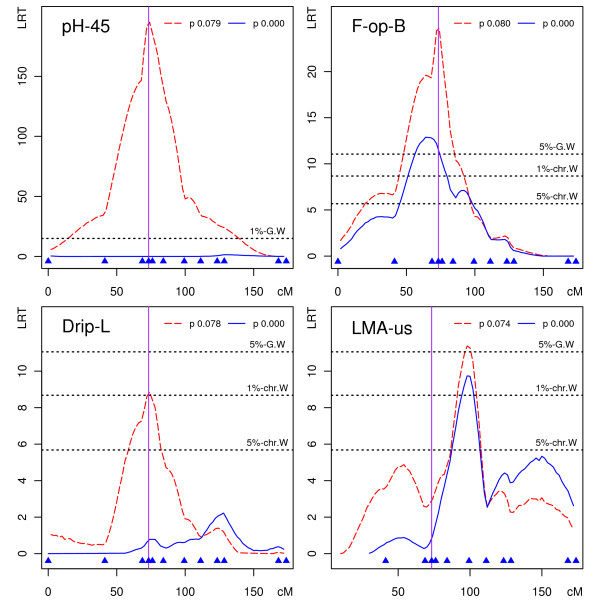
Large QTL effects were detected in the absence of the RYR1 and PRKGA3 mutations, accounting for 12.7% of phenotypic variation in loin colour redness CIE-a* on SSC6 and 15% of phenotypic variation in glycolytic potential on SSC1. We detected 8 significant QTLs with effects on meat quality traits and 20 significant QTLs for carcass composition and growth traits under these conditions. In control analyses including mutation carriers, RYR1 and PRKAG3 mutations were detected as QTLs, from highly significant to suggestive, and explained 53% to 5% of the phenotypic variance according to the trait.
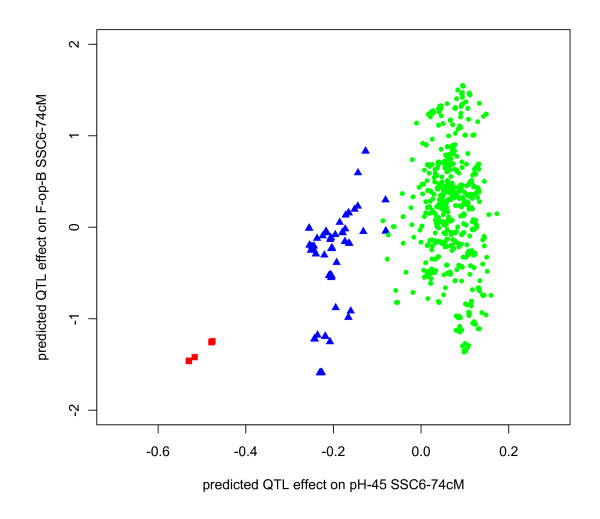
Our results suggest that part of muscle development and backfat thickness effects commonly attributed to the RYR1 mutation may be a consequence of linkage with independent QTLs affecting those traits. The proportion of variation explained by the most significant QTLs detected in this work is close to the influence of major-effect mutations on the least affected traits, but is one order of magnitude lower than effect on variance of traits primarily affected by these causative mutations. This suggests that uncovering physiological traits directly affected by genetic polymorphisms would be an appropriate approach for further characterization of QTLs.
检测影响猪肉质特性的数量性状基因座(QTL)对于设计高效的标记辅助选择计划以及启动鉴定潜在多态性的工作至关重要。最初从对肉质特征的主要影响中确定的 RYR1 和 PRKAG3 致病突变,可以用作广泛受影响性状的总体 QTL 检测策略的对照,也可以用作检测到的 QTL 效应的尺度。我们报告了一种基于微卫星的 QTL 检测扫描,该扫描包括 Pietrain 和大白猪-汉普夏-杜洛克合成父本系杂交产生的 1000 头雌性和阉猪 F2 群体的所有常染色体,用于猪肉质和胴体组成性状。我们的 QTL 检测设计允许在低频率(0.03-0.08)分离时,将 RYR1 和 PRKAG3 突变作为 QTL 进行并排比较,并且从大多数相同的群体中检测到独立的 QTL 效应,排除了这些突变的任何携带者。
在没有 RYR1 和 PRKGA3 突变的情况下,检测到了大的 QTL 效应,占 SSC6 上里脊颜色红色度 CIE-a*的 12.7%和 SSC1 上糖酵解潜力的 15%的表型变异。在这些条件下,我们检测到 8 个对肉质性状有显著影响的 QTL 和 20 个对胴体组成和生长性状有显著影响的 QTL。在包括突变携带者的对照分析中,RYR1 和 PRKAG3 突变被检测为 QTL,从高度显著到提示,根据性状解释了 53%至 5%的表型方差。
我们的结果表明,部分肌肉发育和背膘厚度的影响通常归因于 RYR1 突变,可能是与独立的 QTL 连锁的结果,这些 QTL 影响这些性状。在这项工作中检测到的最显著 QTL 解释的变异比例接近主要效应突变对受影响最小的性状的影响,但比这些致病突变主要影响的性状的变异的影响低一个数量级。这表明,揭示受遗传多态性直接影响的生理性状可能是进一步表征 QTL 的适当方法。