MTT Agrifood Research Finland, Biotechnology and Food Research, FI-31600 Jokioinen, Finland.
BMC Genet. 2014 Feb 28;15:29. doi: 10.1186/1471-2156-15-29.
Color and pH of meat measured 24 h post mortem are common selection objectives in pig breeding programs. Several amino acid substitutions in PRKAG3 have been associated with various meat quality traits. In our previous study ASGA0070625, a SNP next to PRKAG3, had the most significant association with meat quality traits in the Finnish Yorkshire. However, the known amino acid substitutions, including I199V, did not show any association. The aims of this study were to characterize further variation in PRKAG3 and its promoter region, and to test the association between these variants and the pH and color of pork meat.
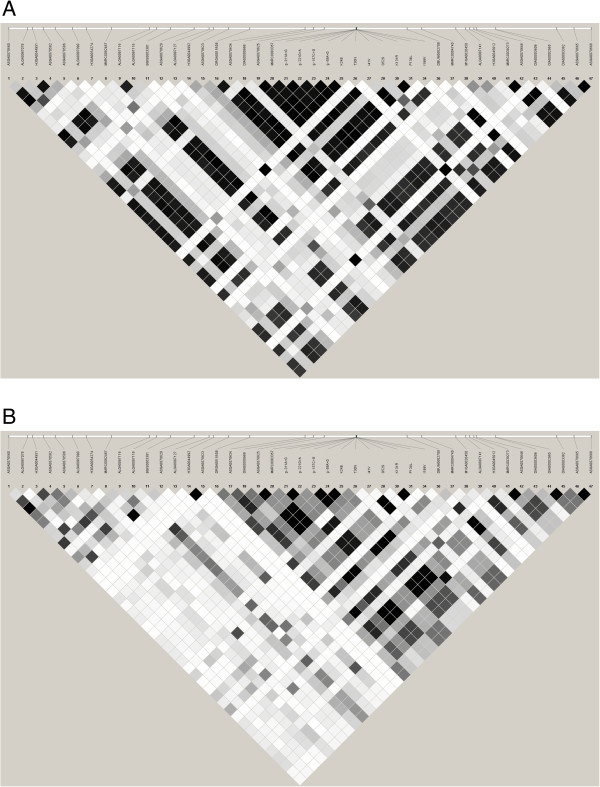
The data comprised of 220 Finnish Landrace and 230 Finnish Yorkshire artificial insemination boars with progeny information. We sequenced the coding and promoter region of PRKAG3 in these and in three additional wild boars. Genotypes from our previous genome-wide scans were also included in the data. Association between SNPs or haplotypes and meat quality traits (deregressed estimates of breeding values from Finnish national breeding value estimation for pH, color lightness and redness measured from loin or ham) was tested using a linear regression model. Sequencing revealed several novel amino acid substitutions in PRKAG3, including K24E, I41V, K131R, and P134L. Linkage disequilibrium was strong among the novel variants, SNPs in the promoter region and ASGA0070625, especially for the Yorkshire. The strongest associations were observed between ASGA0070625 and the SNPs in the promoter region and pH measured from loin in the Yorkshire and between I199V and pH measured from ham in the Landrace. In contrast, ASGA0070625 was not significantly associated with meat quality traits in the Landrace and I199V not in the Yorkshire. Haplotype analysis showed a significant association between a haplotype consisting of 199I and 24E alleles (or g.-157C or g.-58A alleles in the promoter region) and pH measured from loin and ham in both breeds (P-values varied from 1.72 × 10⁻⁴ to 1.80 × 10⁻⁸).
We conclude that haplotype g.-157C - g.-58A - 24E - 199I in PRKAG3 has a positive effect on meat quality in pigs. Our results are readily applicable for marker-assisted selection in pigs.
宰后 24 小时测量的肉色和 pH 值是猪育种计划中常见的选择目标。PRKAG3 中的几个氨基酸替换与各种肉质性状有关。在我们之前的研究 ASGA0070625 中,PRKAG3 旁边的一个 SNP 与芬兰约克夏的肉质性状关联最显著。然而,已知的氨基酸替换,包括 I199V,并没有显示出任何关联。本研究的目的是进一步描述 PRKAG3 及其启动子区域的变异,并检验这些变异与猪肉 pH 值和颜色的关联。
数据包括 220 头芬兰长白和 230 头芬兰约克夏人工授精公猪及其后代信息。我们对这些猪和另外三头野猪的 PRKAG3 编码区和启动子区进行了测序。我们还将来自之前全基因组扫描的基因型纳入数据中。使用线性回归模型测试 SNP 或单倍型与肉质性状(从芬兰国家育种值估计中去遗传估计的 pH 值、肉色亮度和红色度的回归估计值)之间的关联。测序揭示了 PRKAG3 中的几个新的氨基酸替换,包括 K24E、I41V、K131R 和 P134L。新变异、启动子区域中的 SNP 和 ASGA0070625 之间存在强烈的连锁不平衡,尤其是在约克夏猪中。在约克夏猪中,观察到最强的关联是 ASGA0070625 与启动子区域中的 SNP 和里脊 pH 值之间,以及 I199V 与腰肉 pH 值之间。相反,ASGA0070625 与长白猪的肉质性状没有显著关联,I199V 与约克夏猪的肉质性状也没有关联。单倍型分析显示,由 199I 和 24E 等位基因(或启动子区域中的 g.-157C 或 g.-58A 等位基因)组成的单倍型与两个品种的里脊和腰肉 pH 值之间存在显著关联(P 值从 1.72×10⁻⁴到 1.80×10⁻⁸不等)。
我们得出结论,PRKAG3 中的单倍型 g.-157C-g.-58A-24E-199I 对猪的肉质有积极影响。我们的结果可直接应用于猪的标记辅助选择。