Vascular Biology and Stroke Research Laboratory, Department of Neurosurgery, LSU Health Science Center in Shreveport, Shreveport, Louisiana, United States of America.
PLoS One. 2011;6(8):e23239. doi: 10.1371/journal.pone.0023239. Epub 2011 Aug 18.
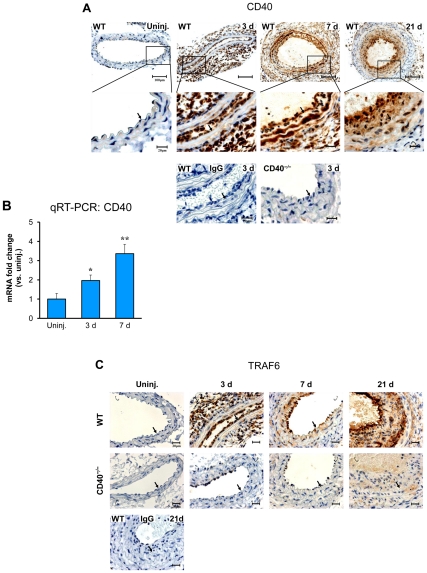
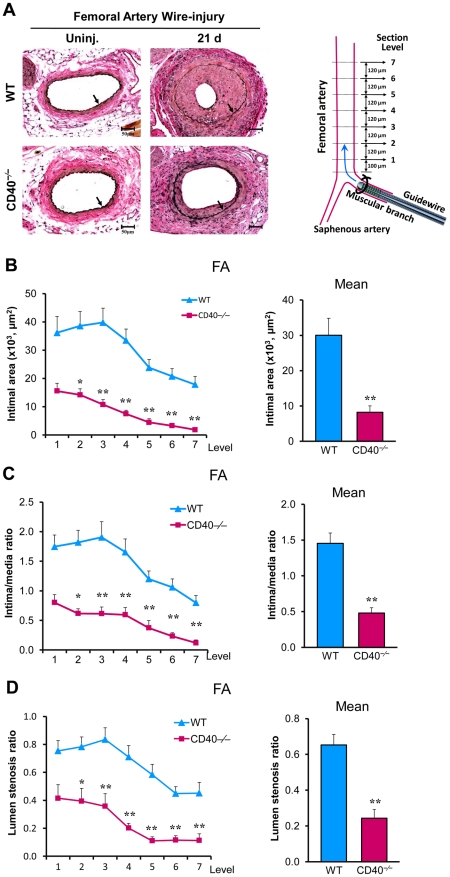
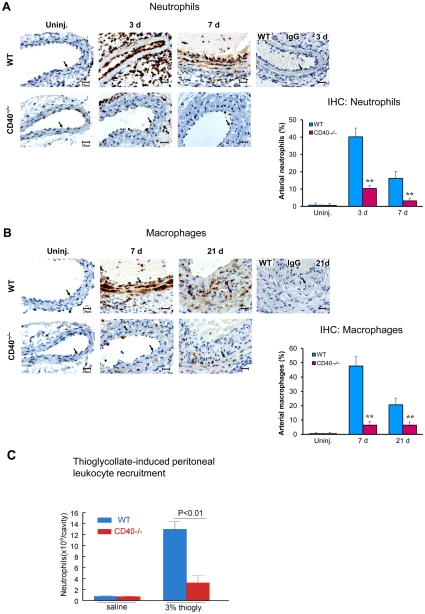
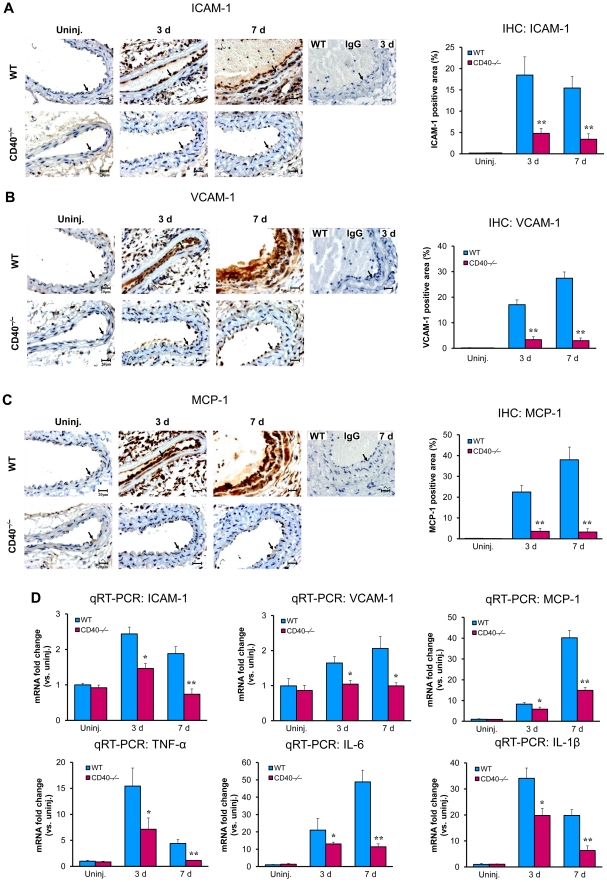
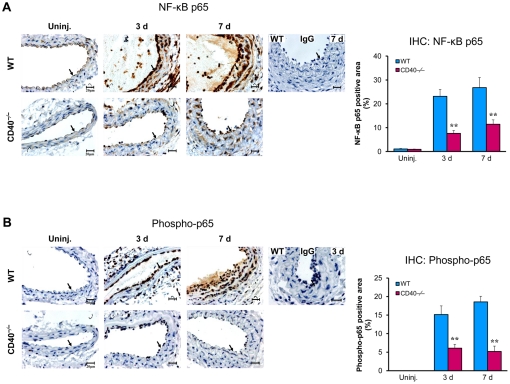
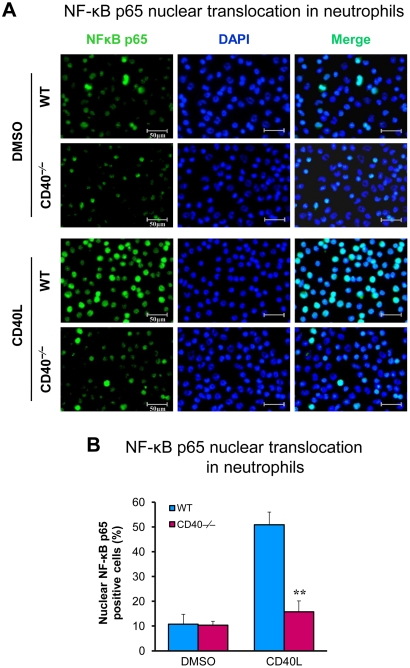
Despite extensive investigations, restenosis, which is characterized primarily by neointima formation, remains an unsolved clinical problem after vascular interventions. A recent study has shown that CD40 signaling through TNF receptor associated factor 6 (TRAF6) plays a key role in neointima formation after carotid artery injury; however, underlying mechanisms are not clearly elucidated. Because neointima formation may vary significantly depending on the type of injury, we first assessed the effect of CD40 deficiency on neointima formation in 2 injury models, carotid artery ligation and femoral artery denudation injury. Compared with wild-type mice, CD40 deficiency significantly reduced neointima formation and lumen stenosis in two different models. Further, we investigated the mechanism by which CD40 signaling affects neointima formation after arterial injury. In wild-type mice, the expression levels of CD40, several TRAF proteins, including TRAF1, TRAF2, TRAF3, TRAF5, and TRAF6, as well as total NF-kB p65 and phospho-NF-kB p65, in the carotid artery were markedly upregulated within 3-7 days after carotid ligation. Deficiency of CD40 abolished the injury-induced upregulation of TRAFs including TRAF6 and NF-kB-p65 in the injured vessel wall. Further, CD40(-/-) mice showed a significant decrease in the recruitment of neutrophils (at 3, 7d) and macrophages (at 7, 21d) into injured artery; this effect was most likely attributed to inhibition of NF-kB activation and marked downregulation of NF-kB-related gene expression, including cytokines (TNFα, IL-1β, IL-6), chemokines (MCP-1), and adhesion molecules (ICAM-1, VCAM-1). Moreover, neutrophil recruitment in a model of thioglycollate-induced peritonitis is impaired in CD40-deficient mice. In vitro data revealed that CD40 deficiency blocked CD40L-induced NF-kB p65 nuclear translocation in leukocytes. Altogether, our data identified for the first time that CD40 is essential in the upregulation of TRAF6, NF-kB activation, and NF-kB-dependent proinflammatory genes in vivo. Our findings firmly established the role for CD40 in neointima formation in 2 distinct injury models.
尽管进行了广泛的研究,但血管介入治疗后仍然存在一个未解决的临床问题,即再狭窄,其主要特征是新生内膜形成。最近的一项研究表明,CD40 通过 TNF 受体相关因子 6(TRAF6)的信号转导在颈动脉损伤后新生内膜形成中发挥关键作用;然而,潜在的机制尚不清楚。由于新生内膜的形成可能因损伤类型的不同而有很大差异,我们首先评估了 CD40 缺失对两种损伤模型(颈动脉结扎和股动脉剥脱损伤)中新生内膜形成的影响。与野生型小鼠相比,CD40 缺失显著减少了两种不同模型中的新生内膜形成和管腔狭窄。此外,我们研究了 CD40 信号转导影响动脉损伤后新生内膜形成的机制。在野生型小鼠中,颈动脉中 CD40、几种 TRAF 蛋白(包括 TRAF1、TRAF2、TRAF3、TRAF5 和 TRAF6)以及总 NF-kB p65 和磷酸化 NF-kB p65 的表达水平在颈动脉结扎后 3-7 天内明显上调。CD40 缺失消除了损伤诱导的 TRAF6 和 NF-kB-p65 在损伤血管壁中的上调。此外,CD40(-/-) 小鼠中损伤动脉募集的中性粒细胞(3、7d)和巨噬细胞(7、21d)显著减少;这种效应很可能归因于 NF-kB 激活的抑制和 NF-kB 相关基因表达的显著下调,包括细胞因子(TNFα、IL-1β、IL-6)、趋化因子(MCP-1)和粘附分子(ICAM-1、VCAM-1)。此外,CD40 缺陷小鼠中硫代乙醇酸盐诱导的腹膜炎中性粒细胞募集受损。体外数据显示,CD40 缺失阻断了白细胞中 CD40L 诱导的 NF-kB p65 核易位。总之,我们的数据首次确定 CD40 在体内 TRAF6、NF-kB 激活和 NF-kB 依赖性促炎基因的上调中是必需的。我们的发现牢固确立了 CD40 在两种不同损伤模型中的新生内膜形成中的作用。