Nephrology Research Group, Centre for Public Health, Queen's University Belfast, Belfast, United Kingdom.
PLoS One. 2011;6(8):e23904. doi: 10.1371/journal.pone.0023904. Epub 2011 Aug 18.
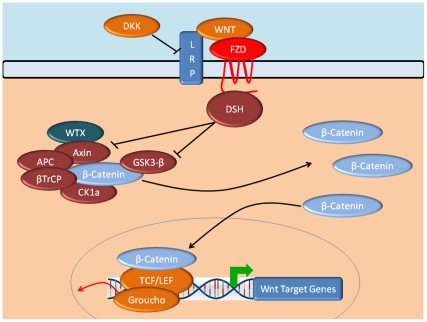
AIMS/HYPOTHESIS: Several studies have provided compelling evidence implicating the Wnt signalling pathway in the pathogenesis of diabetic nephropathy. Gene expression profiles associated with renal fibrosis have been attenuated through Wnt pathway modulation in model systems implicating Wnt pathway members as potential therapeutic targets for the treatment of diabetic nephropathy. We assessed tag and potentially functional single nucleotide polymorphisms (SNPs; n = 31) in four key Wnt pathway genes (CTNNB1, AXIN2, LRP5 and LRP6) for association with diabetic nephropathy using a case-control design.
SNPs were genotyped using Sequenom or Taqman technologies in 1351 individuals with type 1 diabetes (651 cases with nephropathy and 700 controls without nephropathy). Cases and controls were white and recruited from the UK and Ireland. Association analyses were performed using PLINK, to compare allele and haplotype frequencies in cases and controls. Adjustment for multiple testing was performed by permutation testing.
Following logistic regression analysis adjusted by collection centre, duration of T1D, and average HbA1c as covariates, a single SNP in LRP6 (rs1337791) was significantly associated with DN (OR = 0.74; CI: 0.57-0.97; P = 0.028), although this was not maintained following correction for multiple testing. Three additional SNPs (rs2075241 in LRP6; rs3736228 and rs491347 both in LRP5) were marginally associated with diabetic nephropathy, but none of the associations were replicated in an independent dataset. Haplotype and subgroup analysis (according to duration of diabetes, and end-stage renal disease) also failed to reveal an association with diabetic nephropathy.
CONCLUSIONS/INTERPRETATION: Our results suggest that analysed common variants in CTNNB1, AXIN2, LRP5 and LRP6 are not strongly associated with diabetic nephropathy in type 1 diabetes among white individuals. Our findings, however, cannot entirely exclude these genes or other members of the Wnt pathway, from involvement in the pathogenesis of diabetic nephropathy as our study had limited power to detect variants with small effect size.
目的/假设:多项研究表明 Wnt 信号通路在糖尿病肾病的发病机制中起重要作用。在模型系统中,与肾纤维化相关的基因表达谱通过 Wnt 通路调节得到减弱,这表明 Wnt 通路成员可能成为治疗糖尿病肾病的潜在治疗靶点。我们采用病例对照设计,评估了四个关键 Wnt 通路基因(CTNNB1、AXIN2、LRP5 和 LRP6)中的 31 个标记和潜在功能单核苷酸多态性(SNP)与糖尿病肾病的相关性。
使用 Sequenom 或 Taqman 技术对 1351 名 1 型糖尿病患者(651 例有肾病,700 例无肾病)进行 SNP 基因分型。病例和对照均为白人,来自英国和爱尔兰。使用 PLINK 进行关联分析,比较病例和对照的等位基因和单倍型频率。通过置换检验进行多重检验校正。
在经过中心、1 型糖尿病持续时间和平均 HbA1c 调整的逻辑回归分析后,LRP6 中的一个 SNP(rs1337791)与 DN 显著相关(OR=0.74;95%CI:0.57-0.97;P=0.028),但在进行多重检验校正后,这一结果不再成立。另外三个 SNP(LRP6 中的 rs2075241;LRP5 中的 rs3736228 和 rs491347)与糖尿病肾病呈边缘相关,但在独立数据集的复制中均未得到验证。单体型和亚组分析(根据糖尿病持续时间和终末期肾病)也未能揭示与糖尿病肾病的关联。
结论/解释:我们的结果表明,在白人 1 型糖尿病患者中,分析的 CTNNB1、AXIN2、LRP5 和 LRP6 中的常见变异与糖尿病肾病的相关性不强。然而,我们的研究结果并不能完全排除这些基因或 Wnt 通路的其他成员参与糖尿病肾病的发病机制,因为我们的研究在检测具有较小效应的变异方面的能力有限。