Africa Centre for Health and Population Studies, University of KwaZulu-Natal, South Africa.
J Affect Disord. 2011 Dec;135(1-3):362-73. doi: 10.1016/j.jad.2011.08.011. Epub 2011 Aug 31.
Although the prevalence of depression is similar in pregnant, postpartum and non-pregnant women, the onset of new depression is higher during the perinatal period. Women of low-income, and those living in low and middle income countries, are known to be at particularly high risk. Early identification and treatment of antenatal depression may improve pregnancy outcomes and could serve as an early indicator of postnatal depression. Culturally sensitive and accurate diagnostic tools are urgently needed.
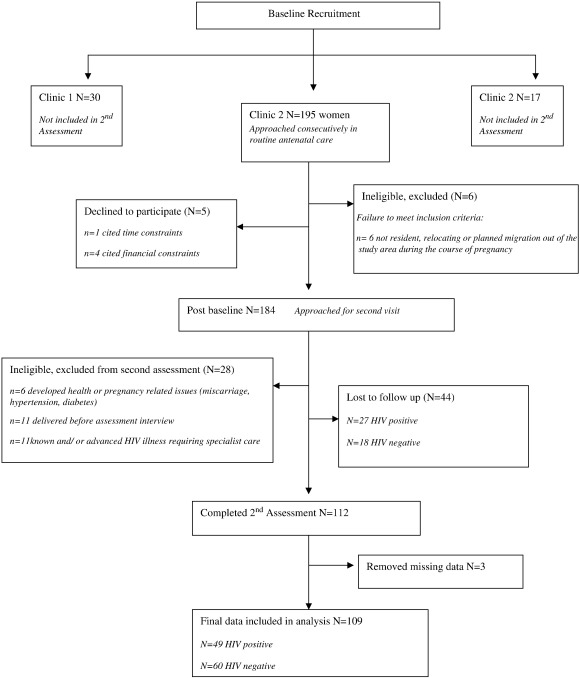
A consecutive series of 109 pregnant women were recruited in the third trimester at a primary health clinic, in a rural part of South Africa, with a high HIV prevalence. A cross sectional assessment of depression was completed using a structured clinical interview method and DSM-IV diagnostic criteria. Qualitative data on women's descriptions of depressive symptoms was also collected. The aim was to examine the prevalence of depression and to better understand the presentation of depressive symptomatology in this population.
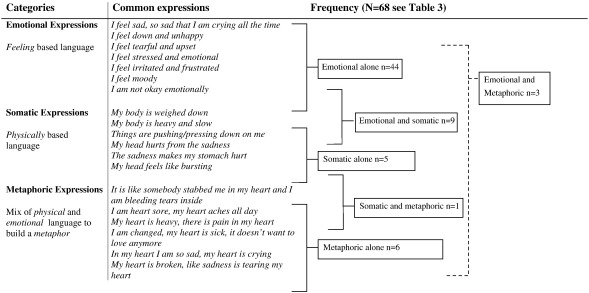
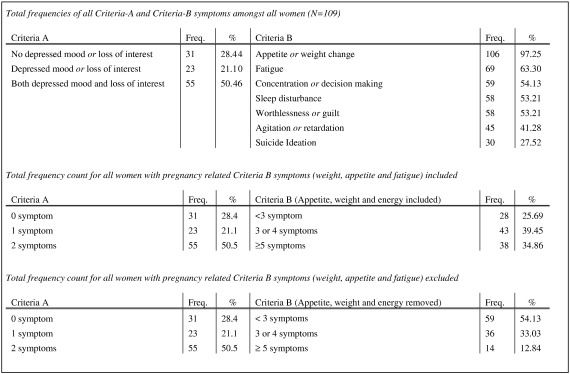
Prevalence of depression was high, 51/109 (47%), with over half of the depressed women 34/51(67%) reporting episode duration greater than two months. 8/51 reported a prior history of depression. Women used psychological language to describe symptoms and, as a result, standardised diagnostic tools were culturally sensitive. Somatic pregnancy symptoms were frequently reported, but did not overestimate depression. Both HIV positive (27/51) and HIV negative (24/51) women were at risk of being depressed.
The study is limited by the small sample size and possible attrition biases.
Antenatal depression is high and clinical presentation is similar to high income countries. Standardised diagnostic tools are culturally sensitive and adequate for early detection.
尽管孕期、产后和非孕期女性的抑郁症患病率相似,但围产期新发抑郁症的发病率更高。低收入女性,以及中低收入国家的女性,已知面临特别高的风险。早期识别和治疗产前抑郁症可能会改善妊娠结局,并可作为产后抑郁症的早期指标。目前迫切需要文化敏感且准确的诊断工具。
在南非农村地区的一个初级保健诊所,连续招募了 109 名处于孕晚期的孕妇。采用结构化临床访谈方法和 DSM-IV 诊断标准进行横断面评估抑郁。还收集了关于女性对抑郁症状描述的定性数据。目的是检查抑郁的患病率,并更好地了解该人群中抑郁症状的表现。
抑郁患病率很高,109 名孕妇中有 51 名(47%)患有抑郁症,其中超过一半的抑郁女性(34/51,67%)报告的发病持续时间超过两个月。8/51 名女性报告有既往抑郁症病史。女性用心理语言描述症状,因此,标准化诊断工具具有文化敏感性。躯体妊娠症状经常被报告,但不会高估抑郁症。HIV 阳性(27/51)和 HIV 阴性(24/51)的女性都有患抑郁症的风险。
该研究受到样本量小和可能的失访偏倚的限制。
产前抑郁症的发病率很高,临床表现与高收入国家相似。标准化诊断工具具有文化敏感性,可用于早期发现。