Department of Medical Sciences, Clinical Physiology, Uppsala University, Uppsala, Sweden.
J Physiol Sci. 2011 Nov;61(6):497-505. doi: 10.1007/s12576-011-0171-x. Epub 2011 Sep 1.
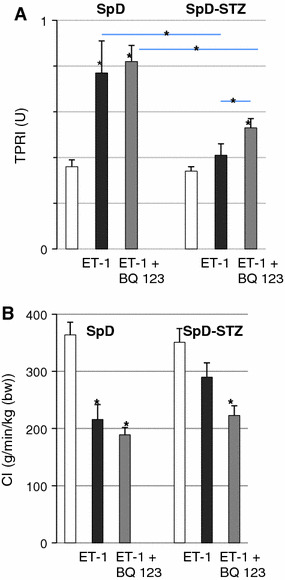
In this study, using the microsphere method, the hemodynamic response to endothelin-1 (ET-1) in healthy and streptozotocin (STZ)-diabetic rats was evaluated as well as the influences of inhibition of nitric oxide (NO)-synthase using L-NAME (Nω-nitro-L: -arginine methyl ester) and the cyclooxygenase inhibitor indomethacin. Blood flow (Q) was measured in tissues of interest for vascular complications in diabetes such as kidney, eye, brain, heart and skeletal muscle with the main focus on ophthalmic circulation. Under resting conditions, evidence for renal vasoconstriction was found in diabetic animals. In both groups, administration of L-NAME reduced Q in all investigated tissues indicating a basal NO influence. In the normal rats, ET-1 induced a significant increase in blood pressure and intense vasoconstriction in all tissues except in the choroid of the eye and in the brain, where it induced an increased Q. In the STZ-diabetic rats, effects of ET-1 were less pronounced. Pretreatment with L-NAME, but not the cyclooxygenase inhibitor, abolished the ET-1-induced vasodilation in the choroid of both groups. Administration of ET A receptor antagonist BQ-123 reduced the ET-1-induced vasodilation in the choroid only in diabetic animals. In conclusion, evidence for altered vascular endothelial response to ET-1 in STZ-diabetic animals was found particularly in the ophthalmic circulation. The findings suggest differential involvement of receptors in the response to ET-1 in normal and STZ-diabetic animals.
在这项研究中,使用微球法评估了内皮素-1 (ET-1)对健康和链脲佐菌素 (STZ) 糖尿病大鼠的血液动力学反应,以及使用 L-NAME (Nω-硝基-L: -精氨酸甲酯)抑制一氧化氮 (NO)-合酶和环氧化酶抑制剂吲哚美辛的影响。使用微球法测量了糖尿病血管并发症相关组织的血流量 (Q),包括肾脏、眼睛、大脑、心脏和骨骼肌,重点关注眼部循环。在休息状态下,糖尿病动物存在肾血管收缩的证据。在两组中,L-NAME 的给药降低了所有研究组织的 Q,表明存在基础 NO 影响。在正常大鼠中,ET-1 诱导血压显著升高,并在所有组织中引起强烈的血管收缩,除了眼睛的脉络膜和大脑,在那里它诱导 Q 增加。在 STZ 糖尿病大鼠中,ET-1 的作用不那么明显。L-NAME 的预处理,但不是环氧化酶抑制剂,消除了两组脉络膜中 ET-1 诱导的血管扩张。ET A 受体拮抗剂 BQ-123 的给药仅在糖尿病动物中降低了脉络膜中 ET-1 诱导的血管扩张。总之,在 STZ 糖尿病动物中发现了血管内皮对 ET-1 的反应改变的证据,特别是在眼部循环中。这些发现表明,在正常和 STZ 糖尿病动物中,受体在对 ET-1 的反应中存在差异参与。