Department of Environmental Health, Harvard School of Public Health, 401 Park Dr., Boston, MA 02215, USA.
Environ Health Perspect. 2012 Jan;120(1):126-31. doi: 10.1289/ehp.1003300. Epub 2011 Sep 1.
Most toxicologic studies focus on a single agent, although this does not reflect real-world scenarios in which humans are exposed to multiple chemicals.
We prospectively studied manganese-lead interactions in early childhood to examine whether manganese-lead coexposure is associated with neurodevelopmental deficiencies that are more severe than expected based on effects of exposure to each metal alone.
Four hundred fifty-five children were enrolled at birth in an longitudinal cohort study in Mexico City, provided blood samples, and were followed until 36 months of age. We measured lead and manganese at 12 and 24 months and assessed neurodevelopment at 6-month intervals from 12 to 36 months of age using Bayley Scales of Infant Development-II.
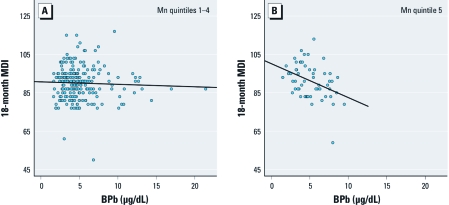
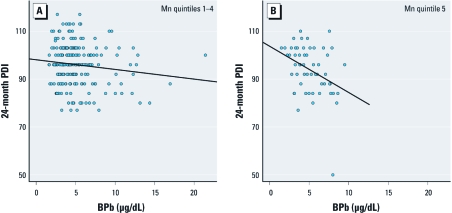
Mean (± SD) blood concentrations at 12 and 24 months were, respectively, 24.7 ± 5.9 μg/L and 21.5 ± 7.4 μg/L for manganese and 5.1 ± 2.6 μg/dL and 5.0 ± 2.9 μg/dL for lead. Mixed-effects models, including Bayley scores at five time points, showed a significant interaction over time: highest manganese quintile × continuous lead; mental development score, β = -1.27 [95% confidence interval (CI): -2.18, -0.37]; psychomotor development score, β = -0.92 (95% CI: -1.76, -0.09). Slopes for the estimated 12-month lead effect on 18-month mental development and 24- through 36-month psychomotor development scores were steeper for children with high manganese than for children with midrange manganese levels.
We observed evidence of synergism between lead and manganese, whereby lead toxicity was increased among children with high manganese coexposure. Findings highlight the importance of understanding health effects of mixed exposures, particularly during potentially sensitive developmental stages such as early childhood.
大多数毒理学研究都集中在单一制剂上,尽管这并不能反映人类接触多种化学物质的实际情况。
我们前瞻性地研究了儿童早期锰与铅的相互作用,以检验锰与铅的共同暴露是否与神经发育缺陷有关,这些缺陷比单独接触每种金属所预期的更为严重。
1999 年至 2001 年,在墨西哥城的一个纵向队列研究中,我们在出生时招募了 455 名儿童,提供了血液样本,并随访至 36 个月龄。我们在 12 个月和 24 个月时测量了铅和锰的浓度,并在 12 个月至 36 个月期间,每隔 6 个月使用贝利婴幼儿发展量表第二版评估神经发育情况。
12 个月和 24 个月时的平均(±标准差)血浓度分别为锰 24.7 ± 5.9 μg/L 和 21.5 ± 7.4 μg/L,铅 5.1 ± 2.6 μg/dL 和 5.0 ± 2.9 μg/dL。包含五个时间点贝利评分的混合效应模型显示出随着时间的推移存在显著的交互作用:最高锰五分位数×连续铅;精神发育评分,β=-1.27(95%置信区间:-2.18,-0.37);精神运动发育评分,β=-0.92(95%置信区间:-1.76,-0.09)。对于高锰儿童,12 个月时铅对 18 个月时精神发育和 24 至 36 个月时精神运动发育评分的影响斜率更陡峭,而对于中锰水平儿童,斜率更平缓。
我们观察到铅和锰之间存在协同作用的证据,即在高锰共暴露的儿童中,铅的毒性增加。这些发现强调了理解混合暴露对健康影响的重要性,特别是在儿童早期等潜在敏感发育阶段。