Molecular Bioenergetics Group, Medical School, Cluster of Excellence Frankfurt Macromolecular Complexes, Center for Membrane Proteomics, Johann Wolfgang Goethe-Universität, Frankfurt, Germany.
PLoS Biol. 2011 Aug;9(8):e1001128. doi: 10.1371/journal.pbio.1001128. Epub 2011 Aug 23.
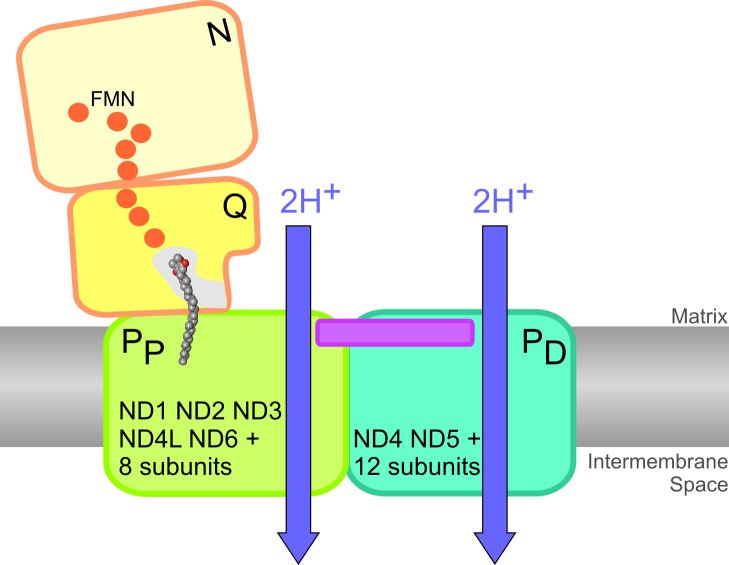
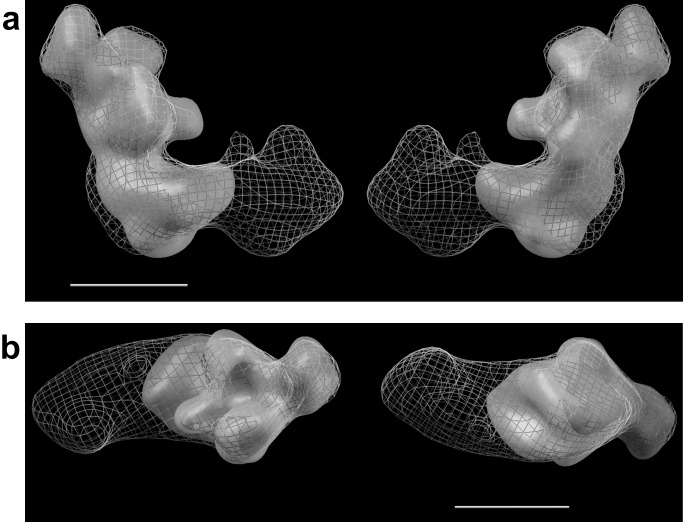
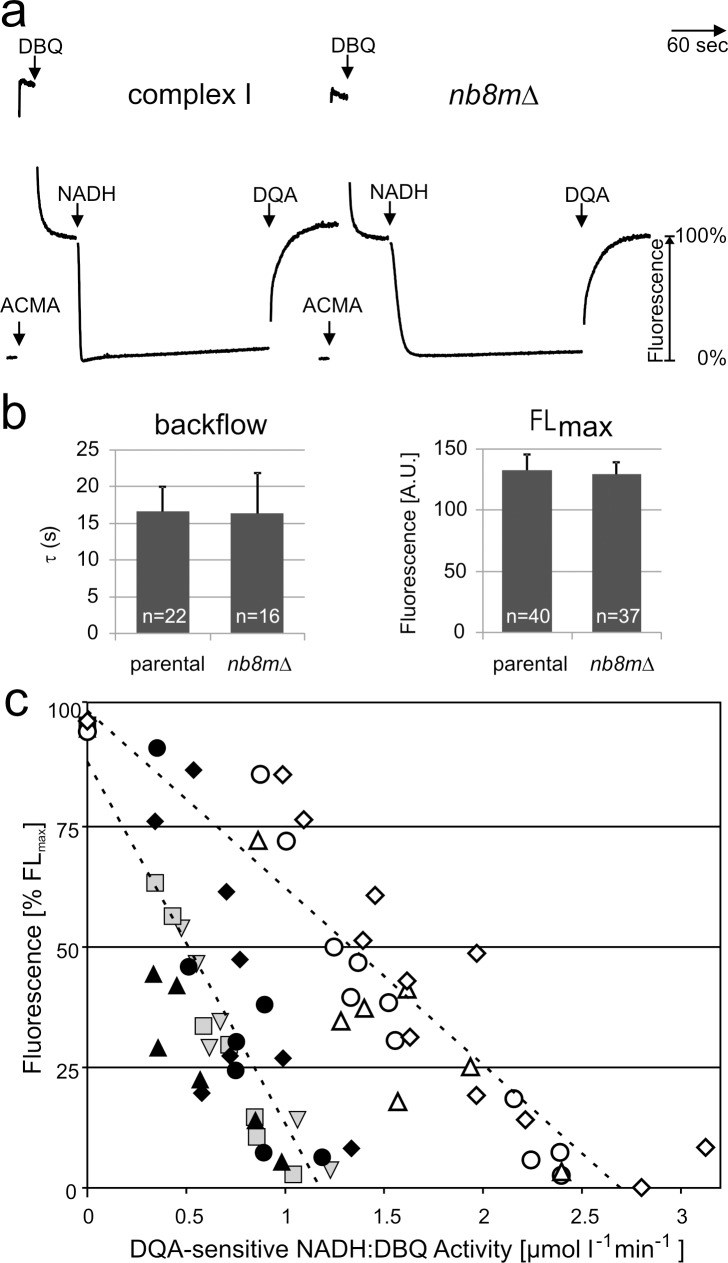
Mitochondrial complex I, the largest and most complicated proton pump of the respiratory chain, links the electron transfer from NADH to ubiquinone to the pumping of four protons from the matrix into the intermembrane space. In humans, defects in complex I are involved in a wide range of degenerative disorders. Recent progress in the X-ray structural analysis of prokaryotic and eukaryotic complex I confirmed that the redox reactions are confined entirely to the hydrophilic peripheral arm of the L-shaped molecule and take place at a remarkable distance from the membrane domain. While this clearly implies that the proton pumping within the membrane arm of complex I is driven indirectly via long-range conformational coupling, the molecular mechanism and the number, identity, and localization of the pump-sites remains unclear. Here, we report that upon deletion of the gene for a small accessory subunit of the Yarrowia complex I, a stable subcomplex (nb8mΔ) is formed that lacks the distal part of the membrane domain as revealed by single particle analysis. The analysis of the subunit composition of holo and subcomplex by three complementary proteomic approaches revealed that two (ND4 and ND5) of the three subunits with homology to bacterial Mrp-type Na(+)/H(+) antiporters that have been discussed as prime candidates for harbouring the proton pumps were missing in nb8mΔ. Nevertheless, nb8mΔ still pumps protons at half the stoichiometry of the complete enzyme. Our results provide evidence that the membrane arm of complex I harbours two functionally distinct pump modules that are connected in series by the long helical transmission element recently identified by X-ray structural analysis.
线粒体复合物 I 是呼吸链中最大、最复杂的质子泵,它将 NADH 到泛醌的电子传递与从基质向膜间空间泵出四个质子联系起来。在人类中,复合物 I 的缺陷与广泛的退行性疾病有关。最近在原核和真核复合物 I 的 X 射线结构分析方面的进展证实,氧化还原反应完全局限于 L 形分子的亲水外围臂上,并发生在与膜域显著的距离处。虽然这清楚地表明,复合物 I 膜臂内的质子泵通过长程构象偶联间接驱动,但分子机制以及泵位的数量、身份和定位仍不清楚。在这里,我们报告说,在删除酿酒酵母复合物 I 的一个小辅助亚基的基因后,形成了一个稳定的亚复合物(nb8mΔ),通过单颗粒分析揭示了该亚复合物缺乏膜域的远端部分。通过三种互补的蛋白质组学方法对全酶和亚复合物的亚基组成进行分析表明,三个与细菌 Mrp 型 Na(+)/H(+)反向转运体同源的亚基中,有两个(ND4 和 ND5)缺失,而这两个亚基曾被认为是质子泵的主要候选者。尽管如此,nb8mΔ 仍以完整酶的一半化学计量泵出质子。我们的结果提供了证据,表明复合物 I 的膜臂包含两个功能上不同的泵模块,它们通过最近的 X 射线结构分析确定的长螺旋传输元件串联连接。