Medical Research Council Mitochondrial Biology Unit, Wellcome Trust/MRC Building, Hills Road, Cambridge CB2 0XY, UK.
Mol Cell Proteomics. 2010 Oct;9(10):2318-26. doi: 10.1074/mcp.M110.001255. Epub 2010 Jul 7.
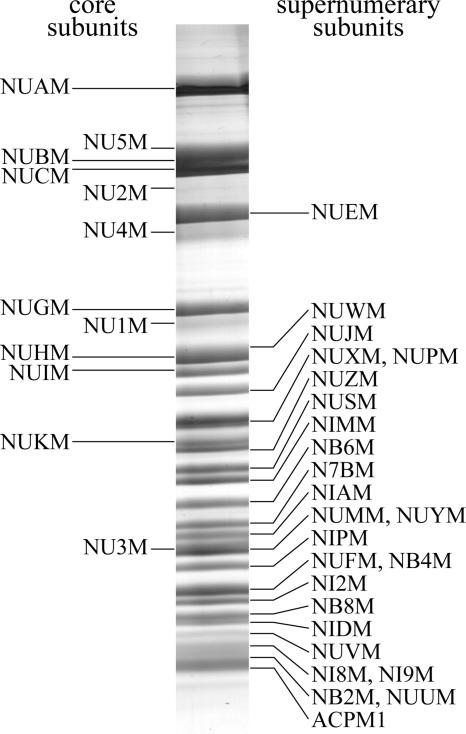
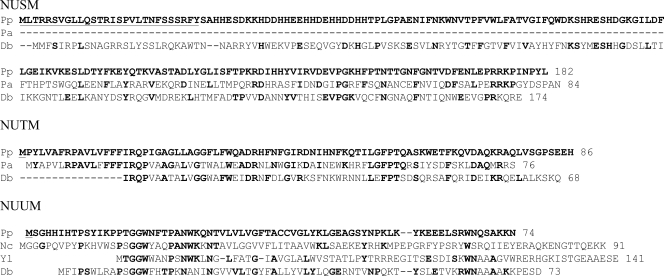
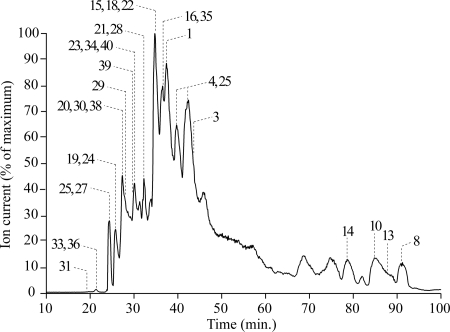
Respiratory complex I (NADH:quinone oxidoreductase) is an entry point to the electron transport chain in the mitochondria of many eukaryotes. It is a large, multisubunit enzyme with a hydrophilic domain in the matrix and a hydrophobic domain in the mitochondrial inner membrane. Here we present a comprehensive analysis of the protein composition and post-translational modifications of complex I from Pichia pastoris, using a combination of proteomic and bioinformatic approaches. Forty-one subunits were identified in P. pastoris complex I, comprising the 14 core (conserved) subunits and 27 supernumerary subunits; seven of the core subunits are mitochondrial encoded. Three of the supernumerary subunits (named NUSM, NUTM, and NUUM) have not been observed previously in any species of complex I. However, homologues to all three of them are present in either Yarrowia lipolytica or Pichia angusta complex I. P. pastoris complex I has 39 subunits in common with Y. lipolytica complex I, 37 in common with N. crassa complex I, and 35 in common with the bovine enzyme. The mitochondrial encoded subunits (translated by the mold mitochondrial genetic code) retain their N-α-formyl methionine residues. At least eight subunits are N-α-acetylated, but the N-terminal modifications of the nuclear encoded subunits are not well-conserved. A combination of two methods of protein separation (SDS-PAGE and HPLC) and three different mass spectrometry techniques (peptide mass fingerprinting, tandem MS and molecular mass measurements) were required to define the protein complement of P. pastoris complex I. This requirement highlights the need for inclusive and comprehensive strategies for the characterization of challenging membrane-bound protein complexes containing both hydrophilic and hydrophobic components.
呼吸复合物 I(NADH:醌氧化还原酶)是许多真核生物线粒体电子传递链的入口点。它是一种大型的多亚基酶,具有基质中的亲水结构域和线粒体内膜中的疏水结构域。在这里,我们使用蛋白质组学和生物信息学方法的组合,对毕赤酵母复合物 I 的蛋白质组成和翻译后修饰进行了全面分析。在毕赤酵母复合物 I 中鉴定出 41 个亚基,包括 14 个核心(保守)亚基和 27 个超数亚基;其中 7 个核心亚基是线粒体编码的。三个超数亚基(命名为 NUSM、NUTM 和 NUUM)以前在任何一种复合物 I 中都没有观察到。然而,它们的同源物在 Yarrowia lipolytica 或 Pichia angusta 复合物 I 中都存在。毕赤酵母复合物 I 与 Y. lipolytica 复合物 I 有 39 个亚基相同,与 N. crassa 复合物 I 有 37 个亚基相同,与牛酶有 35 个亚基相同。线粒体编码的亚基(由真菌线粒体遗传密码翻译)保留其 N-α-甲酰甲硫氨酸残基。至少有 8 个亚基被 N-α-乙酰化,但核编码亚基的 N 端修饰并不完全保守。两种蛋白质分离方法(SDS-PAGE 和 HPLC)和三种不同的质谱技术(肽质量指纹图谱、串联 MS 和分子量测量)的组合用于定义毕赤酵母复合物 I 的蛋白质组成。这种需求突出了需要采用包容性和全面的策略来表征包含亲水和疏水成分的具有挑战性的膜结合蛋白复合物。