State Key Laboratory of Resources and Environmental Information System, Institute of Geographic Sciences and Natural Resources Research, Chinese Academy of Sciences, Beijing, China.
PLoS One. 2011;6(8):e23428. doi: 10.1371/journal.pone.0023428. Epub 2011 Aug 23.
Population health attributes (such as disease incidence and prevalence) are often estimated using sentinel hospital records, which are subject to multiple sources of uncertainty. When applied to these health attributes, commonly used biased estimation techniques can lead to false conclusions and ineffective disease intervention and control. Although some estimators can account for measurement error (in the form of white noise, usually after de-trending), most mainstream health statistics techniques cannot generate unbiased and minimum error variance estimates when the available data are biased.
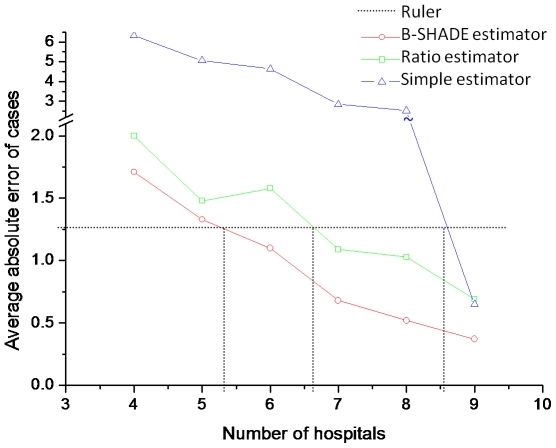
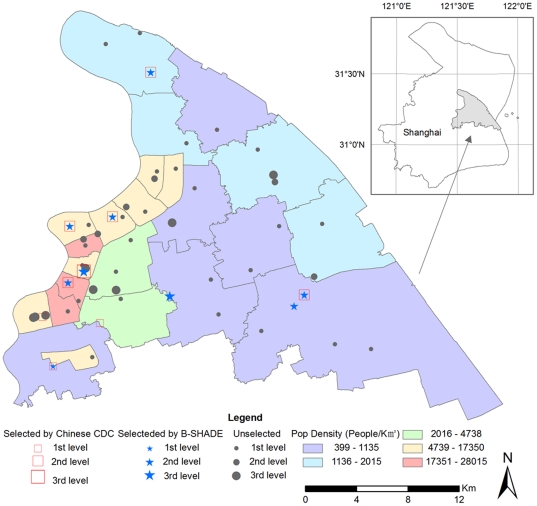
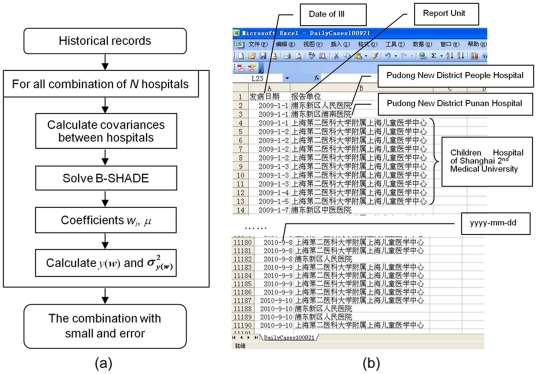
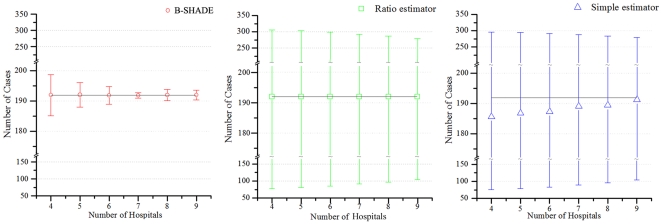
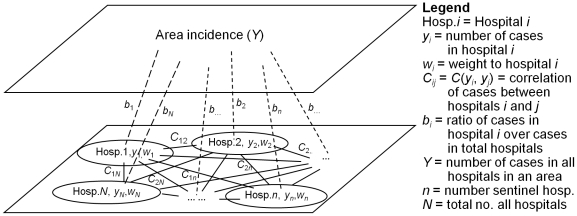
A new technique, called the Biased Sample Hospital-based Area Disease Estimation (B-SHADE), is introduced that generates space-time population disease estimates using biased hospital records. The effectiveness of the technique is empirically evaluated in terms of hospital records of disease incidence (for hand-foot-mouth disease and fever syndrome cases) in Shanghai (China) during a two-year period. The B-SHADE technique uses a weighted summation of sentinel hospital records to derive unbiased and minimum error variance estimates of area incidence. The calculation of these weights is the outcome of a process that combines: the available space-time information; a rigorous assessment of both, the horizontal relationships between hospital records and the vertical links between each hospital's records and the overall disease situation in the region. In this way, the representativeness of the sentinel hospital records was improved, the possible biases of these records were corrected, and the generated area incidence estimates were best linear unbiased estimates (BLUE). Using the same hospital records, the performance of the B-SHADE technique was compared against two mainstream estimators.
The B-SHADE technique involves a hospital network-based model that blends the optimal estimation features of the Block Kriging method and the sample bias correction efficiency of the ratio estimator method. In this way, B-SHADE can overcome the limitations of both methods: Block Kriging's inadequacy concerning the correction of sample bias and spatial clustering; and the ratio estimator's limitation as regards error minimization. The generality of the B-SHADE technique is further demonstrated by the fact that it reduces to Block Kriging in the case of unbiased samples; to ratio estimator if there is no correlation between hospitals; and to simple statistic if the hospital records are neither biased nor space-time correlated. In addition to the theoretical advantages of the B-SHADE technique over the two other methods above, two real world case studies (hand-foot-mouth disease and fever syndrome cases) demonstrated its empirical superiority, as well.
人口健康指标(如疾病发病率和患病率)通常使用哨点医院记录来估计,而这些记录存在多种来源的不确定性。当将这些健康指标应用于这些记录时,常用的有偏估计技术可能会导致错误的结论和无效的疾病干预和控制。虽然一些估计器可以考虑测量误差(以白噪声的形式,通常在去趋势后),但当可用数据存在偏差时,大多数主流健康统计技术无法生成无偏和最小误差方差估计。
本文介绍了一种新的技术,称为基于偏置样本的医院区域疾病估计(B-SHADE),该技术使用偏置的医院记录生成时空人口疾病估计。该技术的有效性通过上海(中国)两年间疾病发病率(手足口病和发热综合征病例)的医院记录进行了实证评估。B-SHADE 技术使用对哨点医院记录进行加权求和,得出区域发病率的无偏最小误差方差估计。这些权重的计算是一个过程的结果,该过程结合了可用的时空信息,以及对医院记录之间的水平关系和每个医院记录与该区域整体疾病情况之间的垂直联系的严格评估。通过这种方式,提高了哨点医院记录的代表性,纠正了这些记录的可能偏差,并生成了最佳线性无偏估计量(BLUE)的区域发病率估计值。使用相同的医院记录,将 B-SHADE 技术的性能与两种主流估计器进行了比较。
B-SHADE 技术涉及一种基于医院网络的模型,该模型融合了块克里金法的最优估计特征和比率估计法的样本偏差校正效率。通过这种方式,B-SHADE 可以克服这两种方法的局限性:块克里金法无法校正样本偏差和空间聚类的问题;以及比率估计法无法最小化误差的问题。B-SHADE 技术的通用性进一步证明了这一点,即在无偏样本的情况下,它简化为块克里金法;在医院之间没有相关性的情况下,简化为比率估计法;在医院记录既没有偏差也没有时空相关性的情况下,简化为简单统计量。除了 B-SHADE 技术在上述两种方法上的理论优势外,两个实际案例研究(手足口病和发热综合征病例)也证明了它的经验优势。