Musculoskeletal and Quantitative Imaging Research, Department of Radiology and Biomedical Imaging, University of California San Francisco, 185 Berry Street, Suite 350, San Francisco, CA 94107, USA.
Skeletal Radiol. 2012 Jun;41(6):633-41. doi: 10.1007/s00256-011-1259-3. Epub 2011 Sep 2.
To study the effect of BMI on the prevalence, severity, and 36-month progression of early degenerative changes in the knee by using 3T MRI in middle-aged subjects without radiographic osteoarthritis (OA).
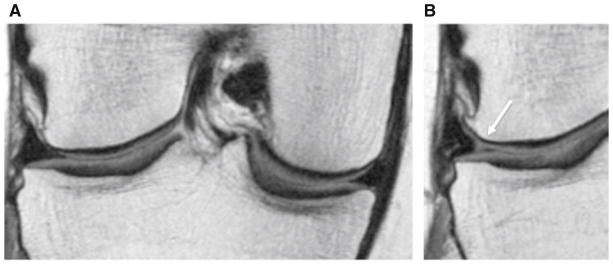
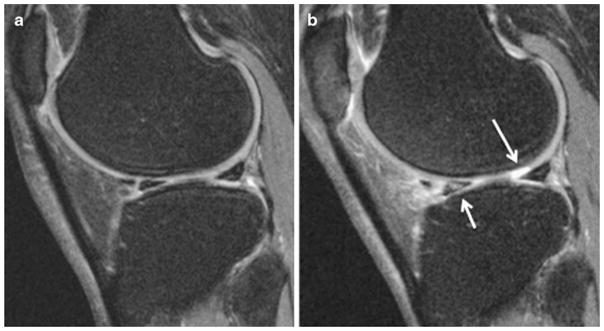
We examined baseline and 36-month follow-up MR studies from 137 middle-aged individuals (45-55 years old) with risk factors for knee OA but no radiographic OA from the Osteoarthritis Initiative. Subjects were grouped into three categories: normal BMI (BMI < 25 kg/m(2), n = 38), overweight (BMI 25-29.9 kg/m(2), n = 37), and obese (BMI ≥ 30 kg/m(2), n = 62). Using 3T MRI, cartilage, meniscus, and bone marrow abnormalities were graded using the OA Whole-organ MR Imaging Score (WORMS). The statistical analysis was corrected as necessary for differences in age, sex, and OA risk factors other than BMI.
The overall prevalence of lesions was 64% for meniscus and 79% for cartilage (including low grade lesions). At baseline, the prevalence and severity of knee lesions was positively associated with BMI, with a nearly fourfold increase in meniscal tears and more than twofold increase in high-grade cartilage defects in obese individuals relative to normal-weight subjects. Over the 36-month follow-up period, the number of new or worsening cartilage lesions of any grade was significantly higher in obese subjects (p = 0.039), while there was no significant difference in meniscal lesion progression.
Obesity was associated with both higher prevalence and severity of early degenerative changes in the knee in middle-aged individuals without radiographic OA and with significantly increased cartilage lesion progression (of any grade) over 36 months.
通过使用 3T MRI 检查无放射学骨关节炎(OA)的中年受试者,研究 BMI 对膝关节早期退行性改变的患病率、严重程度和 36 个月进展的影响。
我们检查了来自 Osteoarthritis Initiative 的 137 名中年个体(45-55 岁)的基线和 36 个月随访的 MRI 研究,这些个体具有膝关节 OA 的危险因素但没有放射学 OA。受试者分为三组:正常 BMI(BMI<25kg/m2,n=38)、超重(BMI 25-29.9kg/m2,n=37)和肥胖(BMI≥30kg/m2,n=62)。使用 3T MRI,使用 OA 全器官 MRI 评分(WORMS)对软骨、半月板和骨髓异常进行分级。统计分析根据年龄、性别和 BMI 以外的 OA 危险因素的差异进行了必要的校正。
半月板病变的总体患病率为 64%,软骨病变的患病率为 79%(包括低级别病变)。在基线时,膝关节病变的患病率和严重程度与 BMI 呈正相关,肥胖个体的半月板撕裂和高级别软骨缺损的发生率分别是正常体重个体的近四倍和两倍以上。在 36 个月的随访期间,肥胖个体任何等级的新的或恶化的软骨病变数量明显更高(p=0.039),而半月板病变进展没有显著差异。
肥胖与中年无放射学 OA 个体膝关节早期退行性改变的高患病率和严重程度有关,并且在 36 个月内软骨病变进展(任何等级)显著增加。