University California San Francisco, San Francisco, CA, USA.
Breast Cancer Res Treat. 2011 Dec;130(3):725-34. doi: 10.1007/s10549-011-1748-z. Epub 2011 Sep 4.
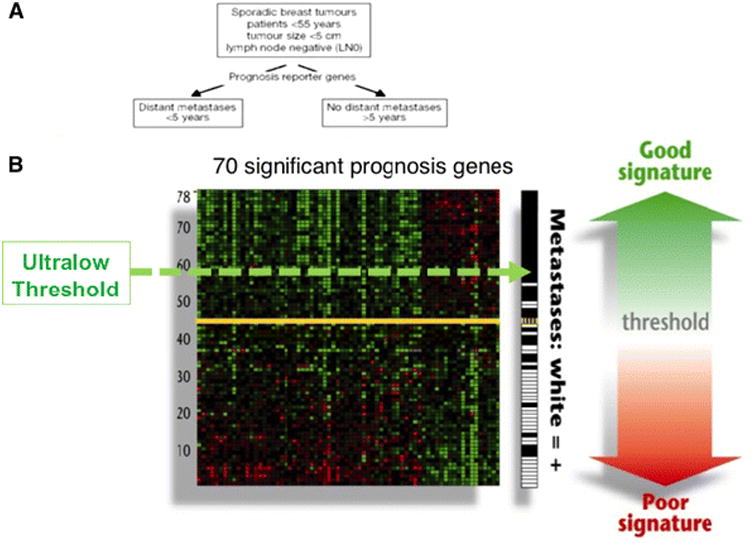
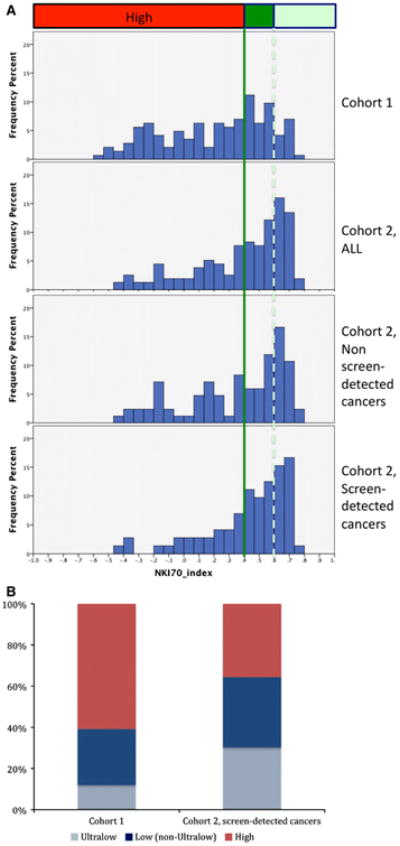
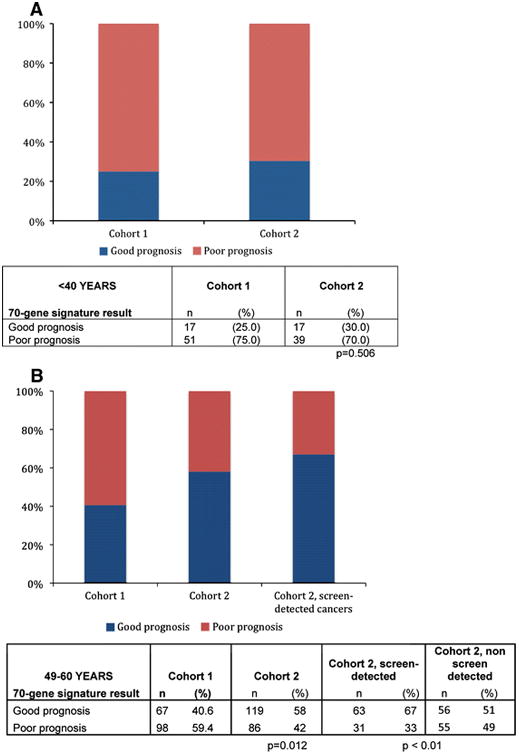
We sought to compare the molecular signature of node negative cancers from two cohorts 15 years apart, to determine if there is molecular evidence of increase in low and ultralow risk cancers over time. We studied the impact of age, time period of diagnosis, and mammographic screening on biology of tumors where The Netherlands Cancer Institute 70-gene prognosis signature was generated as part of 2 validation series, one retrospective (1984-1992), Cohort 1, and one prospective (2004-2006), Cohort 2. A total of 866 patients were analyzed. Regardless of time period of diagnosis, the proportion of T1, grade 1, hormone receptor positive (HR) tumors, and good prognosis by 70-gene signature significantly increases as age increases (P < 0.01). In women aged 49-60, the time period of diagnosis significantly affects the proportion of cancers that were NKI 70-gene low risk: 40.6% (67/165) compared with 58% (119/205) for Cohorts 1 and 2, respectively. This is in contrast to the absence of a significant change for women under age 40, where 25% (17/68) and 30% (17/56) were low risk in Cohorts 1 and 2, respectively. In women aged 49-60, using an ultralow risk threshold of the 70-gene signature, 10% of tumors in Cohort 1 were ultralow risk compared with 30% for women with screen-detected cancers in Cohort 2. Older age and method of detection (screening) are associated with a higher likelihood of a biologically low risk tumor. In women over age 50, biologically low risk tumors are frequent and tools that classify risk may minimize overtreatment.
我们试图比较两个队列中 15 年间隔的阴性淋巴结癌症的分子特征,以确定随着时间的推移是否有低危和超低危癌症的分子证据增加。我们研究了年龄、诊断时间段和乳房 X 线筛查对肿瘤生物学的影响,荷兰癌症研究所的 70 基因预后签名是作为两个验证系列的一部分生成的,一个是回顾性的(1984-1992),队列 1,另一个是前瞻性的(2004-2006),队列 2。共分析了 866 例患者。无论诊断时间段如何,随着年龄的增加,T1、1 级、激素受体阳性(HR)肿瘤的比例以及 70 基因签名的良好预后显著增加(P < 0.01)。在 49-60 岁的女性中,诊断时间段显著影响 NKI 70 基因低风险癌症的比例:队列 1 为 40.6%(67/165),队列 2 为 58%(119/205)。相比之下,40 岁以下的女性没有显著变化,队列 1 和队列 2 中分别有 25%(17/68)和 30%(17/56)为低风险。在 49-60 岁的女性中,使用 70 基因签名的超低风险阈值,队列 1 中有 10%的肿瘤为超低风险,而队列 2 中筛查发现的癌症中有 30%为超低风险。年龄较大和检测方法(筛查)与生物学低风险肿瘤的可能性增加相关。在 50 岁以上的女性中,生物学上的低危肿瘤很常见,并且分类风险的工具可能会最大限度地减少过度治疗。