School of Biosciences, Cardiff University, Cardiff, United Kingdom.
PLoS One. 2011;6(8):e22634. doi: 10.1371/journal.pone.0022634. Epub 2011 Aug 29.
Infection incidence increases with the average number of contacts between susceptible and infected individuals. Contact rates are normally assumed to increase linearly with host density. However, social species seek out each other at low density and saturate their contact rates at high densities. Although predicting epidemic behaviour requires knowing how contact rates scale with host density, few empirical studies have investigated the effect of host density. Also, most theory assumes each host has an equal probability of transmitting parasites, even though individual parasite load and infection duration can vary. To our knowledge, the relative importance of characteristics of the primary infected host vs. the susceptible population has never been tested experimentally.
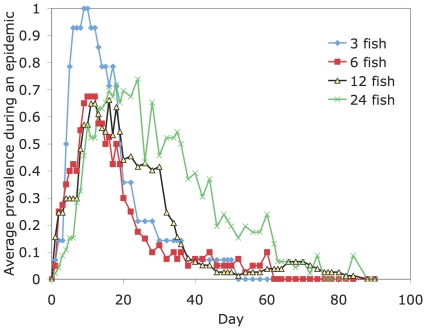
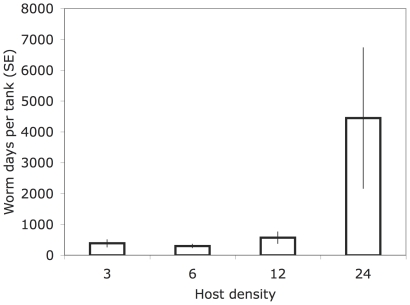
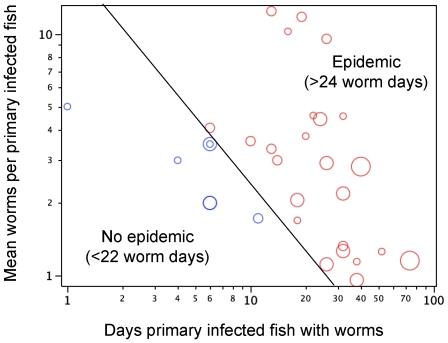
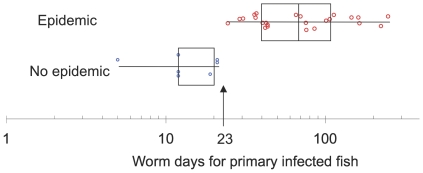
METHODOLOGY/PRINCIPAL FINDINGS: Here, we examine epidemics using a common ectoparasite, Gyrodactylus turnbulli infecting its guppy host (Poecilia reticulata). Hosts were maintained at different densities (3, 6, 12 and 24 fish in 40 L aquaria), and we monitored gyrodactylids both at a population and individual host level. Although parasite population size increased with host density, the probability of an epidemic did not. Epidemics were more likely when the primary infected fish had a high mean intensity and duration of infection. Epidemics only occurred if the primary infected host experienced more than 23 worm days. Female guppies contracted infections sooner than males, probably because females have a higher propensity for shoaling.
CONCLUSIONS/SIGNIFICANCE: These findings suggest that in social hosts like guppies, the frequency of social contact largely governs disease epidemics independent of host density.
感染发生率随易感个体与感染个体之间的平均接触次数增加而增加。接触率通常被认为随宿主密度线性增加。然而,社会性物种在低密度时会互相寻找,而在高密度时则会饱和其接触率。尽管预测疫情行为需要知道接触率如何随宿主密度而变化,但很少有实证研究调查宿主密度的影响。此外,大多数理论假设每个宿主传播寄生虫的概率相等,即使个体寄生虫负荷和感染持续时间可能有所不同。据我们所知,主要感染宿主与易感人群的特征的相对重要性从未在实验中得到检验。
方法/主要发现:在这里,我们使用一种常见的外寄生虫——Gyrodactylus turnbulli 感染其孔雀鱼宿主(Poecilia reticulata)来检查疫情。宿主维持在不同的密度(3、6、12 和 24 条鱼在 40 升水族箱中),我们在种群和个体宿主水平上监测 Gyrodactylus 。尽管寄生虫种群规模随宿主密度增加,但疫情发生的概率并没有增加。当主要感染鱼的平均感染强度和持续时间较高时,疫情更有可能发生。只有当主要感染宿主经历超过 23 个虫日时,才会发生疫情。雌孔雀鱼比雄孔雀鱼更容易感染,可能是因为雌鱼更倾向于群集。
结论/意义:这些发现表明,在像孔雀鱼这样的社会性宿主中,社交接触的频率在很大程度上独立于宿主密度而决定疾病的爆发。