Arizona State University, Tempe, AZ, USA.
J Neuroeng Rehabil. 2011 Sep 8;8:54. doi: 10.1186/1743-0003-8-54.
Few existing interactive rehabilitation systems can effectively communicate multiple aspects of movement performance simultaneously, in a manner that appropriately adapts across various training scenarios. In order to address the need for such systems within stroke rehabilitation training, a unified approach for designing interactive systems for upper limb rehabilitation of stroke survivors has been developed and applied for the implementation of an Adaptive Mixed Reality Rehabilitation (AMRR) System.
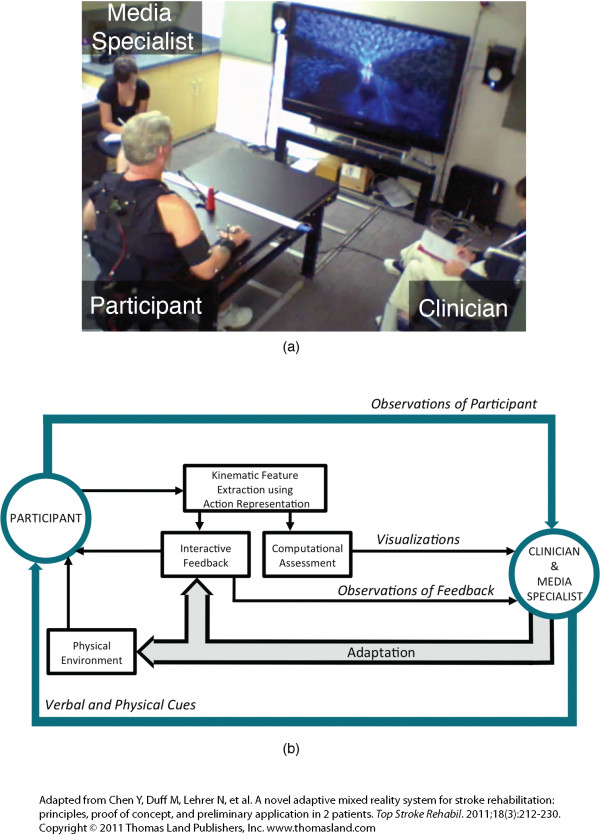
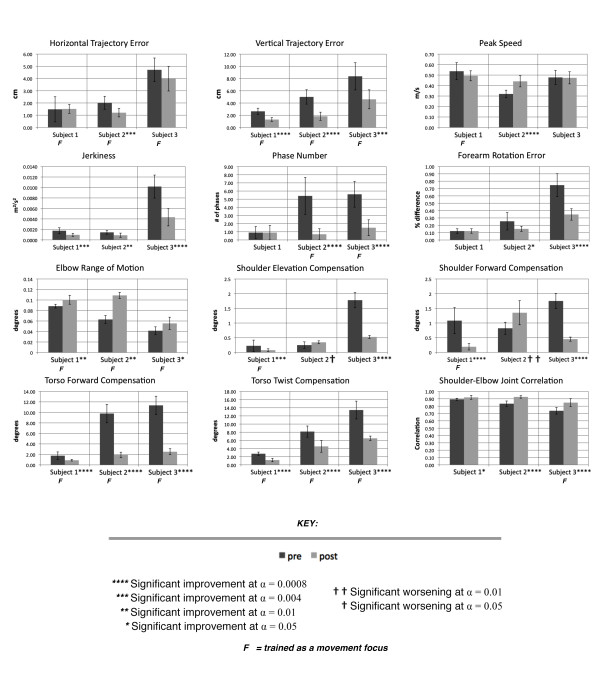
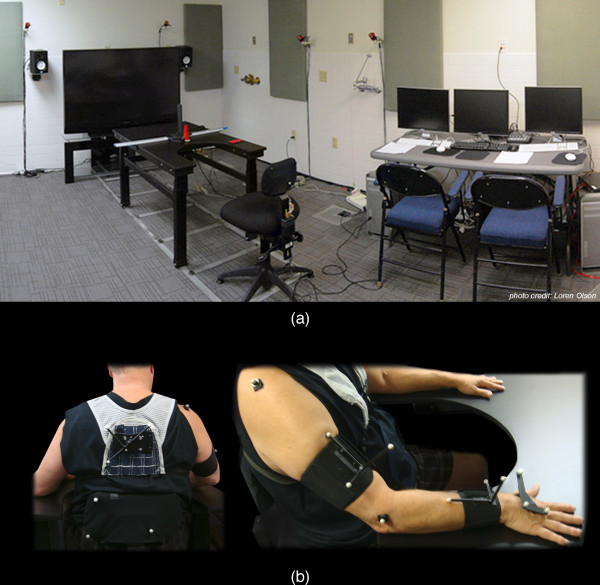
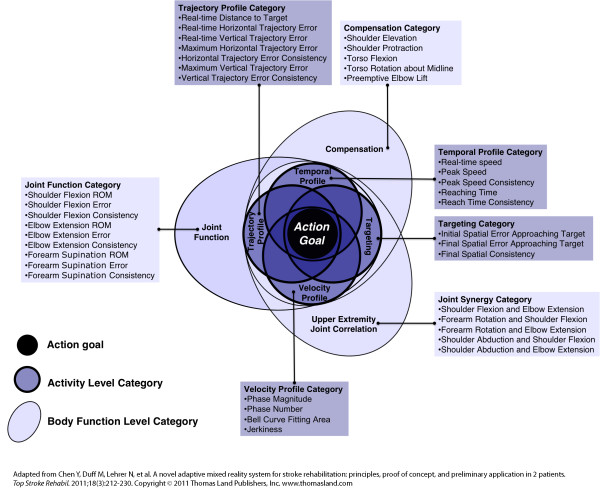
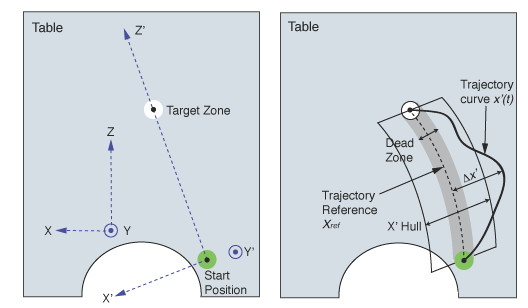
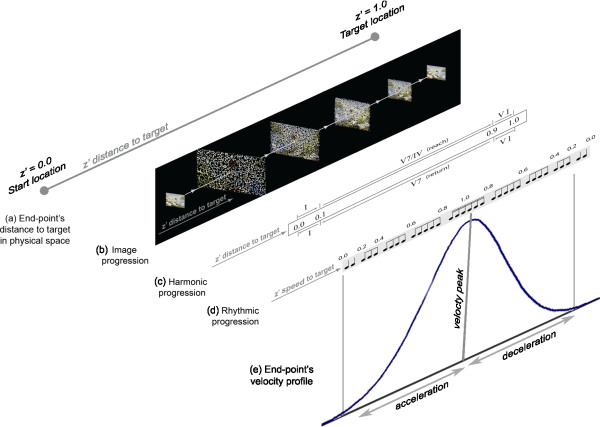
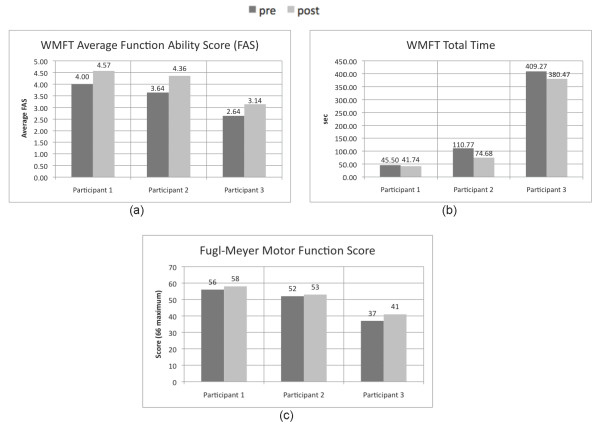
The AMRR system provides computational evaluation and multimedia feedback for the upper limb rehabilitation of stroke survivors. A participant's movements are tracked by motion capture technology and evaluated by computational means. The resulting data are used to generate interactive media-based feedback that communicates to the participant detailed, intuitive evaluations of his performance. This article describes how the AMRR system's interactive feedback is designed to address specific movement challenges faced by stroke survivors. Multimedia examples are provided to illustrate each feedback component. Supportive data are provided for three participants of varying impairment levels to demonstrate the system's ability to train both targeted and integrated aspects of movement.
The AMRR system supports training of multiple movement aspects together or in isolation, within adaptable sequences, through cohesive feedback that is based on formalized compositional design principles. From preliminary analysis of the data, we infer that the system's ability to train multiple foci together or in isolation in adaptable sequences, utilizing appropriately designed feedback, can lead to functional improvement. The evaluation and feedback frameworks established within the AMRR system will be applied to the development of a novel home-based system to provide an engaging yet low-cost extension of training for longer periods of time.
现有的交互式康复系统很少能够有效地同时传达运动表现的多个方面,并且无法在各种训练场景中进行适当的适配。为了满足中风康复训练中对这种系统的需求,我们开发并应用了一种用于中风幸存者上肢康复的统一交互式系统设计方法,用于实现自适应混合现实康复(AMRR)系统。
AMRR 系统为中风幸存者的上肢康复提供了计算评估和多媒体反馈。运动捕捉技术用于跟踪参与者的动作,并通过计算方法进行评估。所得数据用于生成基于交互媒体的反馈,向参与者传达对其表现的详细直观评估。本文介绍了 AMRR 系统的交互式反馈是如何设计的,以解决中风幸存者所面临的特定运动挑战。提供了多媒体示例来说明每个反馈组件。提供了三个不同受损程度的参与者的支持性数据,以证明系统能够训练运动的有针对性和综合方面。
AMRR 系统支持在自适应序列中一起或单独训练多个运动方面,通过基于形式化组合设计原则的连贯反馈来实现。从对数据的初步分析中,我们推断出该系统能够在自适应序列中一起或单独训练多个焦点,利用适当设计的反馈,可以实现功能的改善。将在 AMRR 系统中建立的评估和反馈框架应用于新型家庭系统的开发,以提供更具吸引力且成本更低的长时间训练扩展。