School of Arts, Media and Engineering, Arizona State University, Tempe, AZ, USA.
J Neuroeng Rehabil. 2011 Aug 30;8:51. doi: 10.1186/1743-0003-8-51.
Although principles based in motor learning, rehabilitation, and human-computer interfaces can guide the design of effective interactive systems for rehabilitation, a unified approach that connects these key principles into an integrated design, and can form a methodology that can be generalized to interactive stroke rehabilitation, is presently unavailable.
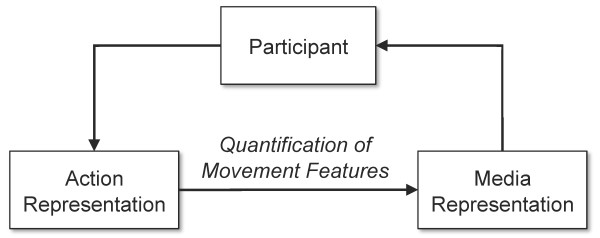
This paper integrates phenomenological approaches to interaction and embodied knowledge with rehabilitation practices and theories to achieve the basis for a methodology that can support effective adaptive, interactive rehabilitation. Our resulting methodology provides guidelines for the development of an action representation, quantification of action, and the design of interactive feedback. As Part I of a two-part series, this paper presents key principles of the unified approach. Part II then describes the application of this approach within the implementation of the Adaptive Mixed Reality Rehabilitation (AMRR) system for stroke rehabilitation.
The accompanying principles for composing novel mixed reality environments for stroke rehabilitation can advance the design and implementation of effective mixed reality systems for the clinical setting, and ultimately be adapted for home-based application. They furthermore can be applied to other rehabilitation needs beyond stroke.
尽管基于运动学习、康复和人机交互的原则可以指导康复的有效交互系统的设计,但目前还没有一种将这些关键原则联系起来的统一方法,形成一种可以推广到交互式中风康复的方法。
本文将交互和具身知识的现象学方法与康复实践和理论相结合,为一种能够支持有效自适应交互康复的方法奠定了基础。我们提出的方法为动作表示、动作量化和交互式反馈的设计提供了指导原则。作为两部分系列的第一部分,本文介绍了统一方法的关键原则。第二部分则描述了该方法在中风康复的自适应混合现实康复(AMRR)系统中的应用。
用于中风康复的新型混合现实环境的组合原则可以推进针对临床环境的有效混合现实系统的设计和实施,并最终适应家庭应用。此外,它们还可以应用于中风以外的其他康复需求。