Hamman J H, Demana P H, Olivier E I
School of Pharmacy, Tshwane University of Technology, Private Bag X680, Pretoria, 0001, South Africa.
Drug Target Insights. 2007;2:71-81. Epub 2007 Mar 6.
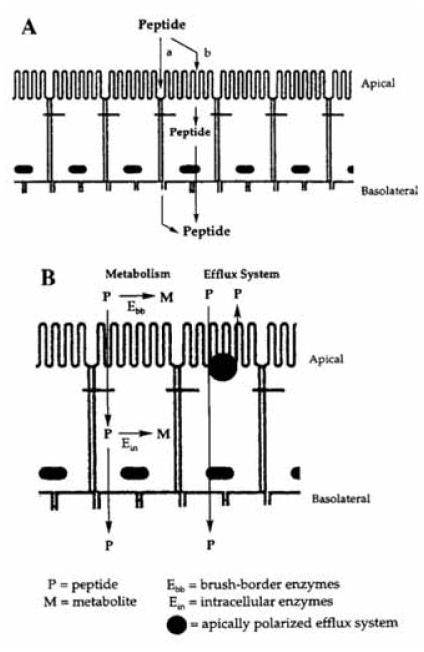
Although the oral route of drug administration is the most acceptable way of self-medication with a high degree of patient compliance, the intestinal absorption of many drugs is severely hampered by different biological barriers. These barriers comprise of biochemical and physical components. The biochemical barrier includes enzymatic degradation in the gastrointestinal lumen, brush border and in the cytoplasm of the epithelial cells as well as efflux transporters that pump drug molecules from inside the epithelial cell back to the gastrointestinal lumen. The physical barrier consists of the epithelial cell membranes, tight junctions and mucus layer. Different strategies have been applied to improve the absorption of drugs after oral administration, which range from chemical modification of drug molecules and formulation technologies to the targeting of receptors, transporters and specialized cells such as the gut-associated lymphoid tissues. This review focuses specifically on the targeting of receptor-mediated endocytosis, transporters and the absorption-site as methods of optimizing intestinal drug absorption. Intestinal epithelial cells express several nutrient transporters that can be targeted by modifying the drug molecule in such a way that it is recognized as a substrate. Receptor-mediated endocytosis is a transport mechanism that can be targeted for instance by linking a receptor substrate to the drug molecule of interest. Many formulation strategies exist for enhancing drug absorption of which one is to deliver drugs at a specific site in the gastrointestinal tract where optimum drug absorption takes place.
尽管口服给药途径是自我给药最易接受的方式,患者依从性高,但许多药物的肠道吸收受到不同生物屏障的严重阻碍。这些屏障由生化和物理成分组成。生化屏障包括胃肠道管腔、刷状缘以及上皮细胞胞质内的酶促降解,还有将药物分子从上皮细胞内泵回胃肠道管腔的外排转运体。物理屏障由上皮细胞膜、紧密连接和黏液层组成。为提高口服给药后药物的吸收,人们采用了不同策略,从药物分子的化学修饰、制剂技术到靶向受体、转运体以及诸如肠道相关淋巴组织等特殊细胞。本综述特别关注靶向受体介导的内吞作用、转运体和吸收部位,将其作为优化肠道药物吸收的方法。肠上皮细胞表达多种营养转运体,通过以某种方式修饰药物分子使其被识别为底物,从而靶向这些转运体。受体介导的内吞作用是一种转运机制,例如通过将受体底物与目标药物分子连接来靶向该机制。存在许多增强药物吸收的制剂策略,其中之一是在胃肠道的特定部位给药,该部位药物吸收最佳。