Department of Medicine, Baylor College of Medicine, Houston, Texas 77030, USA.
J Am Soc Echocardiogr. 2011 Nov;24(11):1276-1284.e5. doi: 10.1016/j.echo.2011.08.002. Epub 2011 Sep 9.
Increased arterial stiffness has been shown to be associated with aging and cardiovascular risk factors. Speckle-tracking algorithms are being used to measure myocardial strain. The aims of this study were to evaluate whether speckle-tracking could be used to measure carotid arterial strain (CAS) reproducibly in healthy volunteers and to determine if CAS was lesser in individuals with diabetes.
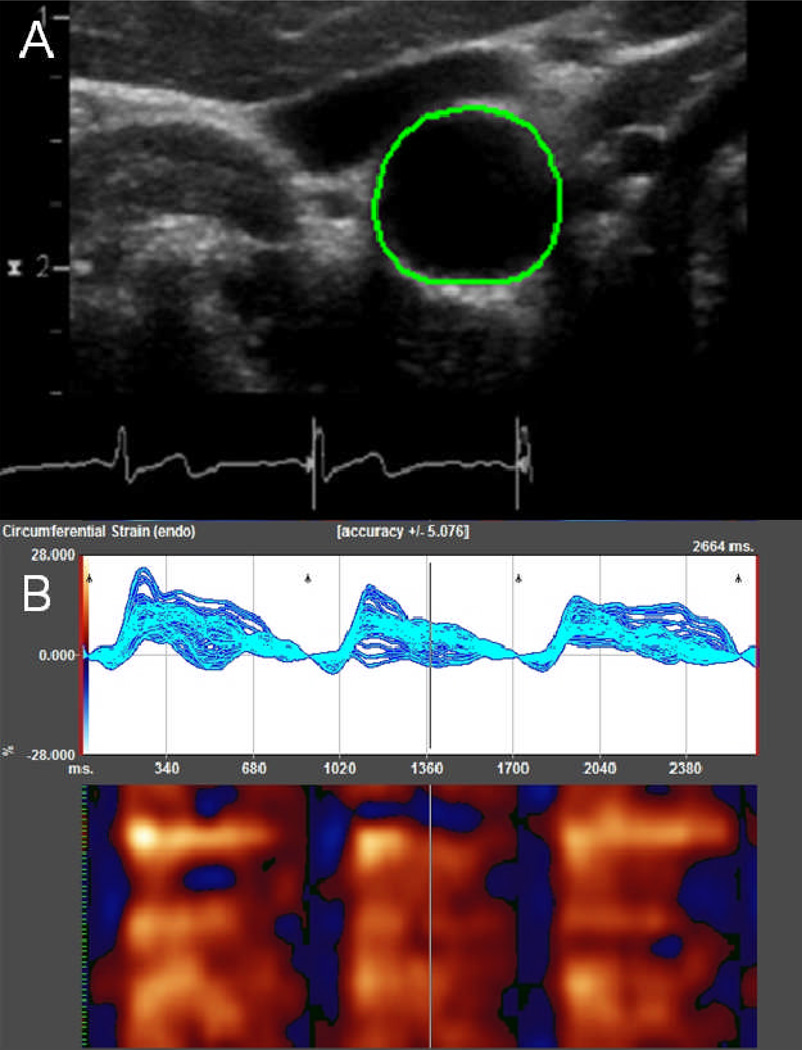
Bilateral electrocardiographically gated ultrasound scans of the distal common carotid arteries (three cardiac cycles; 14-MHz linear probe; mean frame rate, 78.7 ± 8.9 frames/sec) were performed twice (2-4 days apart) on 10 healthy volunteers to test repeatability. Differences in CAS between healthy subjects (n = 20) and patients with diabetes (n = 21) were examined. Peak CAS was measured in each of six equal segments, and averages of all segments (i.e., the global average), of the three segments nearest the probe, and of the three segments farthest from the probe (i.e., the far wall average) were obtained.
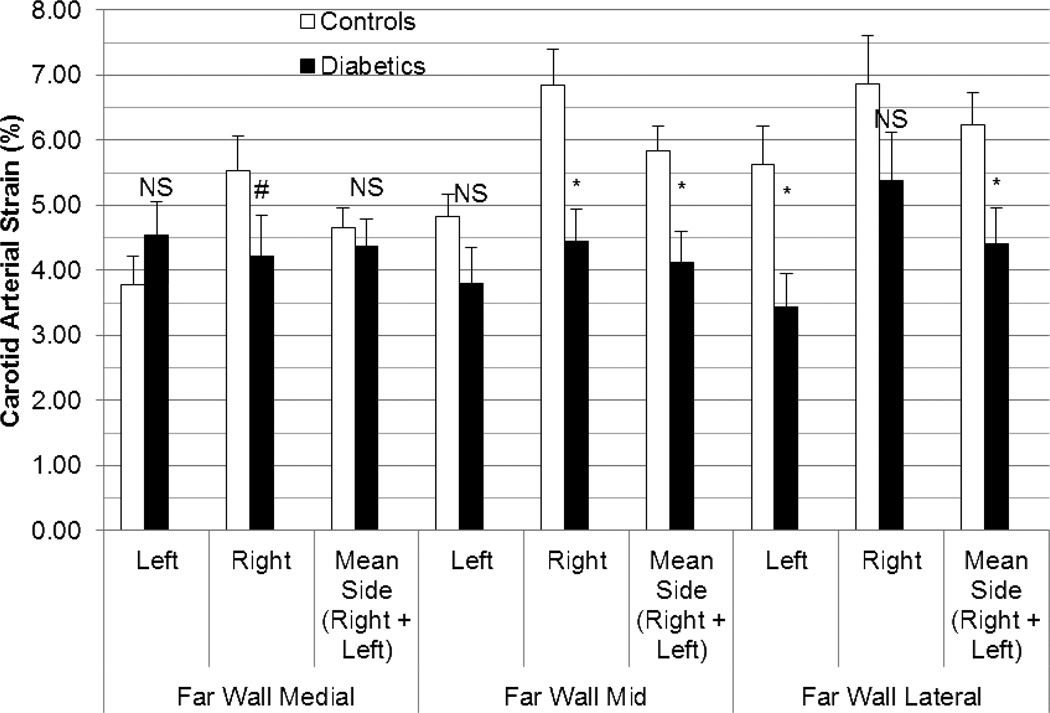
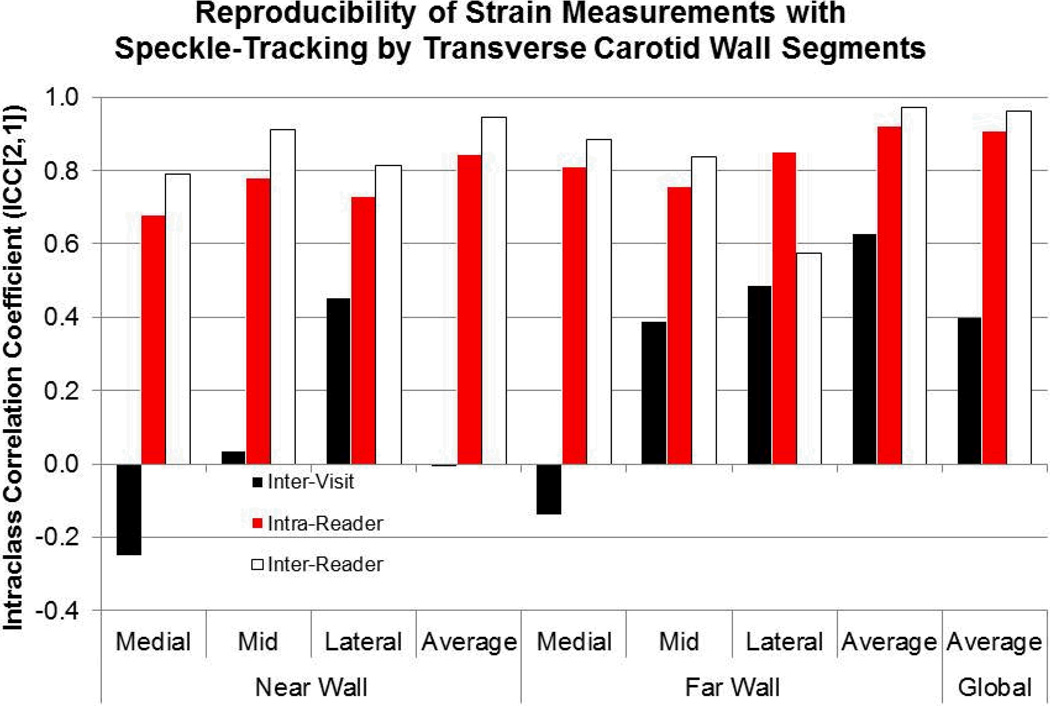
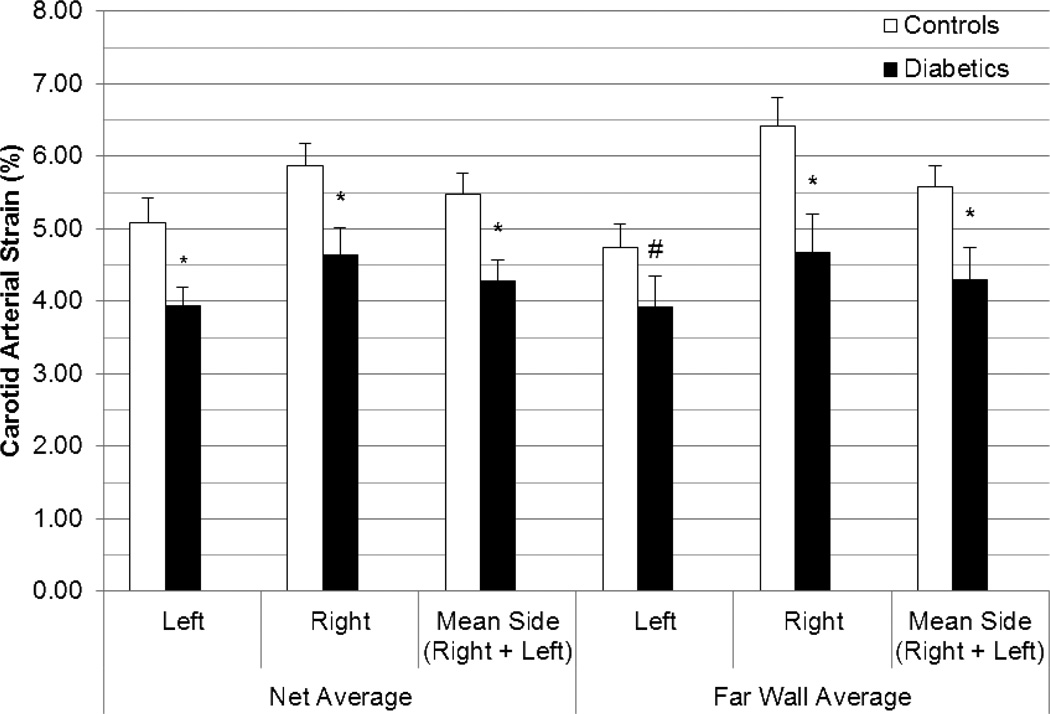
Global CAS (intraclass correlation coefficient = 0.40) and far wall average (intraclass correlation coefficient = 0.63) had the greatest test-retest reliability. Global and far wall averaged CAS values were lower in patients with diabetes (4.29% [SE, 0.27%] and 4.30% [SE, 0.44%], respectively) than in controls (5.48% [SE, 0.29%], P = .001, and 5.58% [SE, 0.44%], P = .003, respectively). This difference persisted after adjustment for age, gender, race, and hemodynamic parameters.
Speckle-tracking to measure CAS is feasible and modestly reliable. Patients with diabetes had lower CAS obtained with speckle-tracking compared with healthy controls.
已有研究表明,动脉僵硬度的增加与衰老和心血管危险因素有关。斑点追踪算法正被用于测量心肌应变。本研究旨在评估斑点追踪技术是否可重复性地用于测量健康志愿者的颈动脉应变(CAS),并确定糖尿病患者的 CAS 是否更小。
对 10 名健康志愿者的双侧颈总动脉(三个心动周期;14MHz 线性探头;平均帧率为 78.7±8.9 帧/秒)进行心电图门控超声扫描,两次(间隔 2-4 天)重复进行,以测试重复性。检查了健康受试者(n=20)和糖尿病患者(n=21)之间的 CAS 差异。测量了每个六个相等节段的 CAS 峰值,并获得了所有节段(即全局平均值)、最接近探头的三个节段和最远离探头的三个节段(即远壁平均值)的平均值。
全局 CAS(组内相关系数=0.40)和远壁平均 CAS(组内相关系数=0.63)具有最大的测试-重测可靠性。糖尿病患者的全局和远壁平均 CAS 值较低(分别为 4.29%[SE,0.27%]和 4.30%[SE,0.44%]),低于对照组(分别为 5.48%[SE,0.29%],P=0.001,和 5.58%[SE,0.44%],P=0.003)。这种差异在调整年龄、性别、种族和血流动力学参数后仍然存在。
使用斑点追踪技术测量 CAS 是可行的,且具有适度的可靠性。与健康对照组相比,糖尿病患者的 CAS 较低。