Department of Medicine, National Jewish Health, Denver, Colorado, United States of America.
PLoS One. 2011;6(9):e23637. doi: 10.1371/journal.pone.0023637. Epub 2011 Sep 1.
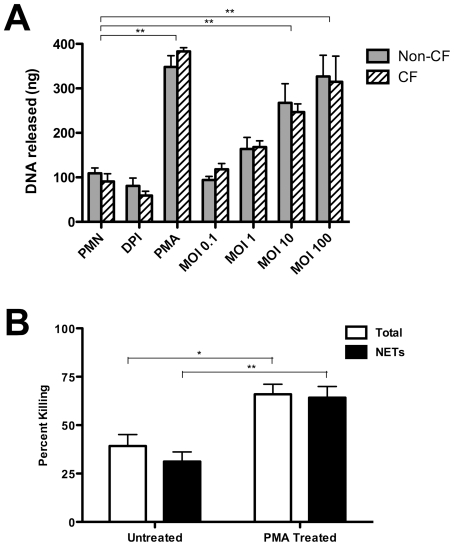
The inability of neutrophils to eradicate Pseudomonas aeruginosa within the cystic fibrosis (CF) airway eventually results in chronic infection by the bacteria in nearly 80 percent of patients. Phagocytic killing of P. aeruginosa by CF neutrophils is impaired due to decreased cystic fibrosis transmembrane conductance regulator (CFTR) function and virulence factors acquired by the bacteria. Recently, neutrophil extracellular traps (NETs), extracellular structures composed of neutrophil chromatin complexed with granule contents, were identified as an alternative mechanism of pathogen killing. The hypothesis that NET-mediated killing of P. aeruginosa is impaired in the context of the CF airway was tested. P. aeruginosa induced NET formation by neutrophils from healthy donors in a bacterial density dependent fashion. When maintained in suspension through continuous rotation, P. aeruginosa became physically associated with NETs. Under these conditions, NETs were the predominant mechanism of killing, across a wide range of bacterial densities. Peripheral blood neutrophils isolated from CF patients demonstrated no impairment in NET formation or function against P. aeruginosa. However, isogenic clinical isolates of P. aeruginosa obtained from CF patients early and later in the course of infection demonstrated an acquired capacity to withstand NET-mediated killing in 8 of 9 isolates tested. This resistance correlated with development of the mucoid phenotype, but was not a direct result of the excess alginate production that is characteristic of mucoidy. Together, these results demonstrate that neutrophils can kill P. aeruginosa via NETs, and in vitro this response is most effective under non-stationary conditions with a low ratio of bacteria to neutrophils. NET-mediated killing is independent of CFTR function or bacterial opsonization. Failure of this response in the context of the CF airway may occur, in part, due to an acquired resistance against NET-mediated killing by CF strains of P. aeruginosa.
中性粒细胞无法在囊性纤维化 (CF) 气道中消灭铜绿假单胞菌,最终导致近 80%的患者发生慢性感染。CF 中性粒细胞吞噬杀伤铜绿假单胞菌的能力受损,原因是囊性纤维化跨膜电导调节因子 (CFTR) 功能下降和细菌获得毒力因子。最近,中性粒细胞胞外陷阱 (NETs) 被鉴定为一种替代的病原体杀伤机制,NETs 是由中性粒细胞染色质与颗粒内容物复合形成的细胞外结构。测试了 CF 气道中 NET 介导的铜绿假单胞菌杀伤受损的假设。铜绿假单胞菌以细菌密度依赖的方式诱导来自健康供体的中性粒细胞形成 NET。当通过连续旋转保持在悬浮状态时,铜绿假单胞菌与 NET 物理上相关联。在这些条件下,NET 是一种广泛的细菌密度范围内的主要杀伤机制。从 CF 患者中分离的外周血中性粒细胞对铜绿假单胞菌的 NET 形成或功能没有受损。然而,从 CF 患者早期和后期感染获得的 9 个临床分离株中的 8 个分离株,对 NET 介导的杀伤具有获得性抗性。这种抗性与粘液表型的发展相关,但不是粘液特征的过量藻酸盐产生的直接结果。总之,这些结果表明,中性粒细胞可以通过 NET 杀死铜绿假单胞菌,在体外,这种反应在非静止条件下效果最佳,细菌与中性粒细胞的比例较低。NET 介导的杀伤独立于 CFTR 功能或细菌调理。在 CF 气道的背景下,这种反应的失败可能部分归因于 CF 型铜绿假单胞菌对 NET 介导的杀伤的获得性抗性。