• 文献检索
  • 文档翻译
  • 深度研究
  • 学术资讯
  • Suppr Zotero 插件Zotero 插件
  • 邀请有礼
  • 套餐&价格
  • 历史记录
应用&插件
Suppr Zotero 插件Zotero 插件浏览器插件Mac 客户端Windows 客户端微信小程序
定价
高级版会员购买积分包购买API积分包
服务
文献检索文档翻译深度研究API 文档MCP 服务
关于我们
关于 Suppr公司介绍联系我们用户协议隐私条款
关注我们

Suppr 超能文献

核心技术专利:CN118964589B侵权必究
粤ICP备2023148730 号-1Suppr @ 2026

文献检索

告别复杂PubMed语法,用中文像聊天一样搜索,搜遍4000万医学文献。AI智能推荐,让科研检索更轻松。

立即免费搜索

文件翻译

保留排版,准确专业,支持PDF/Word/PPT等文件格式,支持 12+语言互译。

免费翻译文档

深度研究

AI帮你快速写综述,25分钟生成高质量综述,智能提取关键信息,辅助科研写作。

立即免费体验

硫化钠和硫化氢在机械通气诱导的肺损伤中对肺的保护作用和损伤作用。

Protective and Detrimental Effects of Sodium Sulfide and Hydrogen Sulfide in Murine Ventilator-induced Lung Injury.

机构信息

Anesthesia Center for Critical Care Research, Department of Anesthesia, Critical Care and Pain Medicine, Massachusetts General Hospital and Harvard Medical School, Boston, Massachusetts, USA.

出版信息

Anesthesiology. 2011 Nov;115(5):1012-21. doi: 10.1097/ALN.0b013e31823306cf.

DOI:10.1097/ALN.0b013e31823306cf
PMID:21912243
原文链接:https://pmc.ncbi.nlm.nih.gov/articles/PMC3752661/
Abstract

BACKGROUND

The antiinflammatory effects of hydrogen sulfide (H2S) and sodium sulfide (Na2S) treatment may prevent acute lung injury induced by high tidal volume (HVT) ventilation. However, lung protection may be limited by direct pulmonary toxicity associated with H2S inhalation. Therefore, the authors tested whether the inhalation of H2S or intravascular Na2S treatment can protect against ventilator-induced lung injury in mice.

METHODS

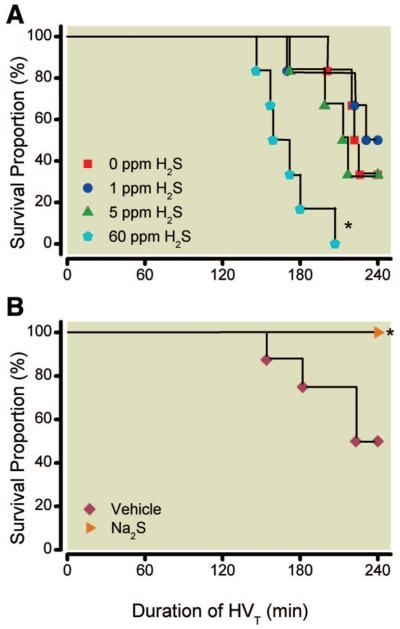
Anesthetized mice continuously inhaled 0, 1, 5, or 60 ppm H2S or received a single bolus infusion of Na2S (0.55 mg/kg) or vehicle and were then subjected to HVT (40 ml/kg) ventilation lasting 4 h (n = 4-8 per group).

RESULTS

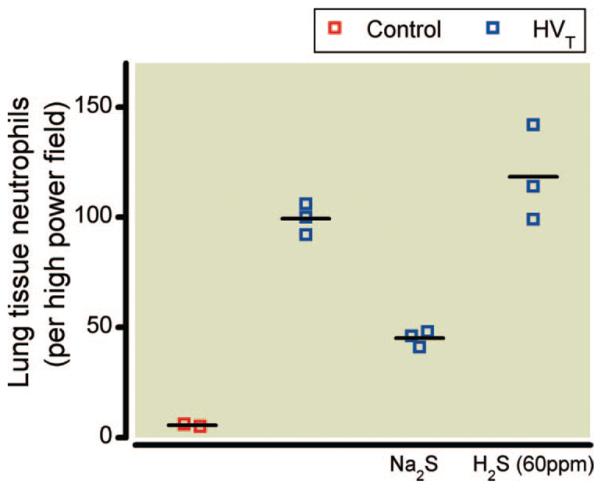
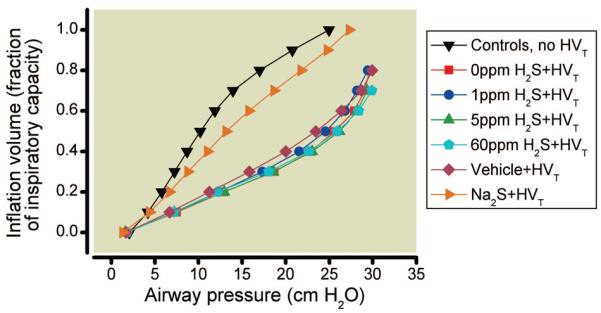
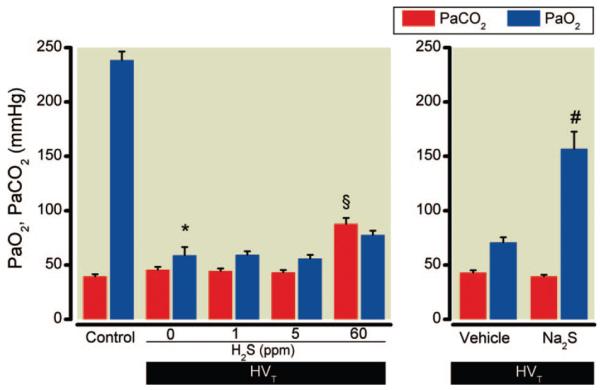
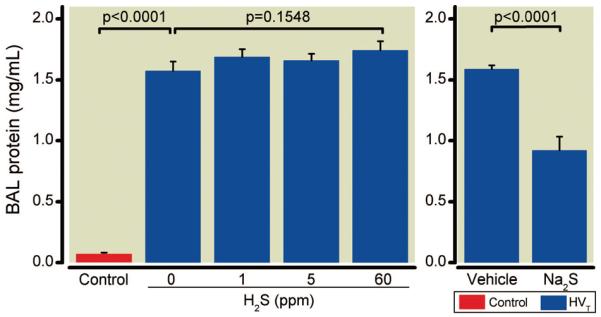
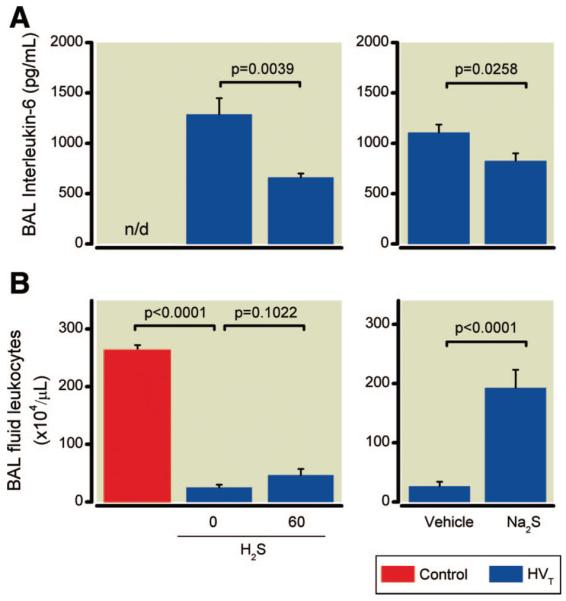
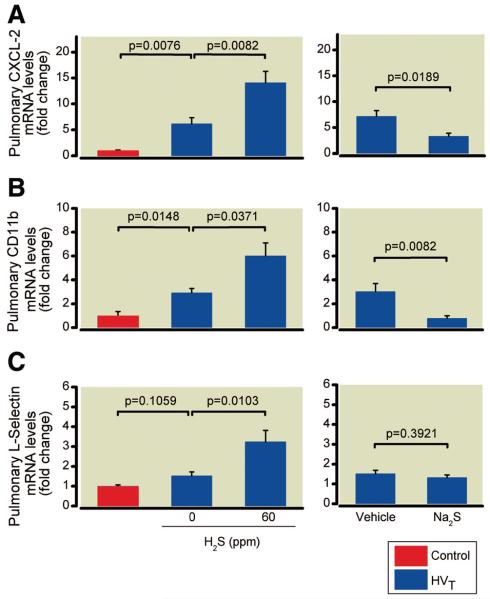
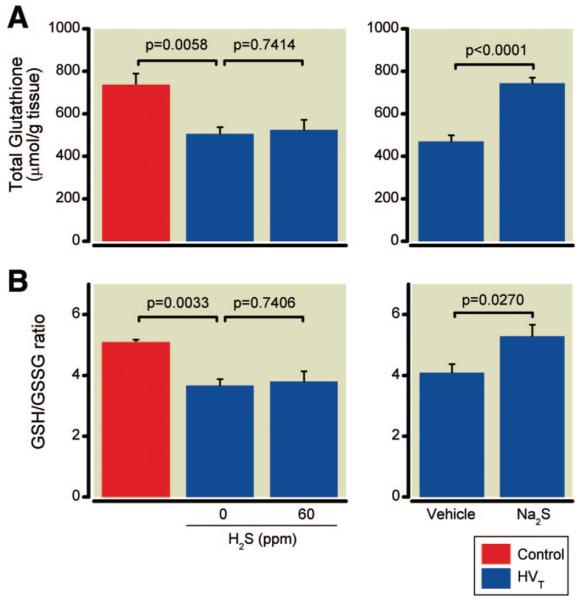
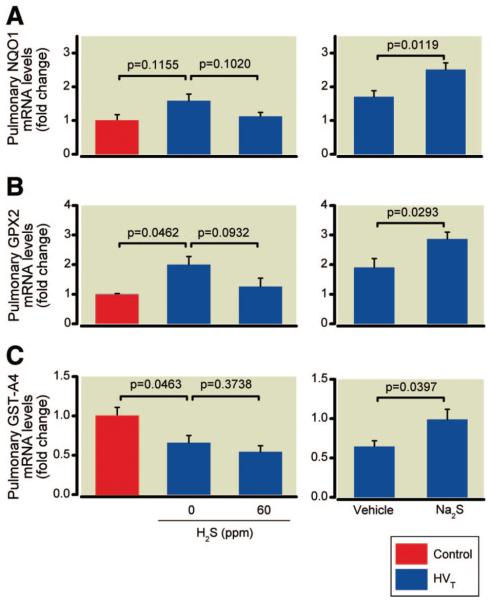
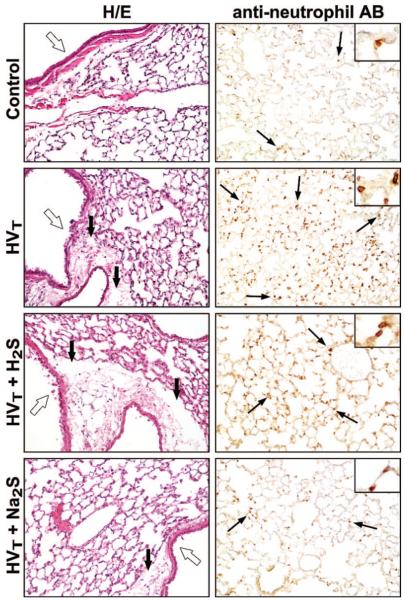
HVT ventilation increased the concentrations of protein and interleukin-6 in bronchoalveolar lavage fluid, contributing to reduced respiratory compliance and impaired arterial oxygenation, and caused death from lung injury and pulmonary edema. Inhalation of 1 or 5 ppm H2S during HVT ventilation did not alter lung injury, but inhalation of 60 ppm H2S accelerated the development of ventilator-induced lung injury and enhanced the pulmonary expression of the chemoattractant CXCL-2 and the leukocyte adhesion molecules CD11b and L-selectin. In contrast, pretreatment with Na2S attenuated the expression of CXCL-2 and CD11b during HVT ventilation and reduced pulmonary edema. Moreover, Na2S enhanced the pulmonary expression of Nrf2-dependent antioxidant genes (NQO1, GPX2, and GST-A4) and prevented oxidative stress-induced depletion of glutathione in lung tissue.

CONCLUSIONS

The data suggest that systemic intravascular treatment with Na2S represents a novel therapeutic strategy to prevent both ventilator-induced lung injury and pulmonary glutathione depletion by activating Nrf2-dependent antioxidant gene transcription.

摘要

背景

硫化氢(H2S)和硫化钠(Na2S)的抗炎作用可能预防大潮气量(HVT)通气引起的急性肺损伤。然而,H2S 吸入相关的直接肺毒性可能会限制肺保护作用。因此,作者测试了 H2S 吸入或血管内 Na2S 治疗是否可以保护小鼠免受呼吸机诱导的肺损伤。

方法

麻醉小鼠连续吸入 0、1、5 或 60 ppm H2S,或单次静脉推注 Na2S(0.55 mg/kg)或载体,然后进行 4 小时的 HVT(40 ml/kg)通气(每组 4-8 只)。

结果

HVT 通气增加了支气管肺泡灌洗液中蛋白质和白细胞介素-6 的浓度,导致呼吸顺应性降低和动脉氧合受损,并导致肺损伤和肺水肿导致的死亡。HVT 通气期间吸入 1 或 5 ppm H2S 不会改变肺损伤,但吸入 60 ppm H2S 加速了呼吸机诱导的肺损伤的发展,并增强了趋化因子 CXCL-2 和白细胞黏附分子 CD11b 和 L-选择素的肺表达。相比之下,Na2S 预处理可减轻 HVT 通气过程中 CXCL-2 和 CD11b 的表达,并减少肺水肿。此外,Na2S 增强了 Nrf2 依赖性抗氧化基因(NQO1、GPX2 和 GST-A4)的肺表达,并防止氧化应激诱导的肺组织谷胱甘肽耗竭。

结论

数据表明,系统血管内给予 Na2S 通过激活 Nrf2 依赖性抗氧化基因转录,代表了一种预防呼吸机诱导的肺损伤和肺组织谷胱甘肽耗竭的新治疗策略。
https://cdn.ncbi.nlm.nih.gov/pmc/blobs/a824/3752661/7bb0fd170d69/nihms-502852-f0010.jpg
https://cdn.ncbi.nlm.nih.gov/pmc/blobs/a824/3752661/5f52ed3e5f39/nihms-502852-f0001.jpg
https://cdn.ncbi.nlm.nih.gov/pmc/blobs/a824/3752661/1f968020465d/nihms-502852-f0002.jpg
https://cdn.ncbi.nlm.nih.gov/pmc/blobs/a824/3752661/314989c273b9/nihms-502852-f0003.jpg
https://cdn.ncbi.nlm.nih.gov/pmc/blobs/a824/3752661/09efab4ecb13/nihms-502852-f0004.jpg
https://cdn.ncbi.nlm.nih.gov/pmc/blobs/a824/3752661/76d69a2e436c/nihms-502852-f0005.jpg
https://cdn.ncbi.nlm.nih.gov/pmc/blobs/a824/3752661/95a793200df2/nihms-502852-f0006.jpg
https://cdn.ncbi.nlm.nih.gov/pmc/blobs/a824/3752661/0926c4d4b927/nihms-502852-f0007.jpg
https://cdn.ncbi.nlm.nih.gov/pmc/blobs/a824/3752661/d0ed3c93fd41/nihms-502852-f0008.jpg
https://cdn.ncbi.nlm.nih.gov/pmc/blobs/a824/3752661/22c755bf7b5c/nihms-502852-f0009.jpg
https://cdn.ncbi.nlm.nih.gov/pmc/blobs/a824/3752661/7bb0fd170d69/nihms-502852-f0010.jpg
https://cdn.ncbi.nlm.nih.gov/pmc/blobs/a824/3752661/5f52ed3e5f39/nihms-502852-f0001.jpg
https://cdn.ncbi.nlm.nih.gov/pmc/blobs/a824/3752661/1f968020465d/nihms-502852-f0002.jpg
https://cdn.ncbi.nlm.nih.gov/pmc/blobs/a824/3752661/314989c273b9/nihms-502852-f0003.jpg
https://cdn.ncbi.nlm.nih.gov/pmc/blobs/a824/3752661/09efab4ecb13/nihms-502852-f0004.jpg
https://cdn.ncbi.nlm.nih.gov/pmc/blobs/a824/3752661/76d69a2e436c/nihms-502852-f0005.jpg
https://cdn.ncbi.nlm.nih.gov/pmc/blobs/a824/3752661/95a793200df2/nihms-502852-f0006.jpg
https://cdn.ncbi.nlm.nih.gov/pmc/blobs/a824/3752661/0926c4d4b927/nihms-502852-f0007.jpg
https://cdn.ncbi.nlm.nih.gov/pmc/blobs/a824/3752661/d0ed3c93fd41/nihms-502852-f0008.jpg
https://cdn.ncbi.nlm.nih.gov/pmc/blobs/a824/3752661/22c755bf7b5c/nihms-502852-f0009.jpg
https://cdn.ncbi.nlm.nih.gov/pmc/blobs/a824/3752661/7bb0fd170d69/nihms-502852-f0010.jpg

相似文献

1
Protective and Detrimental Effects of Sodium Sulfide and Hydrogen Sulfide in Murine Ventilator-induced Lung Injury.硫化钠和硫化氢在机械通气诱导的肺损伤中对肺的保护作用和损伤作用。
Anesthesiology. 2011 Nov;115(5):1012-21. doi: 10.1097/ALN.0b013e31823306cf.
2
-butylhydroquinone augments Nrf2-dependent resilience against oxidative stress and improves survival of ventilator-induced lung injury in mice.丁羟甲苯增强 Nrf2 依赖性对氧化应激的抵抗力,并改善呼吸机诱导的肺损伤小鼠的存活率。
Am J Physiol Lung Cell Mol Physiol. 2021 Jan 1;320(1):L17-L28. doi: 10.1152/ajplung.00131.2020. Epub 2020 Oct 7.
3
Inhaled hydrogen sulfide protects against ventilator-induced lung injury.吸入硫化氢可预防呼吸机相关性肺损伤。
Anesthesiology. 2010 Jul;113(1):104-15. doi: 10.1097/ALN.0b013e3181de7107.
4
Hydrogen Sulfide Prevents Formation of Reactive Oxygen Species through PI3K/Akt Signaling and Limits Ventilator-Induced Lung Injury.硫化氢通过PI3K/Akt信号通路预防活性氧的形成并减轻呼吸机诱导的肺损伤。
Oxid Med Cell Longev. 2017;2017:3715037. doi: 10.1155/2017/3715037. Epub 2017 Jan 31.
5
Cardiopulmonary, histologic, and inflammatory effects of intravenous Na2S after blunt chest trauma-induced lung contusion in mice.钝性胸部创伤致小鼠肺挫伤后静脉注射硫化钠的心肺、组织学及炎症效应
J Trauma. 2011 Dec;71(6):1659-67. doi: 10.1097/TA.0b013e318228842e.
6
Increasing the inspiratory time and I:E ratio during mechanical ventilation aggravates ventilator-induced lung injury in mice.机械通气期间增加吸气时间和吸呼比会加重小鼠呼吸机诱导的肺损伤。
Crit Care. 2015 Jan 28;19(1):23. doi: 10.1186/s13054-015-0759-2.
7
Inhaled Anesthetics Exert Different Protective Properties in a Mouse Model of Ventilator-Induced Lung Injury.吸入麻醉药在呼吸机诱导的肺损伤小鼠模型中发挥不同的保护作用。
Anesth Analg. 2016 Jul;123(1):143-51. doi: 10.1213/ANE.0000000000001296.
8
Genetic targets of hydrogen sulfide in ventilator-induced lung injury--a microarray study.硫化氢在呼吸机诱导性肺损伤中的基因靶点——一项微阵列研究
PLoS One. 2014 Jul 15;9(7):e102401. doi: 10.1371/journal.pone.0102401. eCollection 2014.
9
Inhibition of HMGCoA reductase by simvastatin protects mice from injurious mechanical ventilation.辛伐他汀抑制HMGCoA还原酶可保护小鼠免受机械通气损伤。
Respir Res. 2015 Feb 14;16(1):24. doi: 10.1186/s12931-015-0173-y.
10
Sodium Sulfide Attenuates Ischemic-Induced Heart Failure by Enhancing Proteasomal Function in an Nrf2-Dependent Manner.硫化钠通过以Nrf2依赖的方式增强蛋白酶体功能减轻缺血诱导的心力衰竭。
Circ Heart Fail. 2016 Apr;9(4):e002368. doi: 10.1161/CIRCHEARTFAILURE.115.002368.

引用本文的文献

1
Sodium thiosulfate does not affect energy metabolism or organ (dys)function during resuscitation from murine trauma-and-hemorrhage.在小鼠创伤性出血复苏过程中,硫代硫酸钠不影响能量代谢或器官(功能)障碍。
Intensive Care Med Exp. 2025 Aug 6;13(1):80. doi: 10.1186/s40635-025-00778-0.
2
Sulfide regulation and catabolism in health and disease.健康与疾病中的硫化物调节与分解代谢
Signal Transduct Target Ther. 2025 May 30;10(1):174. doi: 10.1038/s41392-025-02231-w.
3
Slow releasing sulphide donor GYY4137 protects mice against ventilator-induced lung injury.

本文引用的文献

1
Inhaled hydrogen sulfide protects against ventilator-induced lung injury.吸入硫化氢可预防呼吸机相关性肺损伤。
Anesthesiology. 2010 Jul;113(1):104-15. doi: 10.1097/ALN.0b013e3181de7107.
2
Nitric oxide synthase 3 contributes to ventilator-induced lung injury.一氧化氮合酶 3 导致呼吸机相关性肺损伤。
Am J Physiol Lung Cell Mol Physiol. 2010 Aug;299(2):L150-9. doi: 10.1152/ajplung.00341.2009. Epub 2010 May 7.
3
The rise of antioxidant signaling--the evolution and hormetic actions of Nrf2.抗氧化信号的兴起——Nrf2 的进化和适应原作用。
缓释硫化物供体GYY4137可保护小鼠免受呼吸机诱导的肺损伤。
Intensive Care Med Exp. 2025 Apr 22;13(1):45. doi: 10.1186/s40635-025-00753-9.
4
Unveiling the Potential of Sulfur-Containing Gas Signaling Molecules in Acute Lung Injury: A Promising Therapeutic Avenue.揭示含硫气体信号分子在急性肺损伤中的潜力:一条充满希望的治疗途径。
Curr Issues Mol Biol. 2024 Jul 7;46(7):7147-7168. doi: 10.3390/cimb46070426.
5
Hydrogen Sulfide: A Gaseous Mediator and Its Key Role in Programmed Cell Death, Oxidative Stress, Inflammation and Pulmonary Disease.硫化氢:一种气体介质及其在程序性细胞死亡、氧化应激、炎症和肺部疾病中的关键作用。
Antioxidants (Basel). 2022 Oct 31;11(11):2162. doi: 10.3390/antiox11112162.
6
Utility of NO and HS donating platforms in managing COVID-19: Rationale and promise.NO 和 HS 供体平台在管理 COVID-19 中的效用:原理和前景。
Nitric Oxide. 2022 Nov 1;128:72-102. doi: 10.1016/j.niox.2022.08.003. Epub 2022 Aug 24.
7
Induction of severe hypoxemia and low lung recruitability for the evaluation of therapeutic ventilation strategies: a translational model of combined surfactant-depletion and ventilator-induced lung injury.诱导严重低氧血症和低肺可复张性以评估治疗性通气策略:一种联合表面活性剂耗竭和呼吸机诱导性肺损伤的转化模型
Intensive Care Med Exp. 2022 Jul 29;10(1):32. doi: 10.1186/s40635-022-00456-5.
8
Profiling Distinctive Inflammatory and Redox Responses to Hydrogen Sulfide in Stretched and Stimulated Lung Cells.剖析拉伸和刺激的肺细胞中对硫化氢的独特炎症和氧化还原反应
Antioxidants (Basel). 2022 May 19;11(5):1001. doi: 10.3390/antiox11051001.
9
HS in Critical Illness-A New Horizon for Sodium Thiosulfate?危重病中的硫代硫酸钠:新的希望?
Biomolecules. 2022 Apr 4;12(4):543. doi: 10.3390/biom12040543.
10
Hydrogen Sulfide and the Immune System.硫化氢与免疫系统
Adv Exp Med Biol. 2021;1315:99-128. doi: 10.1007/978-981-16-0991-6_5.
Toxicol Appl Pharmacol. 2010 Apr 1;244(1):4-15. doi: 10.1016/j.taap.2010.01.011. Epub 2010 Feb 1.
4
Hydrogen sulfide mediates cardioprotection through Nrf2 signaling.硫化氢通过Nrf2信号通路介导心脏保护作用。
Circ Res. 2009 Aug 14;105(4):365-74. doi: 10.1161/CIRCRESAHA.109.199919. Epub 2009 Jul 16.
5
Applying gases for microcirculatory and cellular oxygenation in sepsis: effects of nitric oxide, carbon monoxide, and hydrogen sulfide.应用气体改善脓毒症中的微循环和细胞氧合:一氧化氮、一氧化碳和硫化氢的作用
Curr Opin Anaesthesiol. 2009 Apr;22(2):168-76. doi: 10.1097/ACO.0b013e328328d22f.
6
Cyclic stretch, reactive oxygen species, and vascular remodeling.循环拉伸、活性氧和血管重构。
Antioxid Redox Signal. 2009 Jul;11(7):1651-67. doi: 10.1089/ars.2008.2390.
7
Hydrogen sulfide attenuates hepatic ischemia-reperfusion injury: role of antioxidant and antiapoptotic signaling.硫化氢减轻肝脏缺血再灌注损伤:抗氧化和抗凋亡信号的作用
Am J Physiol Heart Circ Physiol. 2008 Aug;295(2):H801-6. doi: 10.1152/ajpheart.00377.2008. Epub 2008 Jun 20.
8
Regulatory effects of hydrogen sulfide on IL-6, IL-8 and IL-10 levels in the plasma and pulmonary tissue of rats with acute lung injury.硫化氢对急性肺损伤大鼠血浆及肺组织中白细胞介素-6、白细胞介素-8和白细胞介素-10水平的调节作用
Exp Biol Med (Maywood). 2008 Sep;233(9):1081-7. doi: 10.3181/0712-RM-354. Epub 2008 Jun 5.
9
Protective effect of hydrogen sulfide in a murine model of acute lung injury induced by combined burn and smoke inhalation.硫化氢在烧伤合并烟雾吸入诱导的小鼠急性肺损伤模型中的保护作用
Clin Sci (Lond). 2008 Aug;115(3):91-7. doi: 10.1042/CS20080021.
10
Hydrogen sulphide and its therapeutic potential.硫化氢及其治疗潜力。
Nat Rev Drug Discov. 2007 Nov;6(11):917-35. doi: 10.1038/nrd2425.