Payne John F, Tangpricha Vin, Cleveland Julia, Lynn Michael J, Ray Robin, Srivastava Sunil K
Department of Vitreoretinal Surgery and Disease, Emory University, Atlanta, GA, USA.
Mol Vis. 2011;17:2318-24. Epub 2011 Aug 27.
To assess the relationship between serum insulin-like growth factor I (IGF-I) and diabetic retinopathy.
This was a clinic-based cross-sectional study conducted at the Emory Eye Center. A total of 225 subjects were classified into four groups, based on diabetes status and retinopathy findings: no diabetes mellitus (no DM; n=99), diabetes with no background diabetic retinopathy (no BDR; n=42), nonproliferative diabetic retinopathy (NPDR; n=41), and proliferative diabetic retinopathy (PDR; n=43). Key exclusion criteria included type 1 diabetes and disorders that affect serum IGF-I levels, such as acromegaly. Subjects underwent dilated fundoscopic examination and were tested for hemoglobin A1c, serum creatinine, and serum IGF-I, between December 2009 and March 2010. Serum IGF-I levels were measured using an immunoassay that was calibrated against an international standard.
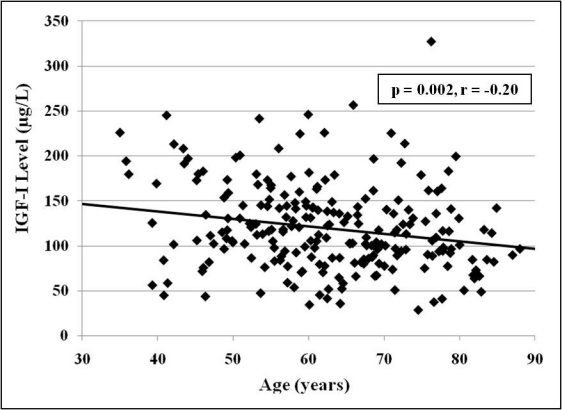
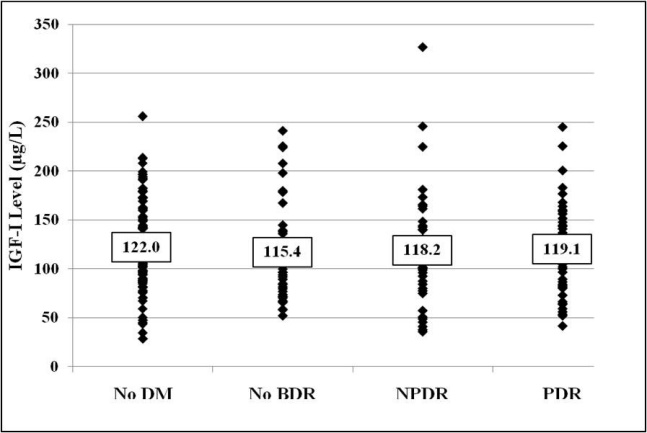
Between the groups, there were no statistical differences with regards to age, race, or sex. Overall, diabetic subjects had similar serum IGF-I concentrations compared to nondiabetic subjects (117.6 µg/l versus 122.0 µg/l; p=0.497). There was no significant difference between serum IGF-I levels among the study groups (no DM=122.0 µg/l, no BDR=115.4 µg/l, NPDR=118.3 µg/l, PDR=119.1 µg/l; p=0.897). Among the diabetic groups, the mean IGF-I concentration was similar between insulin-dependent and non-insulin-dependent subjects (116.8 µg/l versus 118.2 µg/l; p=0.876). The univariate analysis of the IGF-I levels demonstrated statistical significance in regard to age (p=0.002, r=-0.20), body mass index (p=0.008, r=-0.18), and race (p=0.040).
There was no association between serum IGF-I concentrations and diabetic retinopathy in this large cross-sectional study.
评估血清胰岛素样生长因子I(IGF-I)与糖尿病视网膜病变之间的关系。
这是一项在埃默里眼科中心进行的基于诊所的横断面研究。根据糖尿病状态和视网膜病变检查结果,将总共225名受试者分为四组:无糖尿病(无DM;n = 99)、患有糖尿病但无背景性糖尿病视网膜病变(无BDR;n = 42)、非增殖性糖尿病视网膜病变(NPDR;n = 41)和增殖性糖尿病视网膜病变(PDR;n = 43)。主要排除标准包括1型糖尿病以及影响血清IGF-I水平的疾病,如肢端肥大症。在2009年12月至2010年3月期间,受试者接受了散瞳眼底检查,并检测了糖化血红蛋白、血清肌酐和血清IGF-I。血清IGF-I水平采用经国际标准校准的免疫测定法进行测量。
在各组之间,年龄、种族或性别方面无统计学差异。总体而言,糖尿病受试者的血清IGF-I浓度与非糖尿病受试者相似(117.6μg/l对122.0μg/l;p = 0.497)。研究组之间的血清IGF-I水平无显著差异(无DM = 122.0μg/l,无BDR = 115.4μg/l,NPDR = 118.3μg/l,PDR = 119.1μg/l;p = 0.897)。在糖尿病组中,胰岛素依赖型和非胰岛素依赖型受试者的平均IGF-I浓度相似(116.8μg/l对118.2μg/l;p = 0.876)。对IGF-I水平的单因素分析显示,年龄(p = 0.002,r = -0.20)、体重指数(p = 0.008,r = -0.18)和种族(p = 0.040)具有统计学意义。
在这项大型横断面研究中,血清IGF-I浓度与糖尿病视网膜病变之间无关联。