Department of Paediatric Surgery, Medical Faculty of the University of Luebeck, Ratzeburger Allee 160, Luebeck, 23562, Germany.
J Orthop Surg Res. 2011 Sep 18;6:46. doi: 10.1186/1749-799X-6-46.
Elastic Stable intramedullary Nailing (ESIN) of dislocated diaphyseal femur fractures has become an accepted method for the treatment in children and adolescents with open physis. Studies focused on complications of this technique showed problems regarding stability, usually in complex fracture types such as spiral fractures and in older children weighing > 40 kg. Biomechanical in vitro testing was performed to evaluate the stability of simulated spiral femoral fractures after retrograde flexible titanium intramedullary nail fixation with and without End caps.
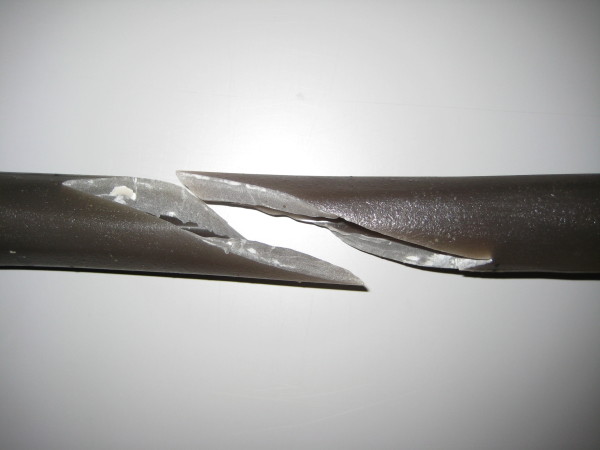
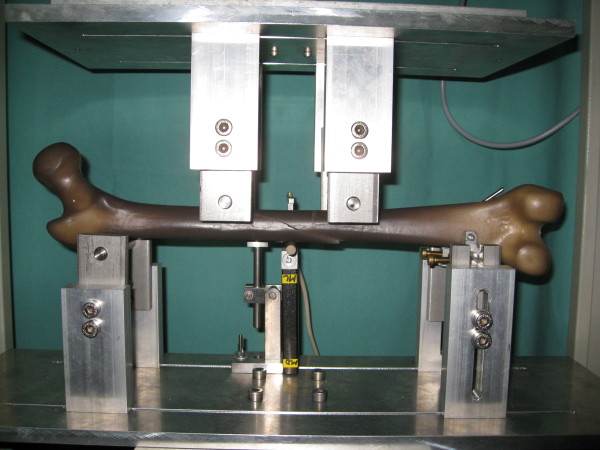
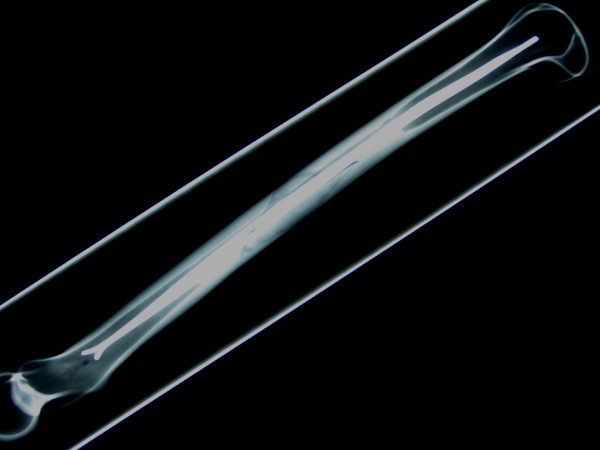
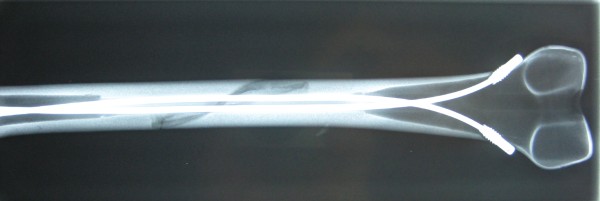
Eight synthetic adolescent-size femoral bone models (Sawbones® with a medullar canal of 10 mm and a spiral fracture of 100 mm length identically sawn by the manufacturer) were used for each group. Both groups underwent retrograde fixation with two 3.5 mm Titanium C-shaped nails inserted from medial and lateral entry portals. In the End Cap group the ends of the nails of the eight specimens were covered with End Caps (Synthes Company, Oberdorf, Switzerland) at the distal entry.
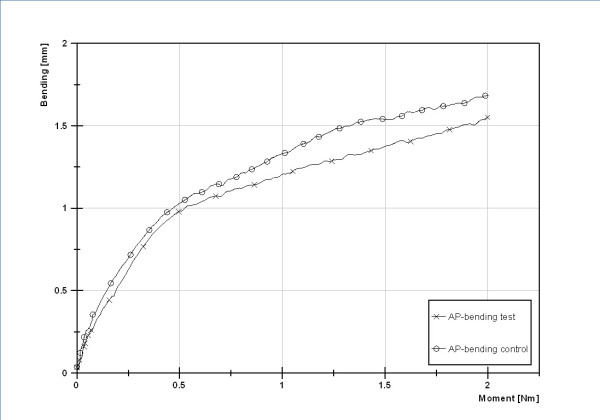
Beside posterior-anterior stress (4.11 Nm/mm vs. 1.78 Nm/mm, p < 0.001), the use of End Caps demonstrated no higher stability in 4-point bending compared to the group without End Caps (anterior-posterior bending 0.27 Nm/mm vs. 0.77 Nm/mm, p < 0.001; medial-lateral bending 0.8 Nm/mm vs. 1.10 Nm/mm, p < 0.01; lateral-medial bending 0.53 Nm/mm vs. 0.86 Nm/mm, p < 0.001) as well as during internal rotation (0.11 Nm/° vs. 0.14 Nm/°, p < 0.05). During compression in 9°- position and external rotation there was no statistical significant difference (0.37 Nm/° vs. 0.32 Nm/°, p = 0.13 and 1.29 mm vs. 2.18 mm, p = 0.20, respectively) compared to the "classic" 2-C-shaped osteosynthesis without End Caps.
In this biomechanical study the use of End Caps did not improve the stability of the intramedullary flexible nail osteosynthesis.
弹性稳定髓内钉(ESIN)治疗儿童和青少年开放性骺板骨折已成为一种被接受的方法。研究集中在该技术的并发症上,发现了稳定性方面的问题,通常在复杂的骨折类型,如螺旋骨折和体重大于 40 公斤的儿童中。本研究进行了生物力学体外测试,以评估逆行弹性钛髓内钉固定后模拟螺旋股骨骨折的稳定性,包括使用和不使用 End caps 的情况。
每个组使用 8 个合成的青少年股骨模型(Sawbones®,髓腔直径为 10mm,螺旋骨折长度为 100mm,由制造商相同锯切)。两组均采用逆行固定,从内侧和外侧入口通道插入两根 3.5mm 钛 C 形钉。在 End Cap 组中,8 个标本的钉端用 End Caps(Synthes Company,Oberdorf,瑞士)覆盖在远端入口处。
除了前后向应力(4.11 Nm/mm 比 1.78 Nm/mm,p < 0.001)外,与无 End caps 组相比,使用 End caps 并不能提高四点弯曲的稳定性(前-后向弯曲 0.27 Nm/mm 比 0.77 Nm/mm,p < 0.001;内-外侧弯曲 0.8 Nm/mm 比 1.10 Nm/mm,p < 0.01;外-内侧弯曲 0.53 Nm/mm 比 0.86 Nm/mm,p < 0.001)以及内旋转(0.11 Nm/°比 0.14 Nm/°,p < 0.05)。在 9°-位压缩和外旋时,与“经典”无 End caps 的 2 形 C 形骨合成相比,没有统计学上的显著差异(0.37 Nm/°比 0.32 Nm/°,p = 0.13 和 1.29mm 比 2.18mm,p = 0.20)。
在这项生物力学研究中,使用 End caps 并没有提高弹性髓内钉的稳定性。