Department of Neurobiology, Weizmann Institute of Science, Rehovot, Israel.
PLoS Biol. 2011 Sep;9(9):e1001150. doi: 10.1371/journal.pbio.1001150. Epub 2011 Sep 13.
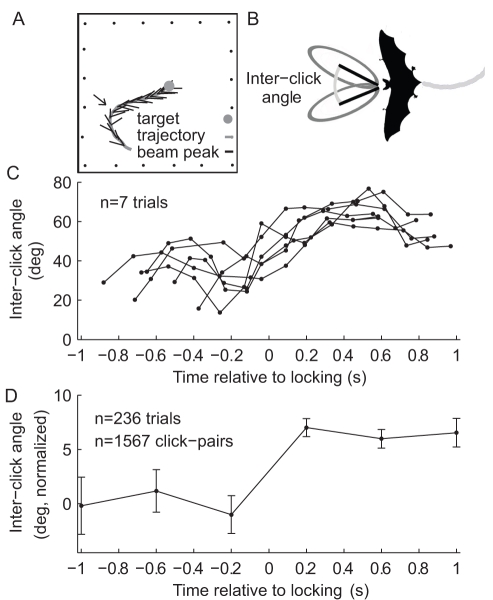
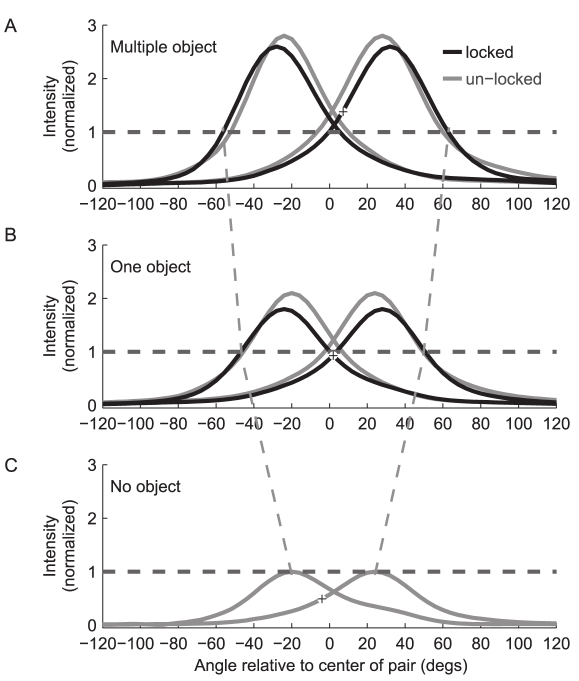
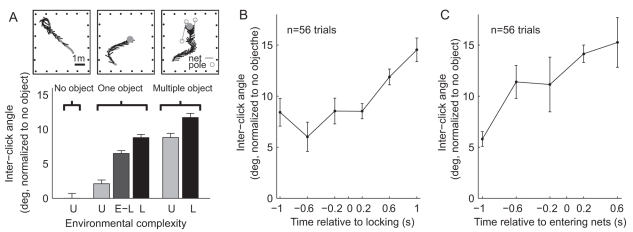
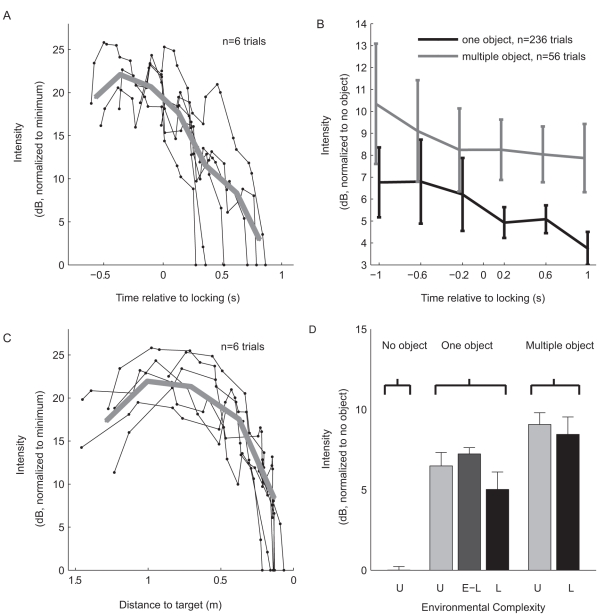
Active-sensing systems abound in nature, but little is known about systematic strategies that are used by these systems to scan the environment. Here, we addressed this question by studying echolocating bats, animals that have the ability to point their biosonar beam to a confined region of space. We trained Egyptian fruit bats to land on a target, under conditions of varying levels of environmental complexity, and measured their echolocation and flight behavior. The bats modulated the intensity of their biosonar emissions, and the spatial region they sampled, in a task-dependant manner. We report here that Egyptian fruit bats selectively change the emission intensity and the angle between the beam axes of sequentially emitted clicks, according to the distance to the target, and depending on the level of environmental complexity. In so doing, they effectively adjusted the spatial sector sampled by a pair of clicks-the "field-of-view." We suggest that the exact point within the beam that is directed towards an object (e.g., the beam's peak, maximal slope, etc.) is influenced by three competing task demands: detection, localization, and angular scanning-where the third factor is modulated by field-of-view. Our results suggest that lingual echolocation (based on tongue clicks) is in fact much more sophisticated than previously believed. They also reveal a new parameter under active control in animal sonar-the angle between consecutive beams. Our findings suggest that acoustic scanning of space by mammals is highly flexible and modulated much more selectively than previously recognized.
主动感应系统在自然界中比比皆是,但对于这些系统用于扫描环境的系统策略,我们知之甚少。在这里,我们通过研究具有指向生物声纳波束到空间受限区域能力的回声定位蝙蝠来解决这个问题。我们训练埃及果蝠在不同环境复杂程度的条件下降落在目标上,并测量它们的回声定位和飞行行为。蝙蝠以任务依赖的方式调节生物声纳发射的强度和它们采样的空间区域。我们在这里报告,埃及果蝠根据目标的距离,并根据环境复杂程度的不同,选择性地改变连续发射的点击的发射强度和波束轴之间的角度。这样,它们有效地调整了一对点击采样的空间扇区 - “视场”。我们认为,指向物体的波束的确切点(例如波束的峰值、最大斜率等)受到三个相互竞争的任务需求的影响:检测、定位和角度扫描 - 其中第三个因素受视场的调制。我们的研究结果表明,基于舌点击的语言回声定位实际上比以前认为的要复杂得多。它们还揭示了动物声纳中主动控制的一个新参数 - 连续波束之间的角度。我们的研究结果表明,哺乳动物对空间的声纳扫描具有高度的灵活性和选择性,比以前认识到的要高得多。