Department of Virology, National Institute of Hygiene and Epidemiology, Hanoi, Vietnam.
PLoS Pathog. 2011 Sep;7(9):e1002215. doi: 10.1371/journal.ppat.1002215. Epub 2011 Sep 8.
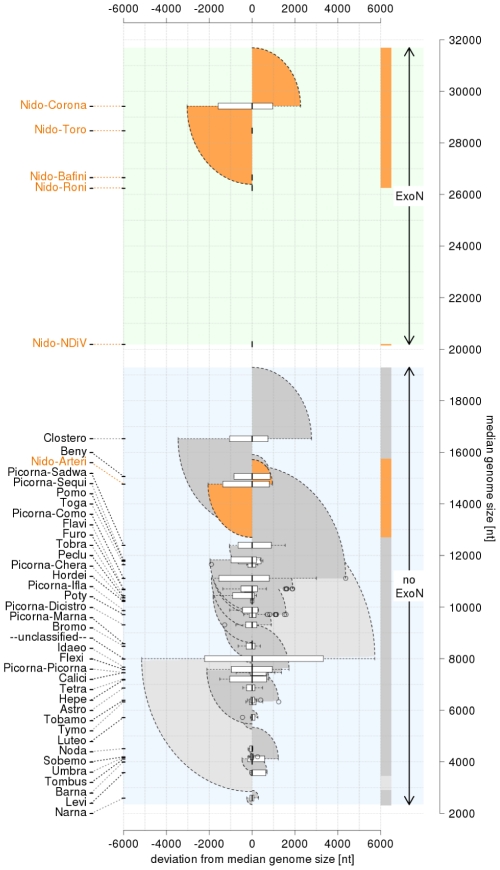
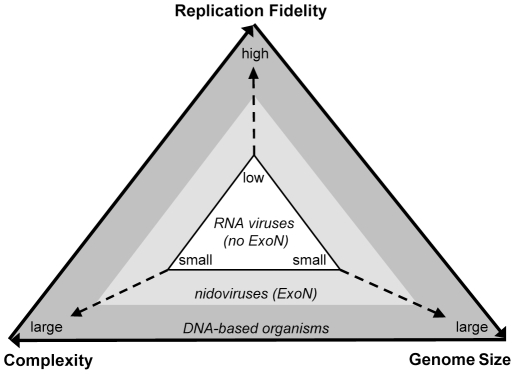
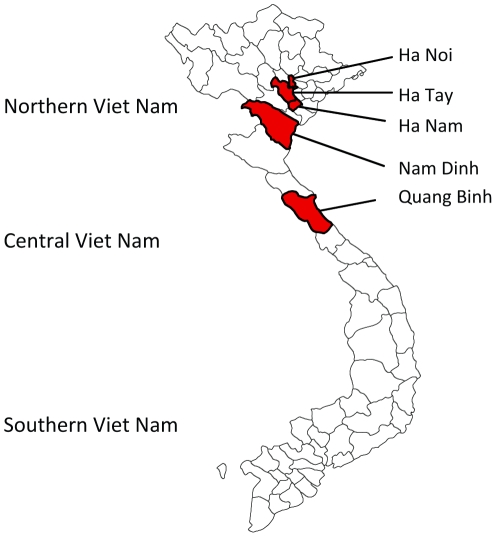
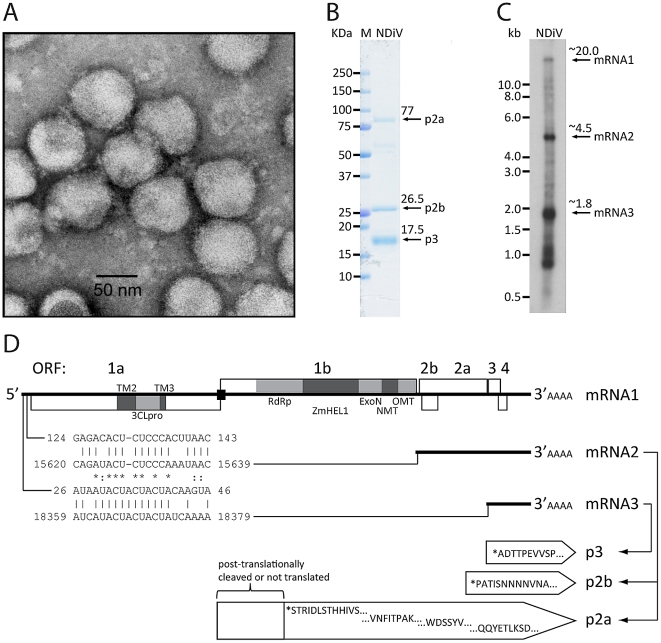
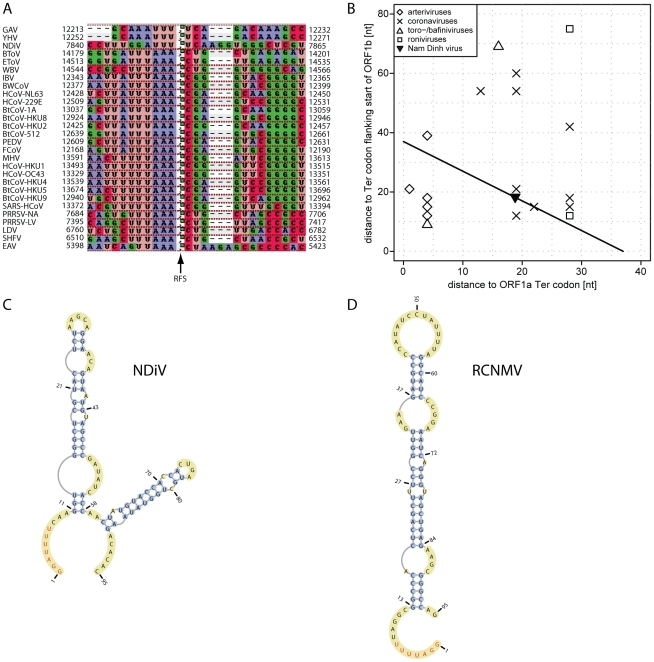
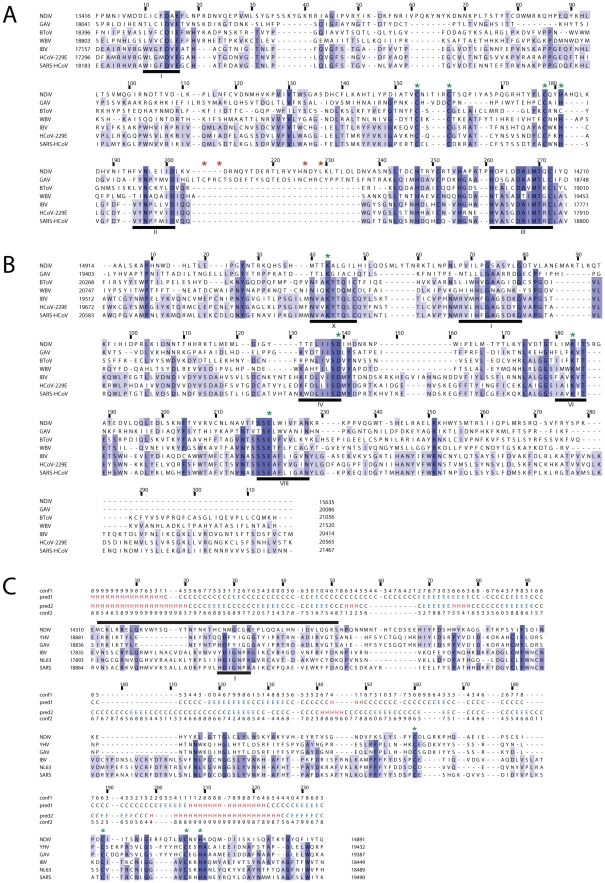
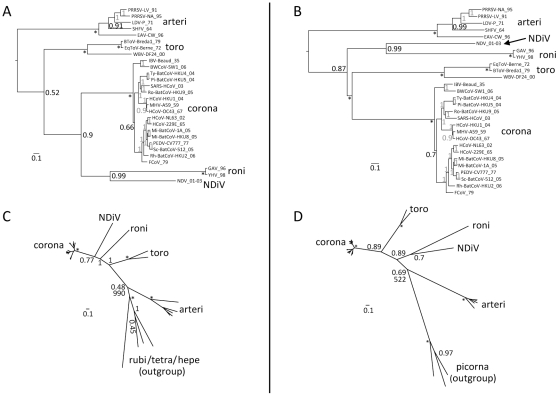
Nidoviruses with large genomes (26.3-31.7 kb; 'large nidoviruses'), including Coronaviridae and Roniviridae, are the most complex positive-sense single-stranded RNA (ssRNA+) viruses. Based on genome size, they are far separated from all other ssRNA+ viruses (below 19.6 kb), including the distantly related Arteriviridae (12.7-15.7 kb; 'small nidoviruses'). Exceptionally for ssRNA+ viruses, large nidoviruses encode a 3'-5'exoribonuclease (ExoN) that was implicated in controlling RNA replication fidelity. Its acquisition may have given rise to the ancestor of large nidoviruses, a hypothesis for which we here provide evolutionary support using comparative genomics involving the newly discovered first insect-borne nidovirus. This Nam Dinh virus (NDiV), named after a Vietnamese province, was isolated from mosquitoes and is yet to be linked to any pathology. The genome of this enveloped 60-80 nm virus is 20,192 nt and has a nidovirus-like polycistronic organization including two large, partially overlapping open reading frames (ORF) 1a and 1b followed by several smaller 3'-proximal ORFs. Peptide sequencing assigned three virion proteins to ORFs 2a, 2b, and 3, which are expressed from two 3'-coterminal subgenomic RNAs. The NDiV ORF1a/ORF1b frameshifting signal and various replicative proteins were tentatively mapped to canonical positions in the nidovirus genome. They include six nidovirus-wide conserved replicase domains, as well as the ExoN and 2'-O-methyltransferase that are specific to large nidoviruses. NDiV ORF1b also encodes a putative N7-methyltransferase, identified in a subset of large nidoviruses, but not the uridylate-specific endonuclease that - in deviation from the current paradigm - is present exclusively in the currently known vertebrate nidoviruses. Rooted phylogenetic inference by Bayesian and Maximum Likelihood methods indicates that NDiV clusters with roniviruses and that its branch diverged from large nidoviruses early after they split from small nidoviruses. Together these characteristics identify NDiV as the prototype of a new nidovirus family and a missing link in the transition from small to large nidoviruses.
具有大基因组(26.3-31.7 kb;“大套式病毒”)的套式病毒,包括冠状病毒科和 Roniviridae,是最复杂的正链单链 RNA(ssRNA+)病毒。根据基因组大小,它们与所有其他 ssRNA+病毒(低于 19.6 kb)相去甚远,包括远亲动脉炎病毒科(12.7-15.7 kb;“小套式病毒”)。非常特殊的是,大套式病毒编码一种 3'-5'外切核糖核酸酶(ExoN),该酶被认为在控制 RNA 复制保真度方面发挥作用。它的获得可能产生了大套式病毒的祖先,我们在这里使用涉及新发现的第一种昆虫传播套式病毒的比较基因组学为这一假设提供了进化支持。这种命名为 Nam Dinh 病毒(NDiV)的病毒以越南一个省的名字命名,从蚊子中分离出来,尚未与任何病理学联系起来。这种包膜的 60-80nm 病毒的基因组长 20192 个核苷酸,具有类似于套式病毒的多顺反子组织,包括两个大的、部分重叠的开放阅读框(ORF)1a 和 1b,后面跟着几个较小的 3'-近端 ORF。肽测序将三个病毒蛋白分配给 ORF2a、2b 和 3,它们由两个 3'-末端亚基因组 RNA 表达。NDiV ORF1a/ORF1b 框移信号和各种复制蛋白被暂时映射到套式病毒基因组中的典型位置。它们包括六个套式病毒广泛保守的复制酶结构域,以及特异性存在于大套式病毒中的 ExoN 和 2'-O-甲基转移酶。NDiV ORF1b 还编码一个推定的 N7-甲基转移酶,该酶在一组大套式病毒中被发现,但不存在尿嘧啶特异性内切核酸酶,与当前的模式不同,该酶仅存在于目前已知的脊椎动物套式病毒中。基于贝叶斯和最大似然法的系统发育推断表明,NDiV 与 Roniviridae 聚类,其分支在大套式病毒与小套式病毒分裂后早期与大套式病毒分支。这些特征共同将 NDiV 鉴定为一种新套式病毒科的原型,也是从小套式病毒到大套式病毒过渡中的缺失环节。