Department of Medicine, Washington University School of Medicine, St Louis, Missouri 63110, USA.
Nature. 2010 Nov 18;468(7322):452-6. doi: 10.1038/nature09489.
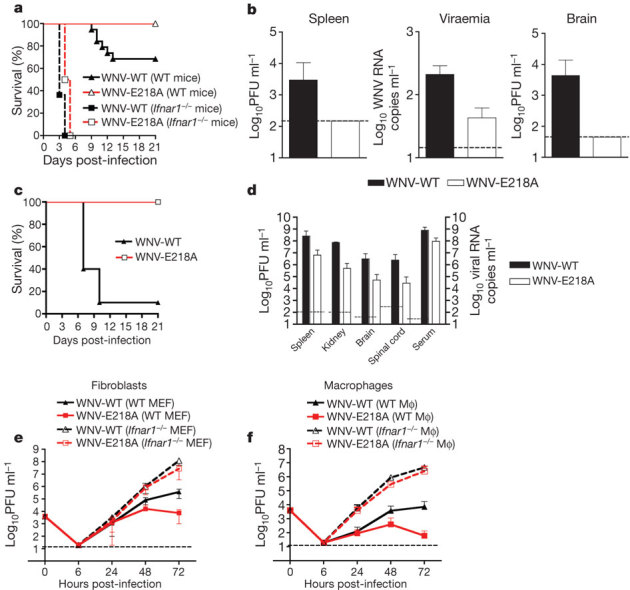
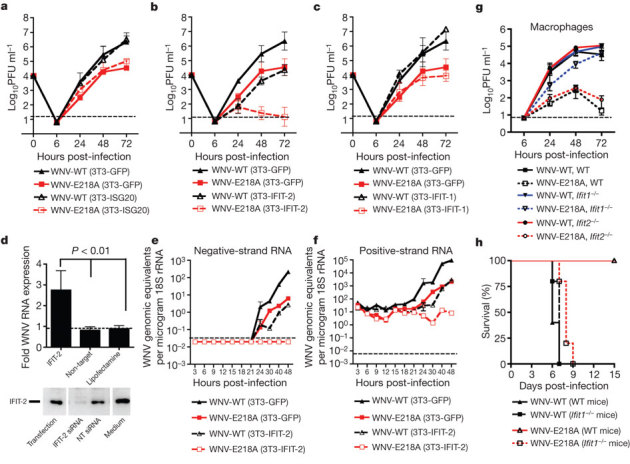
Cellular messenger RNA (mRNA) of higher eukaryotes and many viral RNAs are methylated at the N-7 and 2'-O positions of the 5' guanosine cap by specific nuclear and cytoplasmic methyltransferases (MTases), respectively. Whereas N-7 methylation is essential for RNA translation and stability, the function of 2'-O methylation has remained uncertain since its discovery 35 years ago. Here we show that a West Nile virus (WNV) mutant (E218A) that lacks 2'-O MTase activity was attenuated in wild-type primary cells and mice but was pathogenic in the absence of type I interferon (IFN) signalling. 2'-O methylation of viral RNA did not affect IFN induction in WNV-infected fibroblasts but instead modulated the antiviral effects of IFN-induced proteins with tetratricopeptide repeats (IFIT), which are interferon-stimulated genes (ISGs) implicated in regulation of protein translation. Poxvirus and coronavirus mutants that lacked 2'-O MTase activity similarly showed enhanced sensitivity to the antiviral actions of IFN and, specifically, IFIT proteins. Our results demonstrate that the 2'-O methylation of the 5' cap of viral RNA functions to subvert innate host antiviral responses through escape of IFIT-mediated suppression, and suggest an evolutionary explanation for 2'-O methylation of cellular mRNA: to distinguish self from non-self RNA. Differential methylation of cytoplasmic RNA probably serves as an example for pattern recognition and restriction of propagation of foreign viral RNA in host cells.
高等真核生物的细胞信使 RNA(mRNA)和许多病毒 RNA 分别在核和细胞质中由特定的甲基转移酶(MTase)在 5' 鸟苷帽的 N-7 和 2'-O 位置上进行甲基化。虽然 N-7 甲基化对于 RNA 翻译和稳定性是必需的,但自 35 年前发现 2'-O 甲基化以来,其功能仍然不确定。在这里,我们发现一种缺乏 2'-O MTase 活性的西尼罗河病毒(WNV)突变体(E218A)在野生型原代细胞和小鼠中减弱,但在缺乏 I 型干扰素(IFN)信号的情况下具有致病性。病毒 RNA 的 2'-O 甲基化不会影响 WNV 感染成纤维细胞中的 IFN 诱导,但会调节具有四肽重复(IFIT)的 IFN 诱导蛋白的抗病毒作用,IFIT 是涉及调节蛋白质翻译的干扰素刺激基因(ISG)。缺乏 2'-O MTase 活性的痘病毒和冠状病毒突变体也表现出对 IFN 和特定的 IFIT 蛋白的抗病毒作用的敏感性增加。我们的结果表明,病毒 RNA 5' 帽的 2'-O 甲基化通过逃避 IFIT 介导的抑制作用来破坏先天宿主抗病毒反应,并为细胞 mRNA 的 2'-O 甲基化提供了一种进化解释:区分自身和非自身 RNA。细胞质 RNA 的差异甲基化可能是宿主细胞中识别和限制外来病毒 RNA 传播的一个例子。