Institute of Virology, University of Bonn Medical Center, Bonn, Germany.
mBio. 2011 Jun 14;2(3):e00077-11. doi: 10.1128/mBio.00077-11. Print 2011.
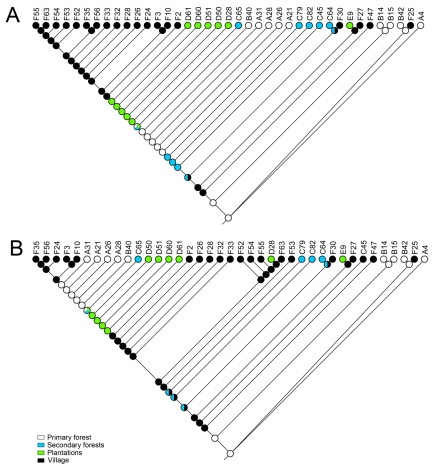
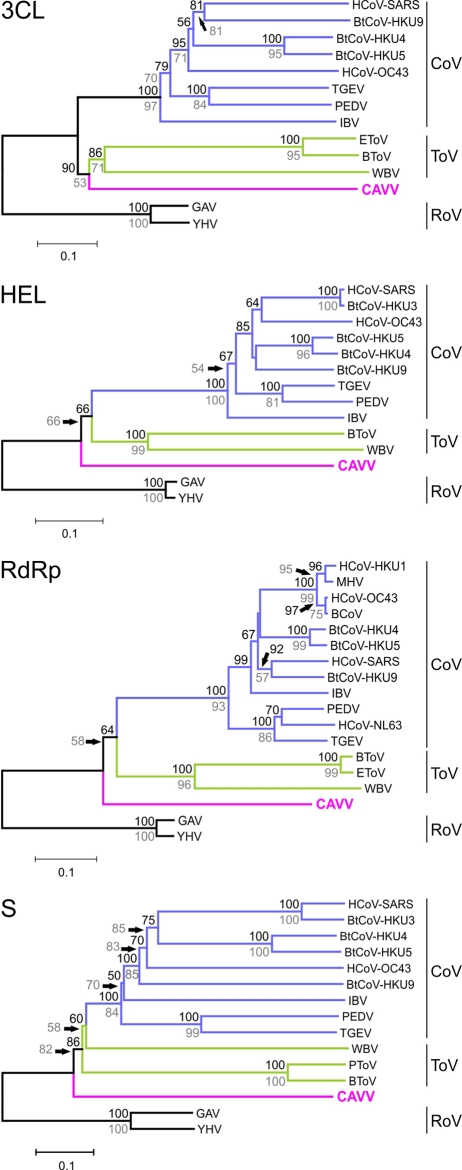
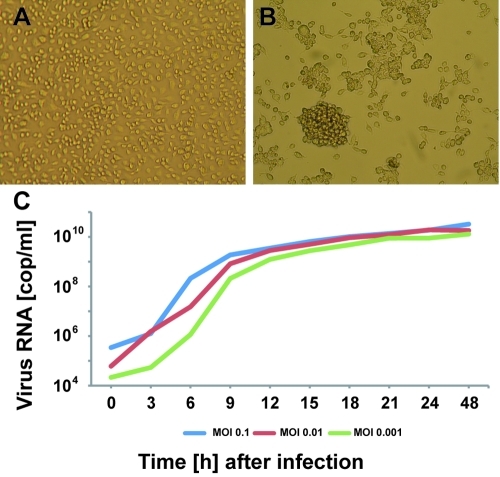
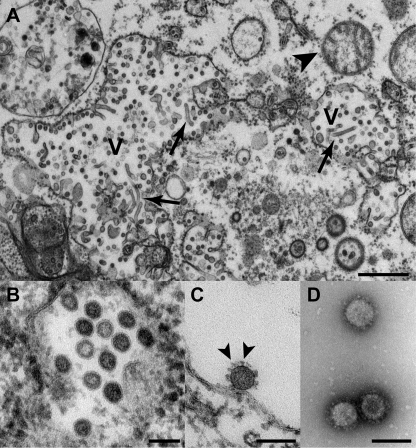
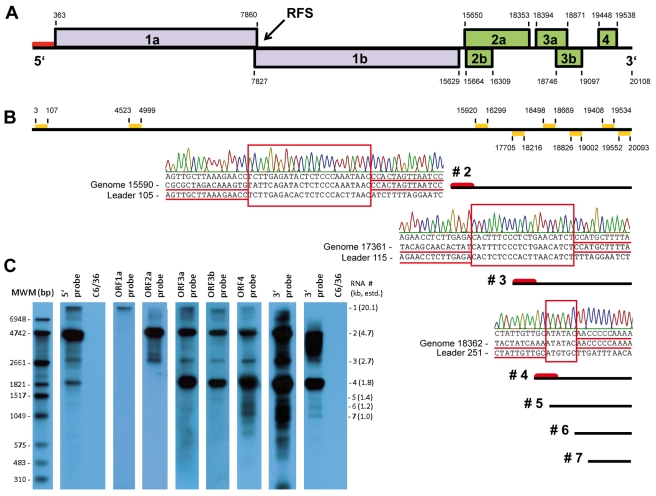
Tropical rainforests show the highest level of terrestrial biodiversity and may be an important contributor to microbial diversity. Exploitation of these ecosystems may foster the emergence of novel pathogens. We report the discovery of the first insect-associated nidovirus, tentatively named Cavally virus (CAVV). CAVV was found with a prevalence of 9.3% during a survey of mosquito-associated viruses along an anthropogenic disturbance gradient in Côte d'Ivoire. Analysis of habitat-specific virus diversity and ancestral state reconstruction demonstrated an origin of CAVV in a pristine rainforest with subsequent spread into agriculture and human settlements. Virus extension from the forest was associated with a decrease in virus diversity (P<0.01) and an increase in virus prevalence (P<0.00001). CAVV is an enveloped virus with large surface projections. The RNA genome comprises 20,108 nucleotides with seven major open reading frames (ORFs). ORF1a and -1b encode two large proteins that share essential features with phylogenetically higher representatives of the order Nidovirales, including the families Coronavirinae and Torovirinae, but also with families in a basal phylogenetic relationship, including the families Roniviridae and Arteriviridae. Genetic markers uniquely conserved in nidoviruses, such as an endoribonuclease- and helicase-associated zinc-binding domain, are conserved in CAVV. ORF2a and -2b are predicted to code for structural proteins S and N, respectively, while ORF3a and -3b encode proteins with membrane-spanning regions. CAVV produces three subgenomic mRNAs with 5' leader sequences (of different lengths) derived from the 5' end of the genome. This novel cluster of mosquito-associated nidoviruses is likely to represent a novel family within the order Nidovirales.
热带雨林显示出最高水平的陆地生物多样性,可能是微生物多样性的重要贡献者。这些生态系统的开发可能会促进新型病原体的出现。我们报告了第一种昆虫相关的套式病毒的发现,暂定名为卡瓦利病毒(CAVV)。在对科特迪瓦人为干扰梯度上的蚊子相关病毒进行调查期间,CAVV 的流行率为 9.3%。对特定栖息地病毒多样性和祖先状态重建的分析表明,CAVV 起源于原始雨林,随后传播到农业和人类住区。病毒从森林向外扩展与病毒多样性减少(P<0.01)和病毒流行率增加(P<0.00001)有关。CAVV 是一种带有大表面突起的包膜病毒。RNA 基因组由 20,108 个核苷酸组成,有七个主要的开放阅读框(ORF)。ORF1a 和 -1b 编码两个大型蛋白质,它们与分类地位更高的套式病毒目代表具有重要特征,包括冠状病毒科和 Torovirinae 科,但也与系统发育上较基础的科,包括 Roniviridae 科和 Arteriviridae 科具有重要特征。套式病毒中保守的独特遗传标记,如内切核酸酶和螺旋酶相关的锌结合域,在 CAVV 中保守。ORF2a 和 -2b 分别预测编码结构蛋白 S 和 N,而 ORF3a 和 -3b 编码具有跨膜区域的蛋白。CAVV 产生三个带有 5' 非翻译区(不同长度)的亚基因组 mRNA,这些 5' 非翻译区来自基因组的 5' 端。这种新的蚊子相关套式病毒簇可能代表套式病毒目中的一个新科。