Program in Translational NeuroPsychiatric Genomics, Department of Neurology, Brigham and Women's Hospital, Boston, Massachusetts, United States of America.
PLoS One. 2011;6(9):e24380. doi: 10.1371/journal.pone.0024380. Epub 2011 Sep 12.
Cumulative genetic profiles can help identify individuals at high-risk for developing RA. We examined the impact of 39 validated genetic risk alleles on the risk of RA phenotypes characterized by serologic and erosive status.
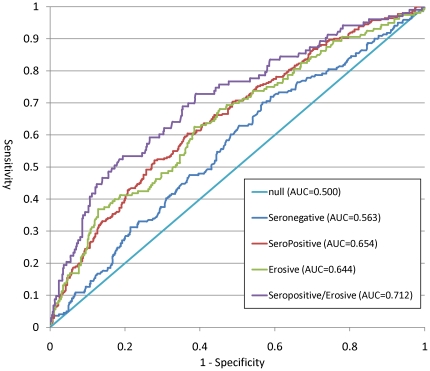
METHODS/PRINCIPAL FINDINGS: We evaluated single nucleotide polymorphisms at 31 validated RA risk loci and 8 Human Leukocyte Antigen alleles among 542 Caucasian RA cases and 551 Caucasian controls from Nurses' Health Study and Nurses' Health Study II. We created a weighted genetic risk score (GRS) and evaluated it as 7 ordinal groups using logistic regression (adjusting for age and smoking) to assess the relationship between GRS group and odds of developing seronegative (RF- and CCP-), seropositive (RF+ or CCP+), erosive, and seropositive, erosive RA phenotypes. In separate case only analyses, we assessed the relationships between GRS and age of symptom onset. In 542 RA cases, 317 (58%) were seropositive, 163 (30%) had erosions and 105 (19%) were seropositive with erosions. Comparing the highest GRS risk group to the median group, we found an OR of 1.2 (95% CI = 0.8-2.1) for seronegative RA, 3.0 (95% CI = 1.9-4.7) for seropositive RA, 3.2 (95% CI = 1.8-5.6) for erosive RA, and 7.6 (95% CI = 3.6-16.3) for seropositive, erosive RA. No significant relationship was seen between GRS and age of onset.
CONCLUSIONS/SIGNIFICANCE: Results suggest that seronegative and seropositive/erosive RA have different genetic architecture and support the importance of considering RA phenotypes in RA genetic studies.
累积的遗传特征可帮助鉴定发生类风湿关节炎(RA)风险较高的个体。我们研究了 39 个已验证的遗传风险等位基因对以血清学和侵蚀状态为特征的 RA 表型的风险的影响。
方法/主要发现:我们在来自护士健康研究和护士健康研究 II 的 542 例白种人 RA 病例和 551 例白种人对照中,评估了 31 个已验证的 RA 风险位点和 8 个人类白细胞抗原等位基因的单核苷酸多态性。我们创建了一个加权遗传风险评分(GRS),并使用逻辑回归(调整年龄和吸烟因素)将其评估为 7 个有序组,以评估 GRS 组与发生血清阴性(RF 和抗环瓜氨酸肽抗体阴性)、血清阳性(RF 阳性或抗环瓜氨酸肽抗体阳性)、侵蚀性和血清阳性、侵蚀性 RA 表型的几率之间的关系。在仅包含病例的分析中,我们评估了 GRS 与症状出现年龄之间的关系。在 542 例 RA 病例中,317 例(58%)为血清阳性,163 例(30%)有侵蚀,105 例(19%)为血清阳性且有侵蚀。与最高 GRS 风险组相比,我们发现血清阴性 RA 的比值比为 1.2(95%可信区间[CI] = 0.8-2.1),血清阳性 RA 的比值比为 3.0(95%CI = 1.9-4.7),侵蚀性 RA 的比值比为 3.2(95%CI = 1.8-5.6),血清阳性、侵蚀性 RA 的比值比为 7.6(95%CI = 3.6-16.3)。未发现 GRS 与发病年龄之间存在显著关系。
结论/意义:结果表明血清阴性和血清阳性/侵蚀性 RA 具有不同的遗传结构,支持在 RA 遗传研究中考虑 RA 表型的重要性。