Department of Medical Biochemistry and Biophysics, Umeå University, Umeå, Sweden.
PLoS One. 2011;6(9):e24774. doi: 10.1371/journal.pone.0024774. Epub 2011 Sep 12.
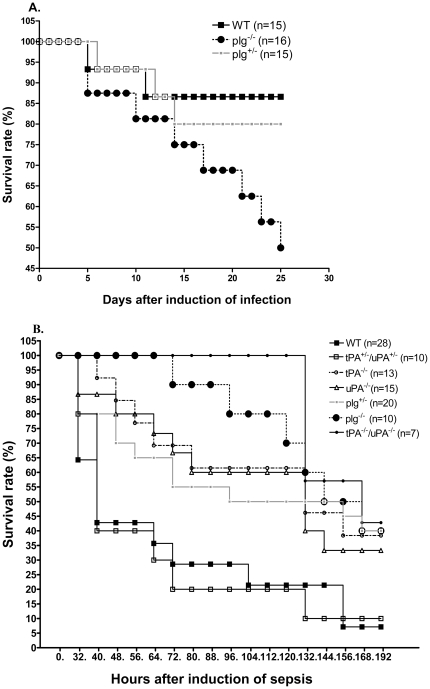
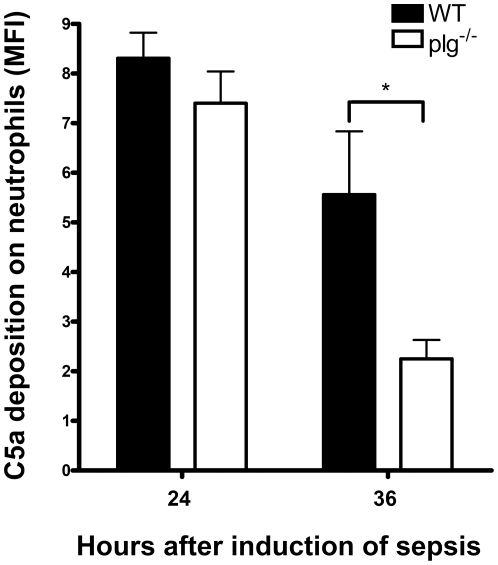
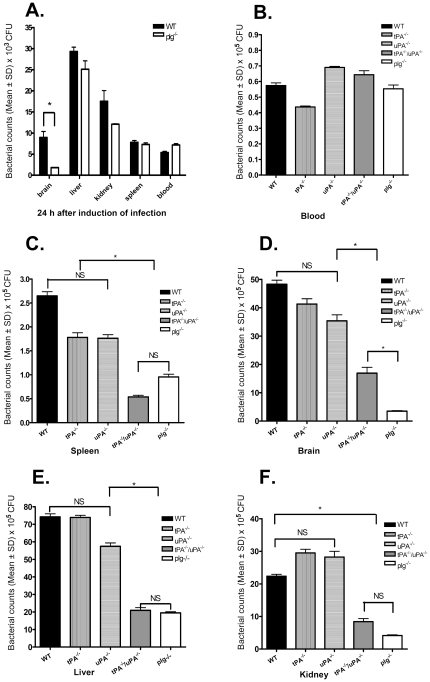
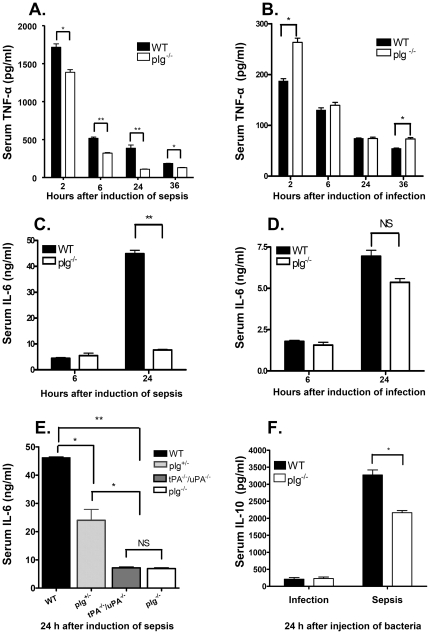
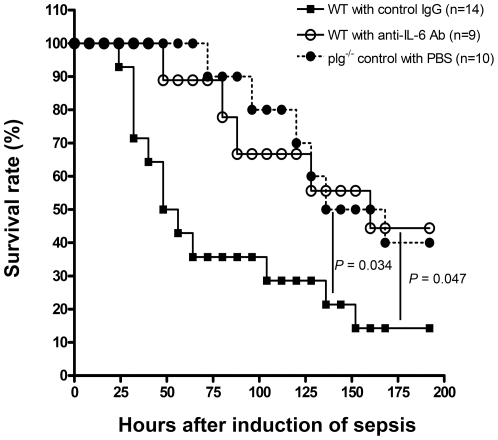
Plasmin has been proposed to be an important mediator during inflammation/infection. In this study, by using mice lacking genes for plasminogen, tissue-type plasminogen activator (tPA), and urokinase-type PA (uPA), we have investigated the functional roles of active plasmin in infection and sepsis. Two models were used: an infection model by intravenous injection of 1×10⁷ CFU of S. aureus, and a sepsis model by intravenous injection of 1.6×10⁸ CFU of S. aureus. We found that in the infection model, wild-type (WT) mice showed significantly higher survival rates than plasminogen-deficient (plg⁻/⁻) mice. However, in the sepsis model, plg⁻/⁻ or tPA⁻/⁻/uPA⁻/⁻ mice showed the highest survival rate whereas WT and tPA⁺/⁻/uPA⁺/⁻ mice showed the lowest survival rate, and plg⁺/⁻, tPA⁻/⁻, and uPA⁻/⁻ mice had an intermediate survival rate. These results indicate that the levels of active plasmin are critical in determining the survival rate in the sepsis, partly through high levels of inflammatory cytokines and enhanced STAT3 activation. We conclude that plasmin is beneficial in infection but promotes the production of inflammatory cytokines in sepsis that may cause tissue destruction, diminished neutrophil function, and an impaired capacity to kill bacteria which eventually causes death of these mice.
纤溶酶已被提出是炎症/感染期间的重要介质。在这项研究中,我们使用缺乏纤溶酶原、组织型纤溶酶原激活物(tPA)和尿激酶型纤溶酶原激活物(uPA)基因的小鼠,研究了活性纤溶酶在感染和败血症中的功能作用。使用了两种模型:静脉注射 1×10⁷ CFU 的金黄色葡萄球菌的感染模型和静脉注射 1.6×10⁸ CFU 的金黄色葡萄球菌的败血症模型。我们发现,在感染模型中,野生型(WT)小鼠的存活率明显高于纤溶酶原缺陷型(plg⁻/⁻)小鼠。然而,在败血症模型中,plg⁻/⁻或 tPA⁻/⁻/uPA⁻/⁻小鼠的存活率最高,而 WT 和 tPA⁺/⁻/uPA⁺/⁻小鼠的存活率最低,plg⁺/⁻、tPA⁻/⁻和 uPA⁻/⁻小鼠的存活率居中。这些结果表明,活性纤溶酶的水平在决定败血症的存活率方面至关重要,部分原因是炎症细胞因子水平升高和 STAT3 激活增强。我们得出结论,纤溶酶在感染中是有益的,但在败血症中会促进炎症细胞因子的产生,这可能导致组织破坏、中性粒细胞功能减弱以及杀死细菌的能力受损,最终导致这些小鼠死亡。