International Diabetes Center at Park Nicollet, Minneapolis, Minnesota, USA.
Diabetes Care. 2011 Nov;34(11):2403-5. doi: 10.2337/dc11-1248. Epub 2011 Sep 20.
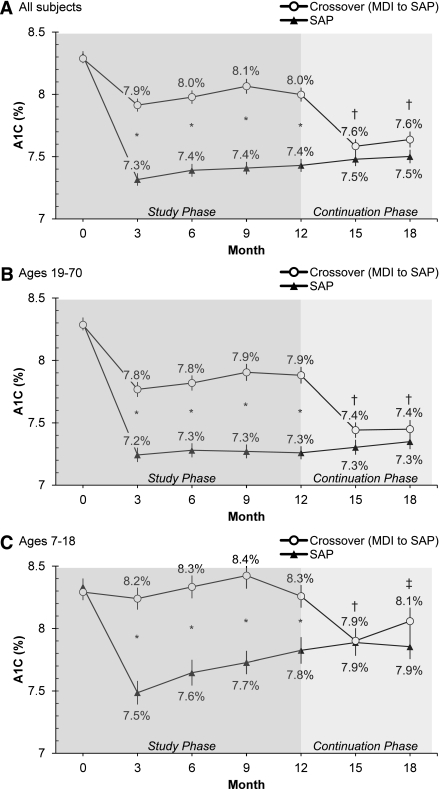
OBJECTIVE To examine the effects of crossing over from optimized multiple daily injection (MDI) therapy to sensor-augmented pump (SAP) therapy for 6 months, and the effects of 18 months' sustained use of SAP. RESEARCH DESIGN AND METHODS The 6-month, single-crossover continuation phase of Sensor-Augmented Pump Therapy for A1C Reduction (STAR 3) provided SAP therapy to 420 subjects who completed the 1-year randomized study. The primary outcome was change in A1C in the crossover group. RESULTS A1C values were initially lower in the continuing-SAP group than in the crossover group (7.4 vs. 8.0%, P < 0.001). A1C values remained reduced in the SAP group. After 3 months on the SAP system, A1C decreased to 7.6% in the crossover group (P < 0.001); this was a significant and sustained decrease among both adults and children (P < 0.05). CONCLUSIONS Switching from optimized MDI to SAP therapy allowed for rapid and safe A1C reductions. Glycemic benefits of SAP therapy persist for at least 18 months.
考察从优化多次每日注射(MDI)治疗转为传感器增强型泵(SAP)治疗 6 个月的效果,以及持续使用 SAP 18 个月的效果。
为期 6 个月的传感器增强型泵治疗降低 A1C 研究(STAR3)的单交叉延续阶段为 420 名完成 1 年随机研究的受试者提供 SAP 治疗。主要结局是交叉组 A1C 的变化。
在继续 SAP 组中,A1C 值最初低于交叉组(7.4%比 8.0%,P <0.001)。SAP 组的 A1C 值持续降低。在使用 SAP 系统 3 个月后,交叉组的 A1C 降至 7.6%(P <0.001);这在成人和儿童中均显著且持续降低(P <0.05)。
从优化 MDI 转为 SAP 治疗可快速、安全地降低 A1C。SAP 治疗的血糖获益至少持续 18 个月。