Department of Biology and Biochemistry, University of Bath, Bath, United Kingdom.
PLoS Genet. 2011 Sep;7(9):e1002283. doi: 10.1371/journal.pgen.1002283. Epub 2011 Sep 15.
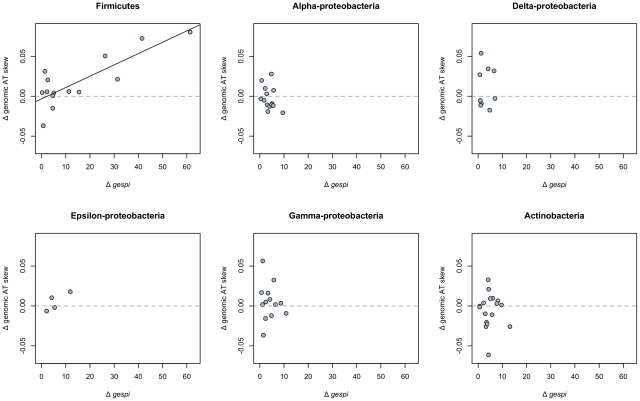
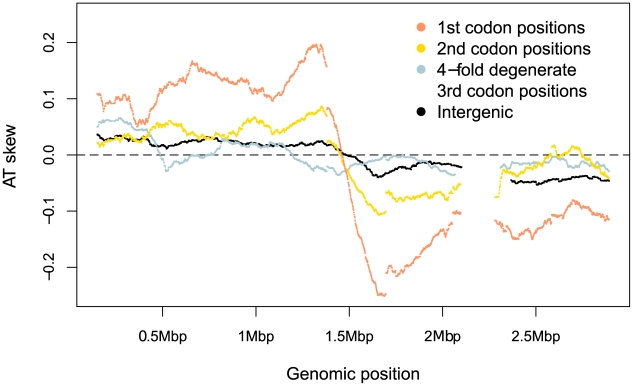
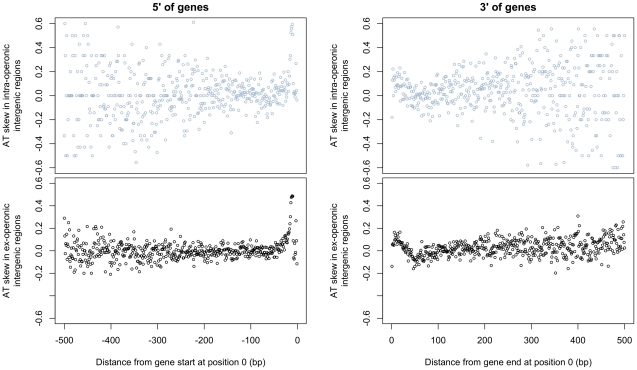
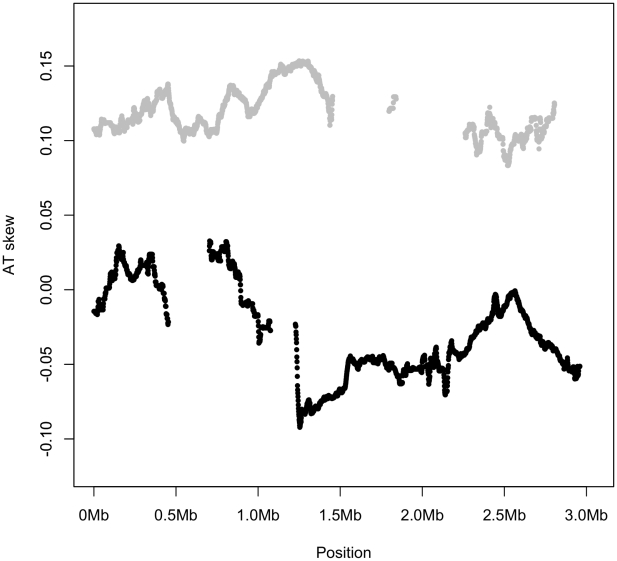
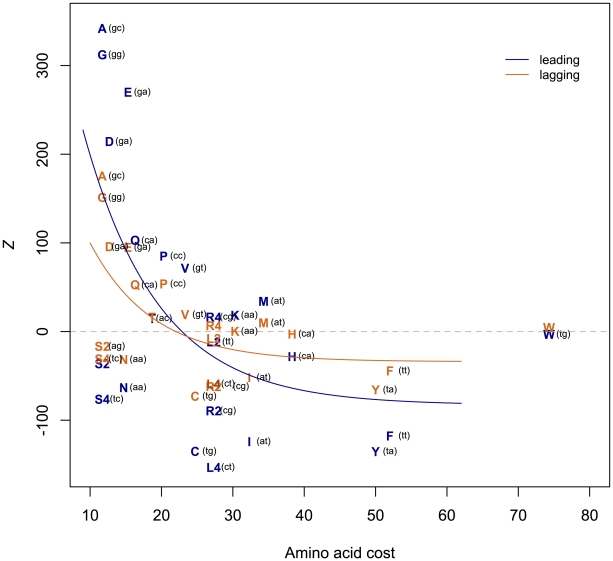
The second parity rule states that, if there is no bias in mutation or selection, then within each strand of DNA complementary bases are present at approximately equal frequencies. In bacteria, however, there is commonly an excess of G (over C) and, to a lesser extent, T (over A) in the replicatory leading strand. The low G+C Firmicutes, such as Staphylococcus aureus, are unusual in displaying an excess of A over T on the leading strand. As mutation has been established as a major force in the generation of such skews across various bacterial taxa, this anomaly has been assumed to reflect unusual mutation biases in Firmicute genomes. Here we show that this is not the case and that mutation bias does not explain the atypical AT skew seen in S. aureus. First, recently arisen intergenic SNPs predict the classical replication-derived equilibrium enrichment of T relative to A, contrary to what is observed. Second, sites predicted to be under weak purifying selection display only weak AT skew. Third, AT skew is primarily associated with largely non-synonymous first and second codon sites and is seen with respect to their sense direction, not which replicating strand they lie on. The atypical AT skew we show to be a consequence of the strong bias for genes to be co-oriented with the replicating fork, coupled with the selective avoidance of both stop codons and costly amino acids, which tend to have T-rich codons. That intergenic sequence has more A than T, while at mutational equilibrium a preponderance of T is expected, points to a possible further unresolved selective source of skew.
第二条配对规则指出,如果突变或选择没有偏差,那么在每条 DNA 链中,互补碱基的出现频率大致相等。然而,在细菌中,复制前导链中通常存在 G(相对于 C)的过剩,在较小程度上还有 T(相对于 A)的过剩。低 G+C 的厚壁菌门,如金黄色葡萄球菌,在其前导链上显示出 A 相对于 T 的过剩,这是不寻常的。由于突变已被确立为在各种细菌分类单元中产生这种偏斜的主要力量,因此,这种异常情况被认为反映了厚壁菌门基因组中异常的突变偏向。在这里,我们表明事实并非如此,突变偏向并不能解释金黄色葡萄球菌中观察到的非典型 AT 偏斜。首先,最近出现的基因间 SNP 预测了经典复制衍生的 T 相对于 A 的平衡富集,这与观察到的情况相反。其次,预测为弱净化选择的位点仅显示出微弱的 AT 偏斜。第三,AT 偏斜主要与大量非同义的第一和第二密码子位点相关,并且与它们的意义方向有关,而与它们所在的复制链无关。我们发现,这种非典型的 AT 偏斜是由于基因与复制叉强烈取向的偏向,加上对终止密码子和昂贵氨基酸的选择性回避,这两种情况往往具有富含 T 的密码子,这是导致 AT 偏斜的主要原因。由于基因与复制叉强烈取向,加上对终止密码子和昂贵氨基酸的选择性回避,这两种情况往往具有富含 T 的密码子,因此,非典型的 AT 偏斜是由于基因与复制叉强烈取向的偏向,加上对终止密码子和昂贵氨基酸的选择性回避,这两种情况往往具有富含 T 的密码子,这是导致 AT 偏斜的主要原因。非典型的 AT 偏斜是由于基因与复制叉强烈取向的偏向,加上对终止密码子和昂贵氨基酸的选择性回避,这两种情况往往具有富含 T 的密码子,这是导致 AT 偏斜的主要原因。我们发现,这种非典型的 AT 偏斜是由于基因与复制叉强烈取向的偏向,加上对终止密码子和昂贵氨基酸的选择性回避,这两种情况往往具有富含 T 的密码子,这是导致 AT 偏斜的主要原因。由于基因与复制叉强烈取向,加上对终止密码子和昂贵氨基酸的选择性回避,这两种情况往往具有富含 T 的密码子,因此,非典型的 AT 偏斜是由于基因与复制叉强烈取向的偏向,加上对终止密码子和昂贵氨基酸的选择性回避,这两种情况往往具有富含 T 的密码子,这是导致 AT 偏斜的主要原因。
尽管插入和缺失可能会破坏密码子的读框,但它们在这些研究中并没有被考虑,这可能会影响密码子使用的解释。