Eppley Institute for Research in Cancer and Allied Diseases, University of Nebraska Medical Center, Omaha, Nebraska, United States of America.
PLoS One. 2011;6(9):e24848. doi: 10.1371/journal.pone.0024848. Epub 2011 Sep 15.
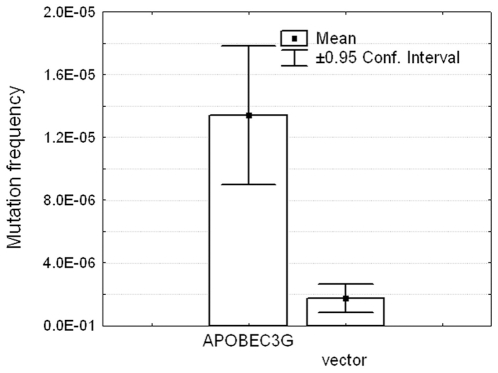
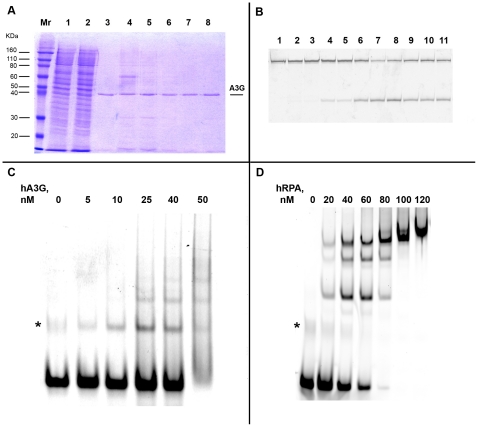
Editing deaminases have a pivotal role in cellular physiology. A notable member of this superfamily, APOBEC3G (A3G), restricts retroviruses, and Activation Induced Deaminase (AID) generates antibody diversity by localized deamination of cytosines in DNA. Unconstrained deaminase activity can cause genome-wide mutagenesis and cancer. The mechanisms that protect the genomic DNA from the undesired action of deaminases are unknown. Using the in vitro deamination assays and expression of A3G in yeast, we show that replication protein A (RPA), the eukaryotic single-stranded DNA (ssDNA) binding protein, severely inhibits the deamination activity and processivity of A3G.
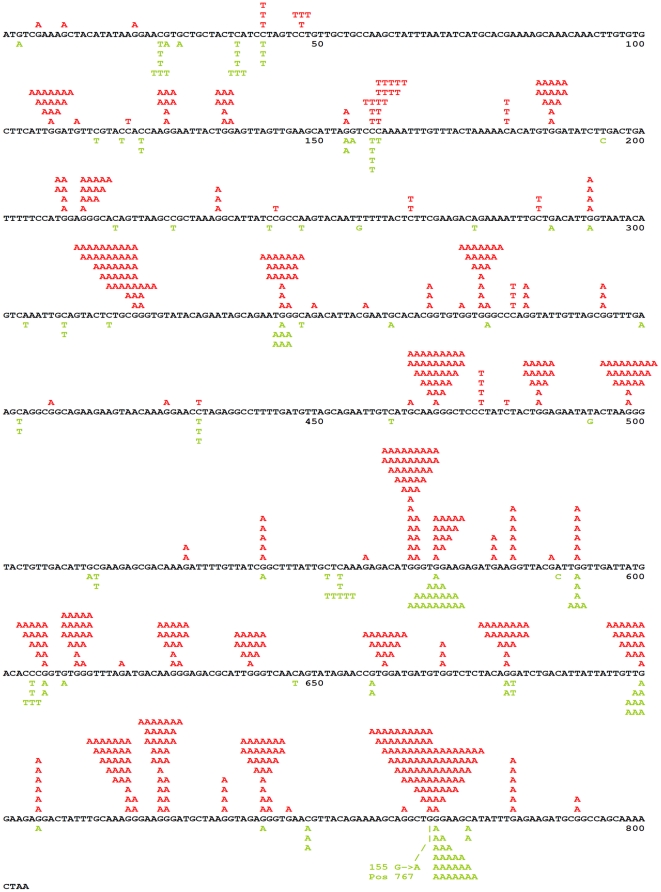
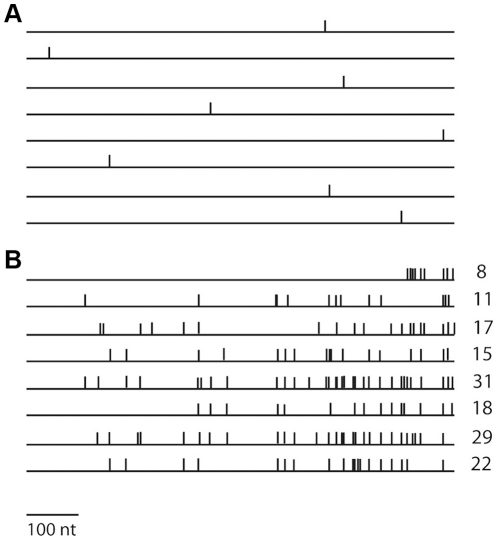
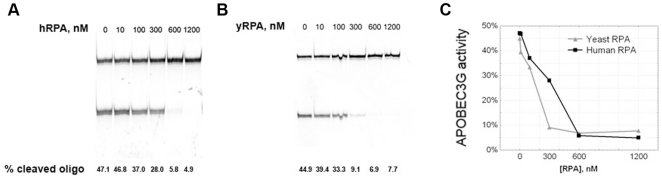
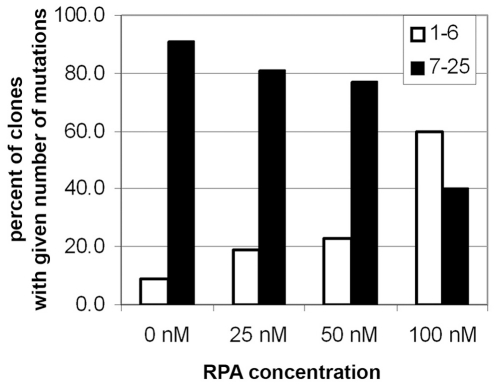
PRINCIPAL FINDINGS/METHODOLOGY: We found that mutations induced by A3G in the yeast genomic reporter are changes of a single nucleotide. This is unexpected because of the known property of A3G to catalyze multiple deaminations upon one substrate encounter event in vitro. The addition of recombinant RPA to the oligonucleotide deamination assay severely inhibited A3G activity. Additionally, we reveal the inverse correlation between RPA concentration and the number of deaminations induced by A3G in vitro on long ssDNA regions. This resembles the "hit and run" single base substitution events observed in yeast.
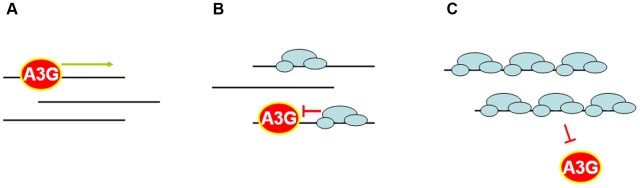
Our data suggest that RPA is a plausible antimutator factor limiting the activity and processivity of editing deaminases in the model yeast system. Because of the similar antagonism of yeast RPA and human RPA with A3G in vitro, we propose that RPA plays a role in the protection of the human genome cell from A3G and other deaminases when they are inadvertently diverged from their natural targets. We propose a model where RPA serves as one of the guardians of the genome that protects ssDNA from the destructive processive activity of deaminases by non-specific steric hindrance.
脱氨酶在细胞生理学中起着关键作用。该超家族的一个著名成员 APOBEC3G(A3G)限制逆转录病毒,而激活诱导的脱氨酶(AID)通过 DNA 中胞嘧啶的局部脱氨作用产生抗体多样性。不受限制的脱氨酶活性会导致全基因组突变和癌症。目前尚不清楚是什么机制保护基因组 DNA 免受脱氨酶的不当作用。通过体外脱氨酶测定和酵母中 A3G 的表达,我们表明,复制蛋白 A(RPA),一种真核单链 DNA(ssDNA)结合蛋白,严重抑制 A3G 的脱氨活性和持续性。
主要发现/方法:我们发现,A3G 在酵母基因组报告基因中诱导的突变是单个核苷酸的变化。这是出乎意料的,因为已知 A3G 在体外一个底物遭遇事件中就能催化多个脱氨反应。重组 RPA 的添加到寡核苷酸脱氨测定中严重抑制了 A3G 的活性。此外,我们揭示了 RPA 浓度与 A3G 在体外长 ssDNA 区域上诱导的脱氨数量之间的反比关系。这类似于在酵母中观察到的“击中-逃逸”单碱基替换事件。
我们的数据表明,RPA 是一种合理的抗突变因子,限制了模型酵母系统中编辑脱氨酶的活性和持续性。由于酵母 RPA 和人 RPA 与 A3G 的体外相似拮抗作用,我们提出 RPA 在保护人类基因组细胞免受 A3G 和其他脱氨酶的影响时发挥作用,当它们无意中偏离其自然靶标时。我们提出了一个模型,其中 RPA 作为基因组的守护者之一,通过非特异性的空间位阻来保护 ssDNA 免受脱氨酶的破坏性持续性活性的影响。