Buchacz Kate, Armon Carl, Palella Frank J, Baker Rose K, Tedaldi Ellen, Durham Marcus D, Brooks John T
Centers for Disease Control and Prevention, Atlanta, GA 30333, USA.
AIDS Res Treat. 2012;2012:869841. doi: 10.1155/2012/869841. Epub 2011 Sep 20.
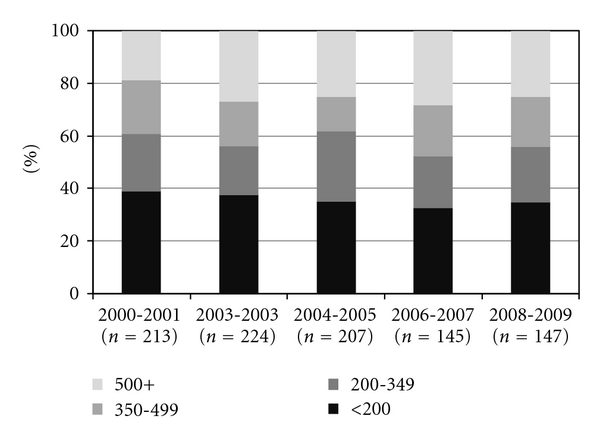
Background. It is unclear if CD4 cell counts at HIV diagnosis have improved over a 10-year period of expanded HIV testing in the USA. Methods. We studied HOPS participants diagnosed with HIV infection ≤6 months prior to entry into care during 2000-2009. We assessed the correlates of CD4 count <200 cells/mm(3) at HIV diagnosis (late HIV diagnosis) by logistic regression. Results. Of 1,203 eligible patients, 936 (78%) had a CD4 count within 3 months after HIV diagnosis. Median CD4 count at HIV diagnosis was 299 cells/mm(3) and did not significantly improve over time (P = 0.13). Comparing periods 2000-2001 versus 2008-2009, respectively, 39% and 35% of patients had a late HIV diagnosis (P = 0.34). Independent correlates of late HIV diagnosis were having an HIV risk other than being MSM, age ≥35 years at diagnosis, and being of nonwhite race/ethnicity. Conclusions. There is need for routine universal HIV testing to reduce the frequency of late HIV diagnosis and increase opportunity for patient- and potentially population-level benefits associated with early antiretroviral treatment.
背景。在美国扩大艾滋病病毒检测的10年期间,艾滋病病毒诊断时的CD4细胞计数是否有所改善尚不清楚。方法。我们研究了2000年至2009年期间在进入治疗前≤6个月被诊断为感染艾滋病病毒的HOPS参与者。我们通过逻辑回归评估了艾滋病病毒诊断时CD4细胞计数<200个/立方毫米(晚期艾滋病病毒诊断)的相关因素。结果。在1203名符合条件的患者中,936名(78%)在艾滋病病毒诊断后3个月内进行了CD4细胞计数。艾滋病病毒诊断时的CD4细胞计数中位数为299个/立方毫米,且未随时间显著改善(P = 0.13)。分别比较2000 - 2001年和2008 - 2009年两个时期,39%和35%的患者为晚期艾滋病病毒诊断(P = 0.34)。晚期艾滋病病毒诊断的独立相关因素包括除男男性行为者外有艾滋病病毒感染风险、诊断时年龄≥35岁以及非白人种族/族裔。结论。需要进行常规的普遍艾滋病病毒检测,以减少晚期艾滋病病毒诊断的频率,并增加患者以及潜在人群层面与早期抗逆转录病毒治疗相关的获益机会。