School of Public Health, Makerere University College of Health Sciences, Kampala Uganda.
BMC Public Health. 2011 Sep 25;11:723. doi: 10.1186/1471-2458-11-723.
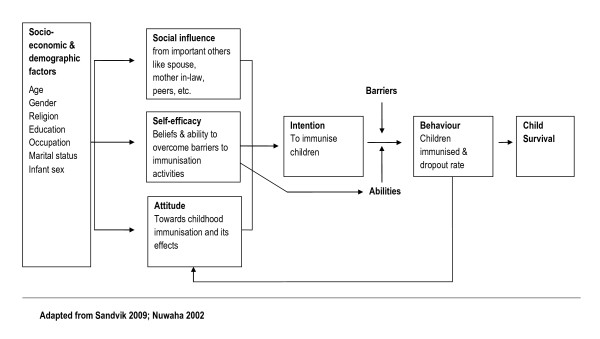
The proportion of Ugandan children who are fully vaccinated has varied over the years. Understanding vaccination behaviour is important for the success of the immunisation programme. This study examined influences on immunisation behaviour using the attitude-social influence-self efficacy model.
We conducted nine focus group discussions (FGDs) with mothers and fathers. Eight key informant interviews (KIIs) were held with those in charge of community mobilisation for immunisation, fathers and mothers. Data was analysed using content analysis.
Influences on the mother's immunisation behaviour ranged from the non-supportive role of male partners sometimes resulting into intimate partner violence, lack of presentable clothing which made mothers vulnerable to bullying, inconvenient schedules and time constraints, to suspicion against immunisation such as vaccines cause physical disability and/or death.
Immunisation programmes should position themselves to address social contexts. A community programme that empowers women economically and helps men recognise the role of women in decision making for child health is needed. Increasing male involvement and knowledge of immunisation concepts among caretakers could improve immunisation.
乌干达儿童完全接种疫苗的比例多年来有所不同。了解疫苗接种行为对于免疫规划的成功至关重要。本研究使用态度-社会影响-自我效能模型来研究免疫接种行为的影响因素。
我们对母亲和父亲进行了 9 次焦点小组讨论(FGD)。与负责社区动员免疫接种的人员、父亲和母亲进行了 8 次关键知情人访谈(KII)。使用内容分析法对数据进行分析。
影响母亲免疫接种行为的因素包括男性伴侣有时不支持,导致亲密伴侣暴力,没有得体的衣服使母亲容易受到欺凌,不方便的日程安排和时间限制,以及对疫苗接种的怀疑,例如疫苗会导致身体残疾和/或死亡。
免疫规划方案应定位自己以应对社会背景。需要一个社区方案,使妇女在经济上获得赋权,并帮助男子认识到妇女在儿童健康决策中的作用。增加照顾者中男性的参与和对免疫概念的了解,可以提高免疫接种率。