Social Epidemiology and Evaluation Research Group, School of Health Sciences, University of South Australia, City East Campus, Adelaide, SA 5000, Australia.
BMC Health Serv Res. 2011 Sep 27;11:237. doi: 10.1186/1472-6963-11-237.
With health sector reform in Vietnam moving towards greater pluralism, commune health stations (CHSs) have been subject to growing competition from private health services and increasing numbers of patients bypassing CHSs for higher-level health facilities. This study describes the pattern of reproductive health (RH) and family planning (FP) service utilization among women at CHSs and other health facilities, and explores socio-demographic determinants of RH service utilization at the CHS level.
This study was based on a cross-sectional survey conducted in Thua Thien Hue and Vinh Long provinces, using a multi-stage cluster sampling technique. Questionnaire-based interviews with 978 ever-married women at reproductive age provided data on socio-demographic characteristics, current use of FP methods, history of RH service use, and the health facility attended for their most recent services. Multiple logistic regression analyses were used to identify socio-demographic determinants of their use of CHS RH services.
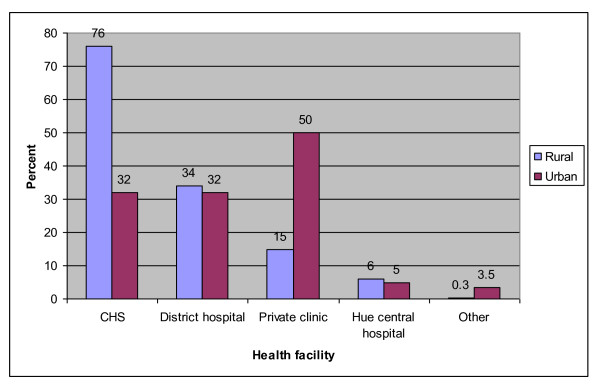
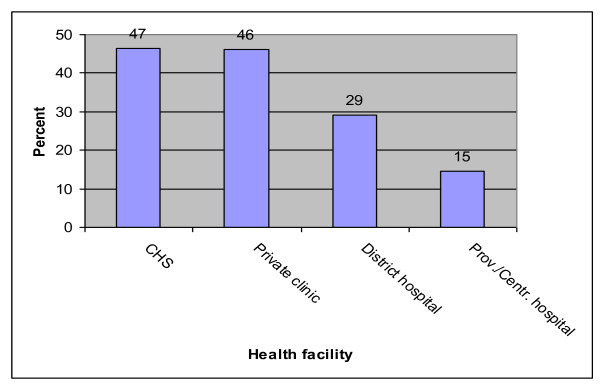
Eighty nine percent of ever-married women reported current use of birth control with 49% choosing intra-uterine device (IUD). Eighty nine percent of pregnant women attended facility-based antenatal care (ANC) with 62% having at least 3 check-ups during their latest pregnancy. Ninety one percent of mothers had their last delivery in a health facility. Seventy-one percent of respondents used CHS for IUD insertion, 55% for antenatal check-ups, and 77% gynecological examination. District and provincial/central hospitals dominated the provision of delivery service, used by 57% of mothers for their latest delivery. The percentage of women opting for private ANC services was reported at 35%, though the use of private delivery services was low (11%). Women who were farmers, earning a lower income, having more than 2 children, and living in a rural area were more likely than others to use ANC, delivery, and/or gynecological check-up services at the CHS.
Women choice of providers for FP and RH services that help them plan and protect their pregnancies is driven by socio-economic factors. While the CHS retains significant utilization rates, it is under challenge by preferences for hospital-based delivery and the growing use of private ANC services.
随着越南医疗卫生体制改革向多元化发展,公社卫生站(CHS)面临着来自私立医疗机构和越来越多的病人的竞争,后者选择绕过公社卫生站前往更高层级的医疗机构就诊。本研究描述了在公社卫生站和其他医疗机构就诊的女性在生殖健康(RH)和计划生育(FP)服务方面的利用模式,并探讨了在公社卫生站一级 RH 服务利用的社会人口学决定因素。
本研究基于在顺化省和广义省进行的一项横断面调查,采用多阶段聚类抽样技术。对 978 名处于生育年龄的已婚女性进行了基于问卷的访谈,收集了社会人口统计学特征、当前使用 FP 方法、RH 服务使用史以及最近一次服务所就诊的卫生机构等数据。采用多因素逻辑回归分析方法确定了她们使用公社卫生站 RH 服务的社会人口学决定因素。
89%的已婚女性报告称正在使用节育方法,其中 49%选择宫内节育器(IUD)。89%的孕妇接受了基于医疗机构的产前保健(ANC),其中 62%在最近一次怀孕时至少进行了 3 次检查。91%的产妇在医疗机构分娩。71%的受访者在公社卫生站接受了 IUD 放置,55%接受了产前检查,77%接受了妇科检查。区和省/中央医院在提供分娩服务方面占据主导地位,57%的产妇选择在这些医院进行最近一次分娩。报告称有 35%的女性选择私立 ANC 服务,但使用私立分娩服务的比例较低(11%)。与其他女性相比,农民、收入较低、有 2 个以上孩子和居住在农村地区的女性更有可能选择在公社卫生站接受 ANC、分娩和/或妇科检查服务。
女性选择 FP 和 RH 服务提供者,以帮助她们计划和保护妊娠,这是由社会经济因素驱动的。尽管公社卫生站仍然具有较高的利用率,但它面临着来自医院分娩偏好和私立 ANC 服务日益增长的使用的挑战。