Institute of Medicine, Tribhuwan University, Maharajgunj, Kathmandu, Nepal.
University of Oslo, Oslo, Norway.
BMC Pregnancy Childbirth. 2020 May 19;20(1):308. doi: 10.1186/s12884-020-02976-y.
With the formulation of the National Safe Motherhood Policy in 1998, safe motherhood has forever been a priority program in Nepal. Under the safe motherhood program, every woman is provided with essential maternal health care services until now through the four-tire district health care system. There is a considerable increase in the utilization of antenatal care (ANC) by a skilled health provider from 2011 to 2016, 58 to 84%, respectively. However, inequality, exclusion, and under-utilization in health care services continue in many regions of Nepal. The present study aimed to explore the different types of socio-demographic factors associated with current ANC service utilization in Nepal.
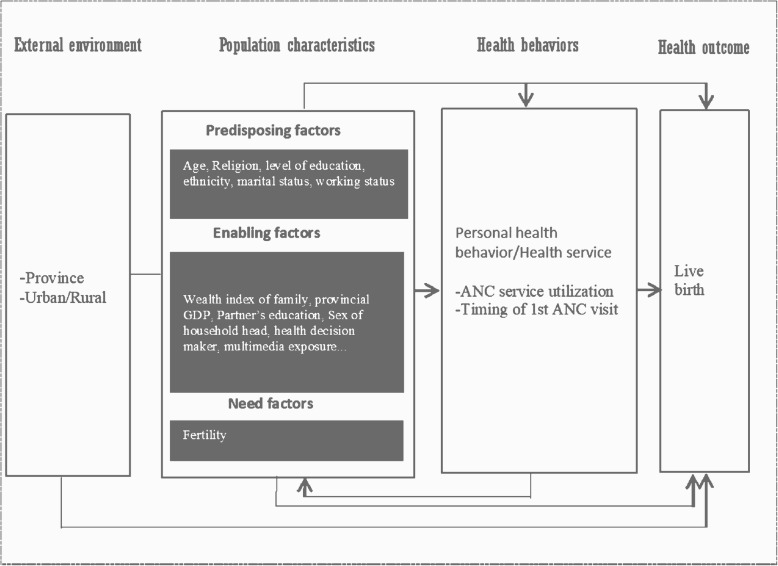
A cross-sectional study was conducted using the Nepal Demographic and Health Surveys data (DHS-7, 2016-2017). We estimated the latest pregnancy and live births in recent 5 years with the utilization of ANC services, and socio-economic differentials in these indicators under the framework of the Andersen behavioral model.
Two in three (69.8%) with last birth accessed at least four ANC visits. The rate of live birth was about 98.6% in the ANC4+ group, higher than that of 96.8% in the ANC4- group (χ2: 14.742, P < 0.001). In the multilevel logistic regression analysis, we found that women from province 2 (OR: 0.48; 95%CI: 0.32-0.74) and province 6 (OR: 0.46; 95%CI: 0.30-0.71) were significantly less likely to visit ANC 4 or more times. Age (OR: 0.95; 95%CI: 0.93-0.96) was also significantly associated with the frequency of ANC visits. Level of Women's education and education of her partner were both significantly associated with the ANC visits: women (OR: 4.64; 95%CI: 3.05-7.05) and her partner (OR: 1.45; 95%CI: 1.01-2.06) having higher education were most likely to go for the recommended number of ANC visits. Moreover, women having exposure to multimedia were more likely to go for four or more ANC check-ups.
The results highlight the need for governments and health care providers to develop special health promotion program with a focus on the vulnerable and disadvantaged and to use multi-media for maternal health literacy improvement flexibly, and maternal health system strengthening.
自 1998 年制定国家母婴安全政策以来,母婴安全一直是尼泊尔的重点项目。在母婴安全项目下,通过四级地区医疗保健系统,每个妇女都能获得基本的孕产妇保健服务。从 2011 年到 2016 年,由熟练卫生提供者提供的产前护理(ANC)利用率显著提高,分别为 58%至 84%。然而,在尼泊尔的许多地区,医疗服务的不平等、排斥和利用不足仍然存在。本研究旨在探讨与尼泊尔当前 ANC 服务利用相关的不同类型的社会人口因素。
本研究采用尼泊尔人口与健康调查(DHS-7,2016-2017 年)的横断面研究。我们根据安德森行为模型,估计了最近 5 年中最新妊娠和活产的 ANC 服务利用情况,并对这些指标进行了社会经济差异分析。
三分之二(69.8%)的最近一次分娩接受了至少四次 ANC 检查。ANC4+组的活产率约为 98.6%,高于 ANC4-组的 96.8%(χ2:14.742,P<0.001)。在多水平逻辑回归分析中,我们发现来自第二省(OR:0.48;95%CI:0.32-0.74)和第六省(OR:0.46;95%CI:0.30-0.71)的妇女接受 ANC4 次或以上的可能性显著降低。年龄(OR:0.95;95%CI:0.93-0.96)也与 ANC 检查次数显著相关。妇女教育水平和其伴侣教育水平均与 ANC 检查次数显著相关:妇女(OR:4.64;95%CI:3.05-7.05)和其伴侣(OR:1.45;95%CI:1.01-2.06)接受更高水平的教育,最有可能接受建议的 ANC 检查次数。此外,接触多媒体的妇女更有可能接受四次或更多次 ANC 检查。
结果强调了政府和医疗保健提供者需要制定针对弱势群体和劣势群体的特别健康促进计划,并灵活利用多媒体提高孕产妇健康素养,加强孕产妇保健系统。