Department of Developmental and Clinical Psychology, University of Tilburg, The Netherlands.
Crisis. 2011;32(6):319-33. doi: 10.1027/0227-5910/a000109.
Evidence-based best practices for incorporation into an optimal multilevel intervention for suicide prevention should be identifiable in the literature.
To identify effective interventions for the prevention of suicidal behavior.
Review of systematic reviews found in the Pubmed, Cochrane, and DARE databases. Steps include risk-of-bias assessment, data extraction, summarization of best practices, and identification of synergistic potentials of such practices in multilevel approaches.
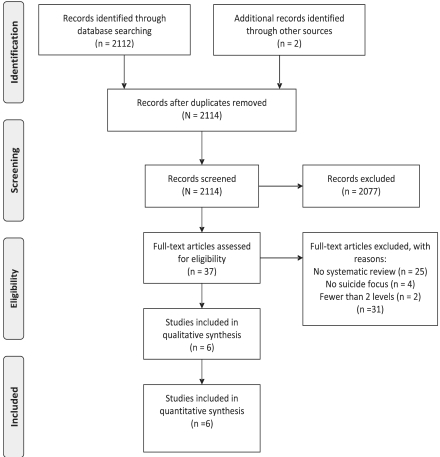
Six relevant systematic reviews were found. Best practices identified as effective were as follows: training general practitioners (GPs) to recognize and treat depression and suicidality, improving accessibility of care for at-risk people, and restricting access to means of suicide. Although no outcomes were reported for multilevel interventions or for synergistic effects of multiple interventions applied together, indirect support was found for possible synergies in particular combinations of interventions within multilevel strategies.
A number of evidence-based best practices for the prevention of suicide and suicide attempts were identified. Research is needed on the nature and extent of potential synergistic effects of various preventive activities within multilevel interventions.
纳入预防自杀的最佳多层次干预措施的循证最佳实践应该在文献中是可识别的。
确定预防自杀行为的有效干预措施。
对 Pubmed、Cochrane 和 DARE 数据库中发现的系统评价进行综述。步骤包括对偏倚风险进行评估、提取数据、总结最佳实践,并确定此类实践在多层次方法中的协同潜力。
发现了 6 项相关的系统评价。被确定为有效的最佳实践如下:培训全科医生(GP)识别和治疗抑郁和自杀倾向、提高高危人群的护理可及性以及限制自杀手段的获取。虽然没有报告多层次干预措施或多种干预措施一起应用的协同作用的结果,但间接支持了在多层次策略中特定干预措施组合内可能存在协同作用的证据。
确定了一些预防自杀和自杀未遂的循证最佳实践。需要研究多层次干预措施中各种预防活动的潜在协同作用的性质和程度。