Department of Biological Sciences, University of Toronto, 1265 Military Trail, Toronto, Ontario, Canada M1C 1A4.
J Exp Bot. 2012 Jan;63(1):151-62. doi: 10.1093/jxb/err267. Epub 2011 Sep 23.
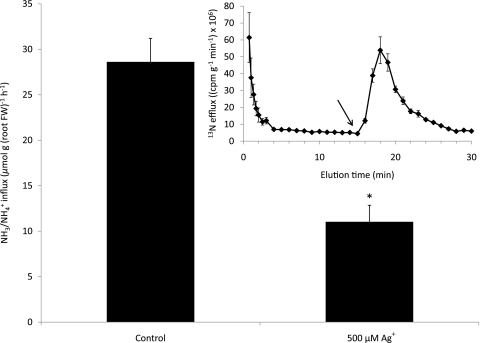
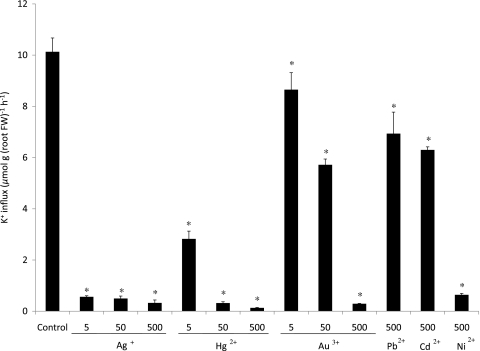
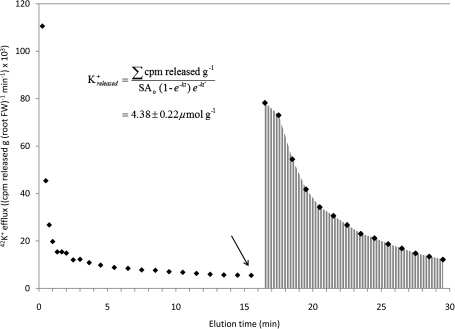
The heavy metals silver, gold, and mercury can strongly inhibit aquaporin-mediated water flow across plant cell membranes, but critical examinations of their side effects are rare. Here, the short-lived radiotracer (42)K is used to demonstrate that these metals, especially silver, profoundly change potassium homeostasis in roots of intact barley (Hordeum vulgare L.) plants, by altering unidirectional K(+) fluxes. Doses as low as 5 μM AgNO(3) rapidly reduced K(+) influx to 5% that of controls, and brought about pronounced and immediate increases in K(+) efflux, while higher doses of Au(3+) and Hg(2+) were required to produce similar responses. Reduced influx and enhanced efflux of K(+) resulted in a net loss of >40% of root tissue K(+) during a 15 min application of 500 μM AgNO(3), comprising the entire cytosolic potassium pool and about a third of the vacuolar pool. Silver also brought about major losses of UV-absorbing compounds, total electrolytes, and NH(4)(+). Co-application, with silver, of the channel blockers Cs(+), TEA(+), or Ca(2+), did not affect the enhanced efflux, ruling out the involvement of outwardly rectifying ion channels. Taken together with an examination of propidium iodide staining under confocal microscopy, the results indicate that silver ions affect K(+) homeostasis by directly inhibiting K(+) influx at lower concentrations, and indirectly inhibiting K(+) influx and enhancing K(+) efflux, via membrane destruction, at higher concentrations. Ni(2+), Cd(2+), and Pb(2+), three heavy metals not generally known to affect aquaporins, did not enhance K(+) efflux or cause propidium iodide incorporation. The study reveals strong and previously unknown effects of major aquaporin inhibitors and recommends caution in their application.
重金属银、金和汞可以强烈抑制水通道蛋白介导的植物细胞膜水流动,但对它们的副作用的批判性检查很少。在这里,使用短寿命放射性示踪剂 (42)K 来证明这些金属,特别是银,通过改变单向 K(+)通量,深刻地改变了完整大麦(Hordeum vulgare L.)植物根部的钾稳态。低至 5 μM AgNO(3)的剂量迅速将 K(+)内流降低到对照的 5%,并立即引起 K(+)外排的明显增加,而更高剂量的 Au(3+)和 Hg(2+)则需要产生类似的反应。减少 K(+)内流和增强 K(+)外排导致 500 μM AgNO(3) 应用 15 分钟后,根组织 K(+)的净损失超过 40%,包括整个细胞质钾池和约三分之一的液泡钾池。银还导致吸收紫外线的化合物、总电解质和 NH(4)(+)的大量损失。与银一起应用通道阻滞剂 Cs(+)、TEA(+)或 Ca(2+),不会影响增强的外排,排除了外向整流离子通道的参与。与共焦显微镜下碘化丙啶染色的检查一起,结果表明,银离子通过在较低浓度下直接抑制 K(+)内流,以及通过在较高浓度下破坏膜来间接抑制 K(+)内流和增强 K(+)外排,来影响 K(+)稳态。镍(Ni(2+))、镉(Cd(2+))和铅(Pb(2+)),三种通常不被认为影响水通道蛋白的重金属,不会增强 K(+)外排或导致碘化丙啶掺入。该研究揭示了主要水通道蛋白抑制剂的强烈和以前未知的影响,并建议在应用时谨慎。