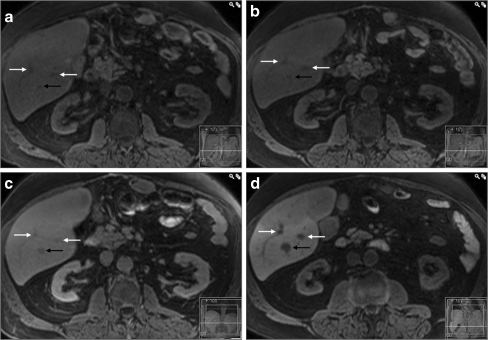
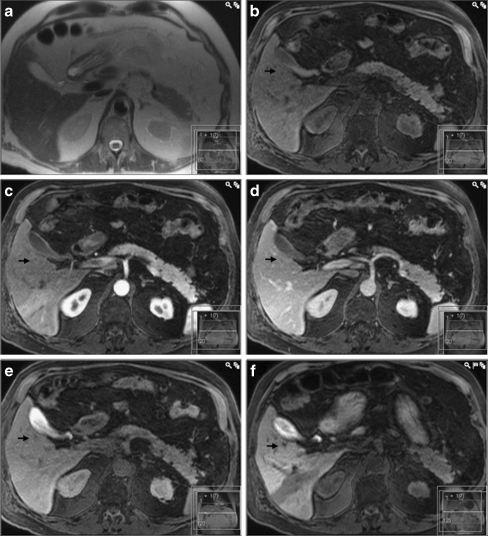
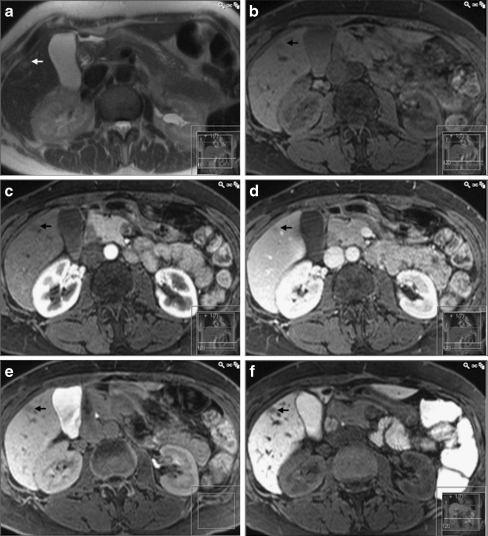
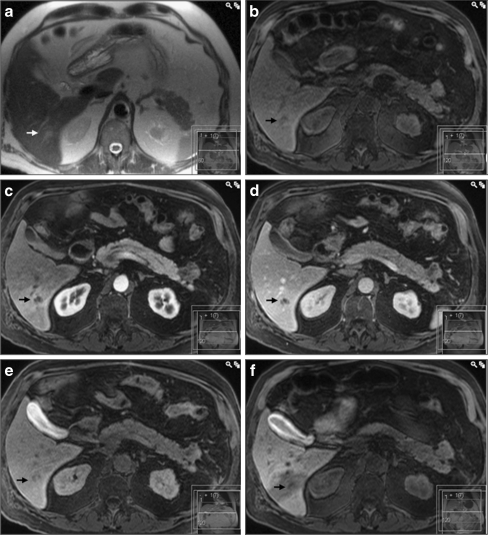
Division of Medical Imaging and Technology, Department of Clinical Science, Intervention and Technology (CLINTEC), Karolinska Institutet, Stockholm, Sweden.
Eur Radiol. 2012 Mar;22(3):633-41. doi: 10.1007/s00330-011-2288-y. Epub 2011 Sep 28.
To compare the sensitivity of MRI to detect colorectal cancer liver metastases (CRLM) after ingestion of manganese-based contrast agent (CMC-001) with that of a comprehensive intravenous gadobenate dimeglumine protocol, and to assess the safety and acceptability of oral manganese.
20 patients suspected of having 1-6 CRLM were included prospectively in this randomised cross-over study. Liver MRI was performed with a one-week interval at 1.5 T and included T1-w VIBE and T2-HASTE, before and after administration of 1.6 g CMC-001 or 0.1 mmol/kg gadobenate dimeglumine. The metastasis-to-liver signal intensity (SI) ratio was calculated. Standard of reference was histopathology after surgery, or combination of other imaging studies and/or follow up. Adverse events (AE) and clinicolaboratory tests were monitored.
Of 44 metastases, 41 were detected after CMC-001 (93%) and 42 after gadobenate dimeglumine (95%). Fifteen false-positive lesions were found after CMC-001 and 2 after gadobenate dimeglumine. The metastasis-to-liver SI ratio was significantly higher after CMC-001 than after gadobenate dimeglumine (0.51 and 0.21 respectively, P < 0.0001). More AE occurred after manganese compared to gadobenate dimeglumine.
CMC-001 is as sensitive as an extensive intravenous gadobenate dimeglumine protocol in detecting CRLM. It was relatively well tolerated but had higher rates of gastrointestinal AE.
• Liver MRI after ingestion of manganese is highly sensitive for detecting metastases • High false-positive rate necessitates further evaluation, in some cases • The MR examination time is short • Oral ingestion of manganese seems safe and relatively well tolerated by patients • Manganese compounds may be useful for liver metastasis surveillance after colorectal cancer.
比较口服锰对比剂(CMC-001)后 MRI 检测结直肠癌肝转移(CRLM)的敏感性与综合静脉钆贝葡胺方案的敏感性,并评估口服锰的安全性和可接受性。
前瞻性纳入 20 例疑似 1-6 个 CRLM 的患者进行这项随机交叉研究。在 1.5T 上进行肝脏 MRI 检查,间隔 1 周,包括 T1-w VIBE 和 T2-HASTE,在给予 1.6g CMC-001 或 0.1mmol/kg 钆贝葡胺前后进行。计算转移灶与肝脏信号强度(SI)比值。参考标准为手术后的组织病理学,或其他影像学研究和/或随访的组合。监测不良事件(AE)和临床实验室检查。
在 44 个转移灶中,41 个在 CMC-001 后(93%),42 个在钆贝葡胺后(95%)被发现。在 CMC-001 后发现 15 个假阳性病变,在钆贝葡胺后发现 2 个。在 CMC-001 后转移灶与肝脏 SI 比值明显高于钆贝葡胺后(分别为 0.51 和 0.21,P<0.0001)。与钆贝葡胺相比,锰后发生的 AE 更多。
与广泛的静脉内钆贝葡胺方案相比,CMC-001 在检测 CRLM 方面同样敏感。它相对耐受良好,但胃肠道 AE 发生率较高。
口服锰后行肝脏 MRI 对检测转移灶高度敏感
高假阳性率需要进一步评估,在某些情况下
MR 检查时间短
口服锰似乎对患者安全且相对耐受良好
锰化合物可能对结直肠癌肝转移的监测有用。