Department of Physiology and Functional Genomics, University of Florida, Gainesville, Florida 32610, USA.
Microcirculation. 2012 Jan;19(1):19-28. doi: 10.1111/j.1549-8719.2011.00139.x.
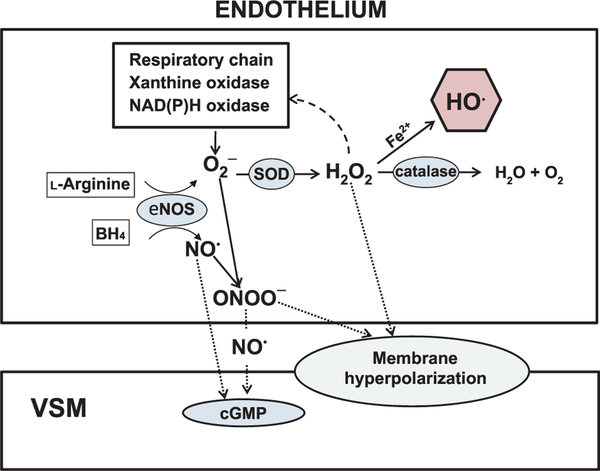
Cardiovascular aging is associated with a decline in the function of the vascular endothelium. Considerable evidence indicates that age-induced impairment of endothelium-dependent vasodilation results from a reduction in the availability of nitric oxide (NO(•) ). NO(•) can be scavenged by reactive oxygen species (ROS), in particular by superoxide radical (O(2) (•-) ), and age-related increases in ROS have been demonstrated to contribute to reduced endothelium-dependent vasodilation in numerous large artery preparations. In contrast, emerging data suggest that ROS may play a compensatory role in endothelial function of the aging microvasculature. The primary goal of this review is to discuss reports in the literature which indicate that ROS function as important signaling molecules in the aging microvasculature. Emphasis is placed upon discussion of the emerging roles of hydrogen peroxide (H(2) O(2) ) and peroxynitrite (ONOO(•-) ) in the aging microcirculation. Overall, existing data in animal models suggest that maintenance in the balance of ROS is critical to successful microvascular aging. The limited work that has been performed to investigate the role of ROS in human microvascular aging is also discussed, and the need for future investigations of ROS signaling in older humans is considered.
心血管衰老与血管内皮功能下降有关。大量证据表明,年龄引起的内皮依赖性血管舒张功能障碍是由于一氧化氮(NO(•))的可用性降低所致。NO(•)可被活性氧(ROS),特别是超氧自由基(O(2)(•-))清除,并且已经证明与年龄相关的 ROS 增加有助于许多大动脉制剂中内皮依赖性血管舒张的减少。相比之下,新出现的数据表明 ROS 可能在衰老微血管内皮功能中起代偿作用。本综述的主要目标是讨论文献中的报告,这些报告表明 ROS 作为衰老微血管中的重要信号分子发挥作用。重点讨论了过氧化氢(H(2)O(2))和过氧亚硝酸盐(ONOO(•-))在衰老微循环中的新兴作用。总的来说,动物模型中的现有数据表明,维持 ROS 的平衡对于成功的微血管衰老至关重要。还讨论了在人类微血管衰老中研究 ROS 作用的有限工作,并考虑了在老年人中研究 ROS 信号的必要性。