VA RR&D National Center for Rehabilitative Auditory Research, VA, Medical Center, Department of Otolaryngology/Head and Neck Surgery, Oregon Health & Science University, Portland, Oregon 97207, USA.
Ear Hear. 2012 Mar-Apr;33(2):179-290. doi: 10.1097/AUD.0b013e31822f6740.
Because audiometric evaluation, symptom histories, questionnaires, and similar standard assessment tools may not adequately sample the effects of chronic tinnitus on day-to-day activities, there is a need for alternative methodological approaches to study the impact of tinnitus on day-to-day life. An innovative methodological approach that has shown great promise in the study of chronic health problems characterized by reported temporal and/or situational variability in symptoms and distress is known as ecological momentary assessment (EMA). EMA involves the real-time measurement of states, situational factors, and symptoms by individuals as they go about their day-to-day activities. The objective of this pilot investigation was to explore the feasibility of using EMA methods to examine within- and between-day effects of tinnitus.
This study was conducted in three phases: (1) design and development of an EMA methodology that could be used to assess effects of tinnitus; (2) refinement of the methodology through the use of two focus groups; and (3) field-test the methodology with individuals who experienced bothersome tinnitus. For Phase 3, each of the 24 participants wore, throughout their waking hours for 2 weeks, a personal digital assistant that produced alerts four times a day. The alerts prompted participants to respond to 19 questions, including 9 relating to situational and mood factors and 10 comprising the Tinnitus Handicap Inventory-Screening version (THI-S). To evaluate for potential reactive effects of performing the EMA protocol, each participant completed the paper-and-pencil version of the full 25-item THI before and after the 2-week EMA period.
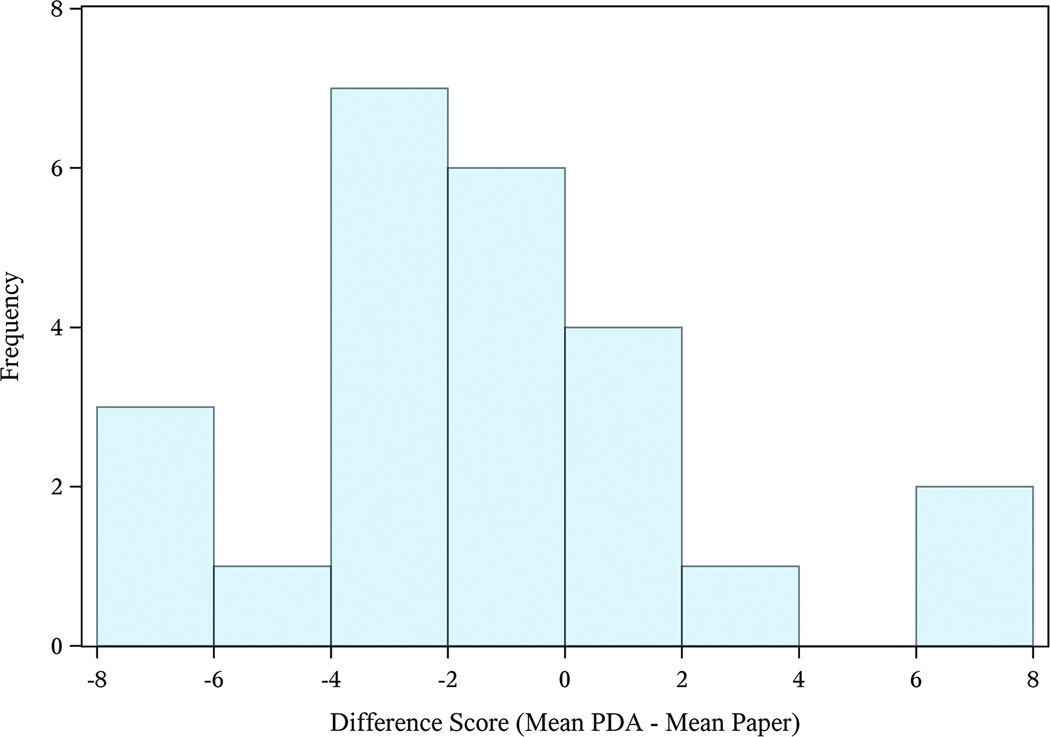
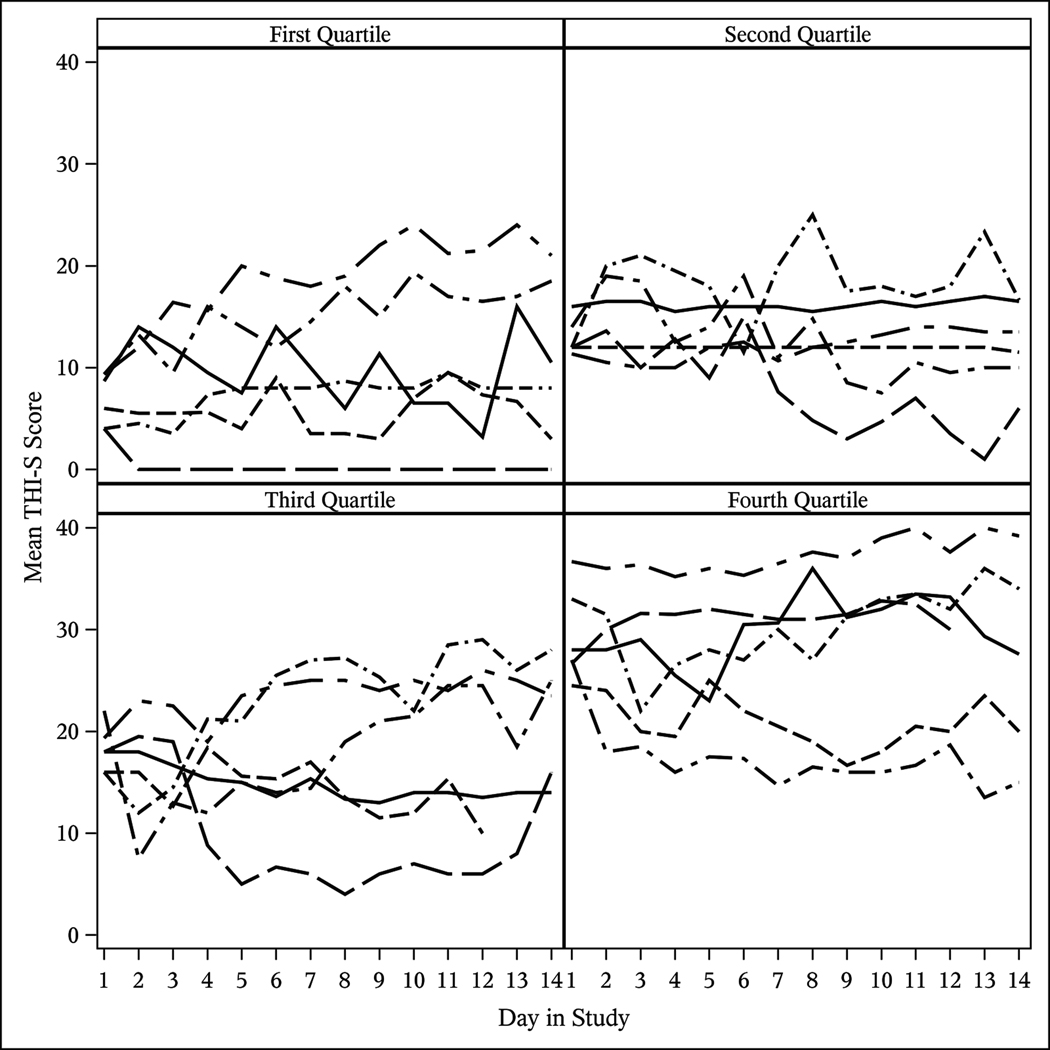
Participants responded to the alerts with a 90% compliance rate, providing a total of 1210 completed surveys. At the time of their response, participants indicated that they were in their house or apartment (67.7%), alone (50.2%), happy (50%), and calm (54.5%). Across most responses, participants could hear their tinnitus (97%), and the loudness of their tinnitus averaged 4.7 on a 7-point increasing-loudness scale. The mean THI-S index score (out of a possible maximum 40 points for greatest tinnitus severity) was 17.0 (moderate self-perceived tinnitus handicap). Repeated THI-S index scores varied considerably both within and between participants. Mean 25-item THI scores were not significantly different before and after the EMA period, suggesting little reactivity of the EMA.
The high compliance rate, positive feedback from participants, lack of reactivity as a result of performing the EMA protocol, and data collected indicate that EMA methodology is feasible with patients who have tinnitus. Outcome data obtained with this methodology cannot be obtained any other way because retrospective questionnaires cannot capture the day-to-day reactions. This methodology has the potential to provide more in-depth and accurate assessments of patients receiving therapy for tinnitus.
由于听力评估、症状史、问卷和类似的标准评估工具可能无法充分采样慢性耳鸣对日常活动的影响,因此需要替代方法来研究耳鸣对日常生活的影响。一种创新的方法学方法在研究以症状和痛苦的报告时间和/或情境变异性为特征的慢性健康问题方面显示出巨大的前景,称为生态瞬时评估(EMA)。EMA 涉及个体在日常生活活动中实时测量状态、情境因素和症状。本研究的目的是探讨使用 EMA 方法检查耳鸣的日内和日间效应的可行性。
这项研究分三个阶段进行:(1)设计和开发一种 EMA 方法,可用于评估耳鸣的影响;(2)通过使用两个焦点小组对方法进行改进;(3)用经历令人烦恼的耳鸣的个体对该方法进行现场测试。在第 3 阶段,24 名参与者中的每一名在两周的清醒时间内,每天四次佩戴个人数字助理,该助理会发出警报。警报提示参与者回答 19 个问题,其中 9 个与情境和情绪因素有关,10 个由耳鸣障碍量表-筛查版(THI-S)组成。为了评估执行 EMA 方案的潜在反应性影响,每个参与者在 2 周 EMA 期前后完成了完整的 25 项 THI 的纸笔版。
参与者以 90%的合规率回复了警报,共提供了 1210 份完整的调查问卷。在回复时,参与者表示他们在自己的房子或公寓(67.7%)、独自一人(50.2%)、快乐(50%)和冷静(54.5%)。在大多数情况下,参与者都能听到他们的耳鸣(97%),他们的耳鸣响度平均为 7 点递增响度量表上的 4.7。THI-S 指数得分的平均值(最高可能得分为 40 分,代表最大的耳鸣严重程度)为 17.0(中度自我感知的耳鸣障碍)。参与者的 THI-S 指数得分差异很大,既有个体内的差异,也有个体间的差异。在 EMA 期间前后,25 项 THI 的平均得分没有显著差异,这表明 EMA 没有反应性。
高合规率、参与者的积极反馈、由于执行 EMA 方案而缺乏反应性,以及收集到的数据表明,耳鸣患者可以使用 EMA 方法。使用这种方法学获得的结果数据是无法通过其他方式获得的,因为回顾性问卷无法捕捉日常反应。这种方法有可能为接受耳鸣治疗的患者提供更深入和准确的评估。