
牛磺熊去氧胆酸(TUDCA)可保护实验性视网膜脱离后光感受器细胞免于死亡。
Tauroursodeoxycholic acid (TUDCA) protects photoreceptors from cell death after experimental retinal detachment.
机构信息
Retina Service, Angiogenesis Laboratory, Massachusetts Eye and Ear Infirmary, Department of Ophthalmology, Harvard Medical School, Boston, Massachusetts, United States of America.
出版信息
PLoS One. 2011;6(9):e24245. doi: 10.1371/journal.pone.0024245. Epub 2011 Sep 22.
BACKGROUND
Detachment of photoreceptors from the underlying retinal pigment epithelium is seen in various retinal disorders such as retinal detachment and age-related macular degeneration and leads to loss of photoreceptors and vision. Pharmacologic inhibition of photoreceptor cell death may prevent this outcome. This study tests whether systemic administration of tauroursodeoxycholic acid (TUDCA) can protect photoreceptors from cell death after experimental retinal detachment in rodents.
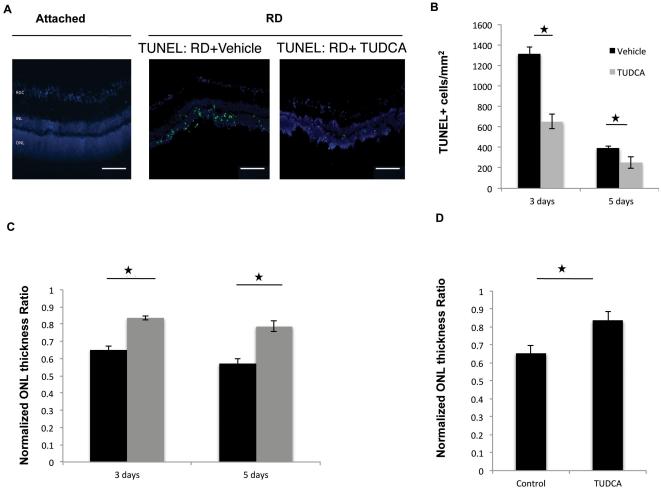
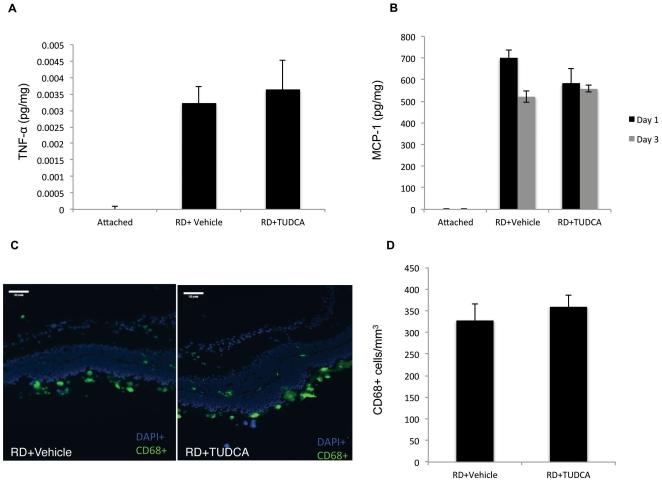
METHODOLOGY/PRINCIPAL FINDINGS: Retinal detachment was created in rats by subretinal injection of hyaluronic acid. The animals were treated daily with vehicle or TUDCA (500 mg/kg). TUNEL staining was used to evaluate cell death. Photoreceptor loss was evaluated by measuring the relative thickness of the outer nuclear layer (ONL). Macrophage recruitment, oxidative stress, cytokine levels, and caspase levels were also quantified. Three days after detachment, TUDCA decreased the number of TUNEL-positive cells compared to vehicle (651±68/mm(2) vs. 1314±68/mm(2), P = 0.001) and prevented the reduction of ONL thickness ratio (0.84±0.03 vs. 0.65±0.03, P = 0.002). Similar results were obtained after 5 days of retinal detachment. Macrophage recruitment and expression levels of TNF-a and MCP-1 after retinal detachment were not affected by TUDCA treatment, whereas increases in activity of caspases 3 and 9 as well as carbonyl-protein adducts were almost completely inhibited by TUDCA treatment.
CONCLUSIONS/SIGNIFICANCE: Systemic administration of TUDCA preserved photoreceptors after retinal detachment, and was associated with decreased oxidative stress and caspase activity. TUDCA may be used as a novel therapeutic agent for preventing vision loss in diseases that are characterized by photoreceptor detachment.
背景
在各种视网膜疾病中,如视网膜脱离和年龄相关性黄斑变性,感光细胞从其下方的视网膜色素上皮细胞分离,导致感光细胞和视力丧失。抑制感光细胞死亡的药理学干预可能阻止这种结果。本研究测试了熊去氧胆酸(TUDCA)的全身给药是否可以在实验性视网膜脱离后保护啮齿动物的感光细胞免受细胞死亡。
方法/主要发现:通过视网膜下注射透明质酸在大鼠中制造视网膜脱离。动物每天用载体或 TUDCA(500mg/kg)治疗。TUNEL 染色用于评估细胞死亡。通过测量外核层(ONL)的相对厚度来评估感光细胞的损失。还定量了巨噬细胞募集、氧化应激、细胞因子水平和半胱天冬酶水平。脱离后 3 天,与载体相比,TUDCA 减少了 TUNEL 阳性细胞的数量(651±68/mm² vs. 1314±68/mm²,P=0.001)并防止了 ONL 厚度比的降低(0.84±0.03 vs. 0.65±0.03,P=0.002)。在视网膜脱离 5 天后也得到了类似的结果。TUDCA 处理对视网膜脱离后巨噬细胞募集和 TNF-a 和 MCP-1 的表达水平没有影响,而半胱天冬酶 3 和 9 的活性增加以及羰基蛋白加合物几乎完全被 TUDCA 处理抑制。
结论/意义:全身给予 TUDCA 可在视网膜脱离后保护感光细胞,并与减少氧化应激和半胱天冬酶活性有关。TUDCA 可作为一种新型治疗药物,用于预防以感光细胞脱离为特征的疾病导致的视力丧失。



 Zotero 插件