Department of Integrative Physiology, UCB 354, University of Colorado, Boulder, CO 80309, USA.
Gait Posture. 2012 Jan;35(1):143-7. doi: 10.1016/j.gaitpost.2011.08.025. Epub 2011 Oct 2.
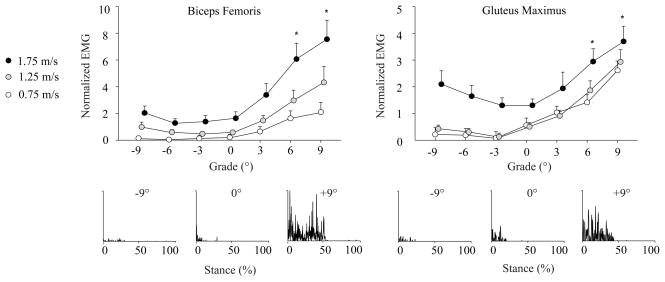
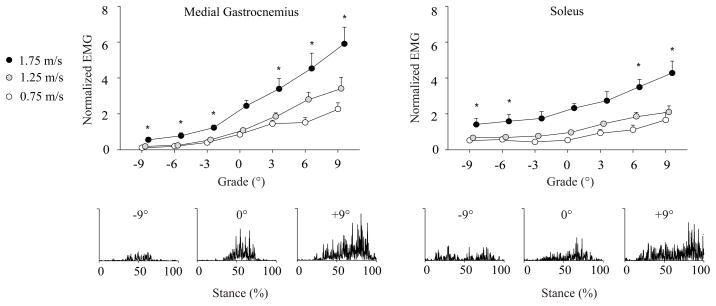
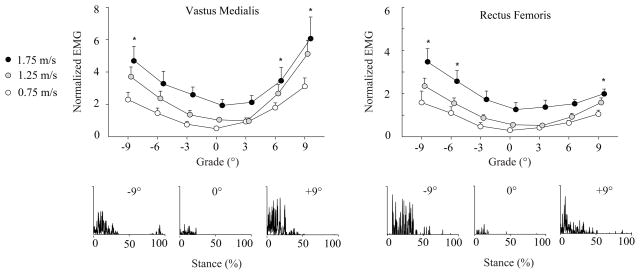
Compared to level walking, additional muscle actions are required to raise and lower the center of mass during uphill and downhill walking, respectively. However, it remains unclear which muscle recruitment strategies are employed at typical grades when walking over a range of speeds. Based on previous reports, we hypothesized that, across a range of walking speeds, hip, knee, and ankle extensor muscle activations would increase with steeper uphill grade, but only knee extensor muscle activations would increase with steeper downhill grade. We also hypothesized that these changes in muscle activations with grade would become more pronounced at faster walking speeds. To test these hypotheses, 10 young adults (5M/5F) walked on a standard treadmill at seven grades (0°, ± 3°, ± 6°, and ± 9°) and three speeds (0.75, 1.25, and 1.75 ms(-1)). We quantified the stance phase electromyographic activities of the gluteus maximus (GMAX), biceps femoris (BF), rectus femoris (RF), vastus medialis (VM), medial gastrocnemius (MG), and soleus (SOL) muscles. On average, compared to level walking, hip (BF: 635%, GMAX: 345%), knee (RF: 165%, VM: 366%), and ankle (MG: 175%, SOL: 136%) extensor muscle activities increased to walk up 9°, but only knee (RF: 310%, VM: 246%) extensor muscle activities increased to walk down 9°. Further, these changes in muscle activations with grade became greater with faster walking speed. We conclude that people employ distinct uphill (hip, knee, and ankle extensors) and downhill (knee extensors) muscle recruitment strategies generally across walking speeds and progressively with steeper grade.
与平地行走相比,在上坡和下坡行走时分别需要额外的肌肉活动来抬起和降低质心。然而,当以不同的速度行走时,在典型的坡度下,人们采用哪种肌肉募集策略仍不清楚。根据以往的报告,我们假设,在不同的行走速度范围内,随着坡度变陡,髋关节、膝关节和踝关节伸肌的激活会增加,但只有膝关节伸肌的激活会随着坡度变陡而增加。我们还假设,随着行走速度的增加,这些肌肉激活随坡度的变化会变得更加明显。为了验证这些假设,10 名年轻成年人(5 男/5 女)在 7 个坡度(0°、±3°、±6°和±9°)和 3 个速度(0.75、1.25 和 1.75 ms(-1))上在标准跑步机上行走。我们量化了臀大肌(GMAX)、股二头肌(BF)、股直肌(RF)、股中间肌(VM)、内侧腓肠肌(MG)和比目鱼肌(SOL)肌肉在站立相的肌电活动。平均而言,与平地行走相比,髋关节(BF:635%,GMAX:345%)、膝关节(RF:165%,VM:366%)和踝关节(MG:175%,SOL:136%)伸肌的肌肉活动增加了 9°,但只有膝关节(RF:310%,VM:246%)伸肌的肌肉活动增加了 9°。此外,这些随坡度变化的肌肉激活随着行走速度的增加而增加。我们得出的结论是,人们通常在不同的行走速度下采用不同的上坡(髋关节、膝关节和踝关节伸肌)和下坡(膝关节伸肌)肌肉募集策略,并随着坡度的增加而逐渐增加。