United States Agency for International Development-Academic Model Providing Access to Healthcare Partnership, Eldoret, Kenya.
J Acquir Immune Defic Syndr. 2011 Dec 15;58(5):e121-6. doi: 10.1097/QAI.0b013e318237ca80.
To determine the impact of routine care (RC) and integrated family planning (IFP) and HIV care service on family planning (FP) uptake and pregnancy outcomes.
Retrospective cohort study conducted between October 10, 2005, and February 28, 2009.
United States Agency for International Development-Academic Model Providing Access To Healthcare (USAID-AMPATH) in western Kenya.
Records of adult HIV-infected women.
Integration of FP into one of the care teams. PRIMARY OUTCOMES MEASURES: Incidence of FP methods and pregnancy.
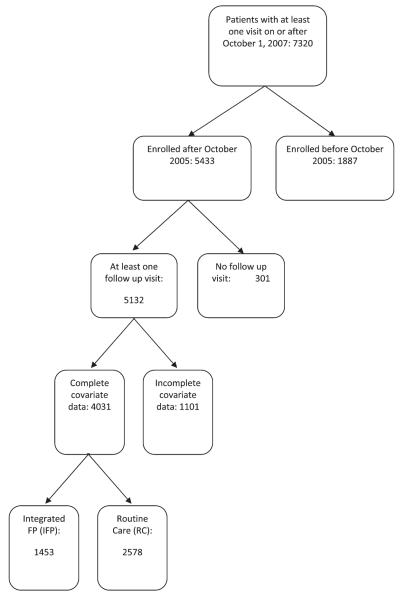
Four thousand thirty-one women (1453 IFP; 2578 RC) were eligible. Among the IFP group, there was a 16.7% increase (P < 0.001) [95% confidence interval (CI): 13.2% to 20.2%] in incidence of condom use, 12.9% increase (P < 0.001) (95% CI: 9.4% to 16.4%) in incidence of FP use including condoms, 3.8% reduction (P < 0.001) (95% CI: 1.9% to 5.6%) in incidence of FP use excluding condoms, and 0.1% increase (P = 0.9) (95% CI: -1.9% to 2.1%) in incidence of pregnancies. The attributable risk of the incidence rate per 100 person-years of IFP and RC for new condom use was 16.4 (95% CI: 11.9 to 21.0), new FP use including condoms was 13.5 (95% CI: 8.7 to 18.3), new FP use excluding condoms was -3.0 (95% CI: -4.6 to -1.4) and new cases of pregnancies was 1.2 (95% CI: -0.6 to 3.0).
Integrating FP services into HIV care significantly increased the use of modern FP methods but no impact on pregnancy incidence. HIV programs need to consider integrating FP into their program structure.
确定常规护理(RC)和综合计划生育(IFP)以及艾滋病毒护理服务对计划生育(FP)的采用和妊娠结局的影响。
2005 年 10 月 10 日至 2009 年 2 月 28 日进行的回顾性队列研究。
美国国际开发署-学术模式提供医疗保健(USAID-AMPATH)在肯尼亚西部。
成年艾滋病毒感染者的记录。
将 FP 纳入其中一个护理团队。主要结局测量:FP 方法和妊娠的发生率。
符合条件的妇女有 4031 名(IFP 组 1453 名;RC 组 2578 名)。在 IFP 组中,避孕套使用率增加了 16.7%(P<0.001)[95%置信区间(CI):13.2%至 20.2%],FP 使用率(包括避孕套)增加了 12.9%(P<0.001)(95%CI:9.4%至 16.4%),FP 使用率(不包括避孕套)减少了 3.8%(P<0.001)(95%CI:1.9%至 5.6%),妊娠发生率增加了 0.1%(P=0.9)(95%CI:-1.9%至 2.1%)。每 100 人年 IFP 和 RC 的新避孕套使用率的发病率归因风险为 16.4(95%CI:11.9 至 21.0),新的包括避孕套在内的 FP 使用率为 13.5(95%CI:8.7 至 18.3),新的不包括避孕套在内的 FP 使用率为-3.0(95%CI:-4.6 至-1.4),新的妊娠病例数为 1.2(95%CI:-0.6 至 3.0)。
将 FP 服务纳入艾滋病毒护理服务显著增加了现代 FP 方法的使用,但对妊娠发生率没有影响。艾滋病毒规划需要考虑将 FP 纳入其规划结构。